Department of Cellular and Integrative Physiology, University of Nebraska Medical Center, Omaha, USA.
Am J Hypertens. 2011 Jun;24(6):724-30. doi: 10.1038/ajh.2011.33. Epub 2011 Mar 10.
We have previously documented the finding that central angiotensin type 2 receptors (AT2R) negatively modulate sympathetic outflow and arterial blood pressure (BP). In this study, we investigated the effects of intracerebroventricular (icv) infusion of Compound 21 (C21), the first selective nonpeptide AT2R agonist, on norepinephrine (NE) excretion and BP in rats.
C21 was infused icv for 7 days, using a micro-osmotic pump. Urinary NE concentration was measured using the NE enzyme immunoassay kit. BP was recorded by radiotelemetry. After 7 days, the rats were killed and three relevant samples from sympathetic brain regions and the cerebral cortex were obtained by micro-punching to measure neuronal nitric oxide synthase (nNOS) protein expression by western blot. In addition, the influence of C21 on neuronal potassium current (I(Kv)) was determined by whole-cell patch-clamp in a neuron cell line, CATH.a.
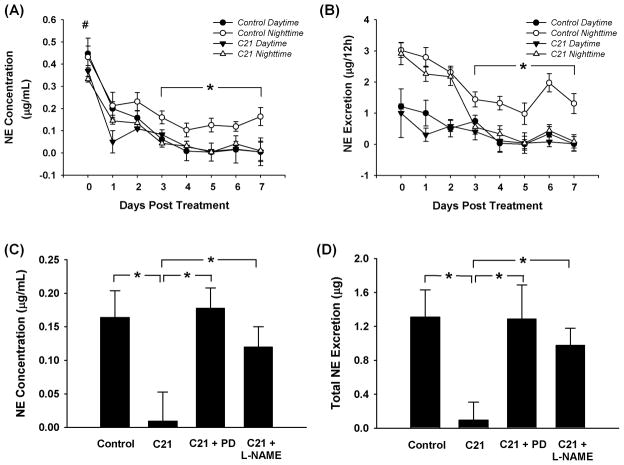
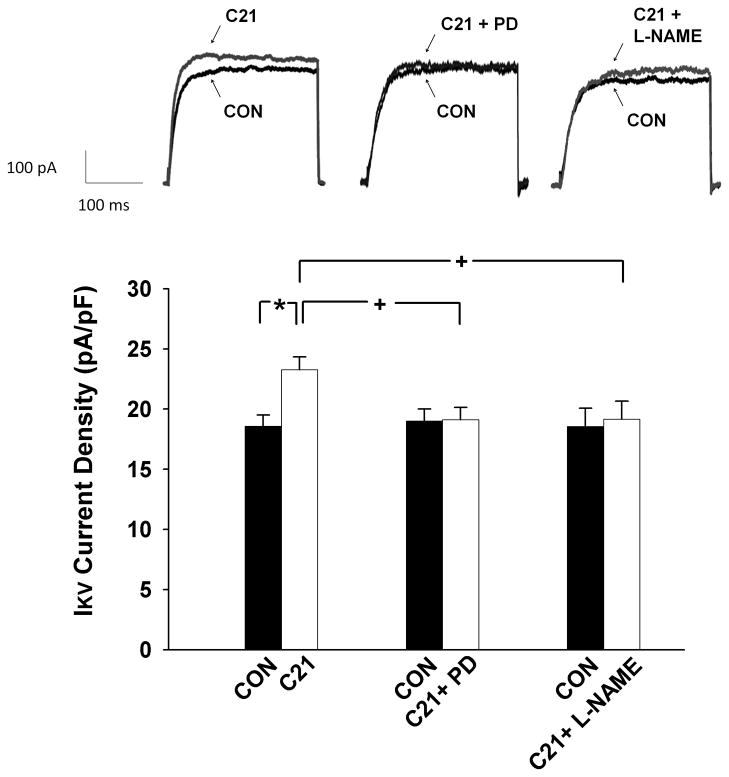
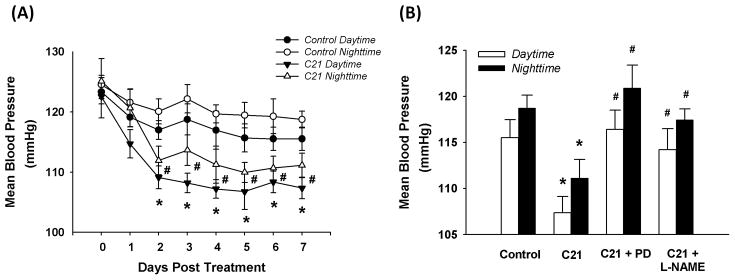
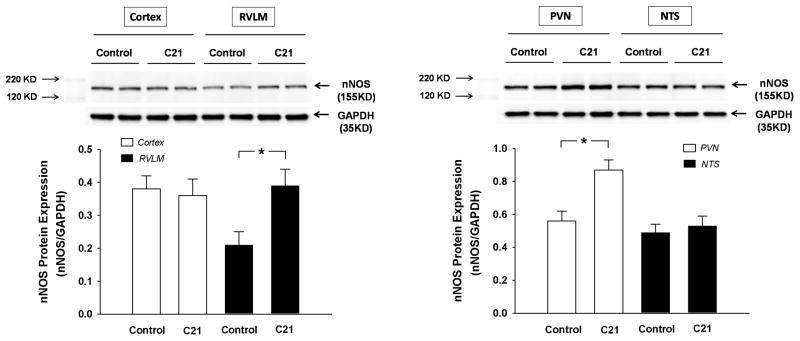
(i) Icv treatment with C21 significantly decreased both the concentration and the amount of NE in night time urine, but had no effect on daytime urine. (ii) C21-treated rats exhibited a slight but significant decrease in BP. (iii) The effects of C21 on NE excretion and BP were abolished by use of the AT2R antagonist, PD123319, and nitric oxide synthase (NOS) inhibitor, N-omega-nitro-L-arginine methyl ester (L-NAME). (iv) C21 treatment significantly upregulated nNOS expression in the paraventricular nucleus of the hypothalamus (PVN) and rostral ventrolateral medulla (RVLM), but not in the nucleus of the solitary tract (NTS) and cerebral cortex. (v) In CATH.a neurons, C21 treatment significantly increased I(Kv), and this increase was completely abolished by PD123319 and L-NAME.
These results demonstrate a central inhibitory influence of C21 on sympathetic outflow by means of a nNOS-dependent mechanism that might be mediated by facilitating the neuronal potassium channel.
我们之前已经证明,中枢血管紧张素 II 型受体(AT2R)负调节交感神经输出和动脉血压(BP)。在这项研究中,我们研究了脑室内(icv)输注化合物 21(C21),即第一个选择性非肽 AT2R 激动剂,对大鼠去甲肾上腺素(NE)排泄和 BP 的影响。
使用微量渗透泵 icv 输注 C21 7 天。使用 NE 酶免疫试剂盒测量尿 NE 浓度。通过无线电遥测记录 BP。7 天后,处死大鼠,通过微穿孔从交感脑区和大脑皮层获得三个相关样本,通过 Western blot 测量神经元型一氧化氮合酶(nNOS)蛋白表达。此外,通过全细胞膜片钳在神经元细胞系 CATH.a 中测定 C21 对神经元钾电流(I(Kv))的影响。
(i)icv 给予 C21 可显著降低夜间尿液中 NE 的浓度和量,但对白天尿液无影响。(ii)C21 处理大鼠的 BP 略有但显著降低。(iii)使用 AT2R 拮抗剂 PD123319 和一氧化氮合酶(NOS)抑制剂 N-ω-硝基-L-精氨酸甲酯(L-NAME)可消除 C21 对 NE 排泄和 BP 的影响。(iv)C21 处理显著上调下丘脑室旁核(PVN)和延髓头侧腹外侧区(RVLM)的 nNOS 表达,但不在孤束核(NTS)和大脑皮层。(v)在 CATH.a 神经元中,C21 处理可显著增加 I(Kv),而 PD123319 和 L-NAME 可完全消除这种增加。
这些结果表明 C21 通过一种依赖 nNOS 的机制对交感神经输出产生中枢抑制作用,该机制可能通过促进神经元钾通道来介导。