Department of Structural and Molecular Biology, Division of Biosciences, Darwin Building, University College London, Gower Street, London WC1E 6BT, UK.
J Mol Biol. 2011 May 13;408(4):714-35. doi: 10.1016/j.jmb.2011.03.006. Epub 2011 Mar 17.
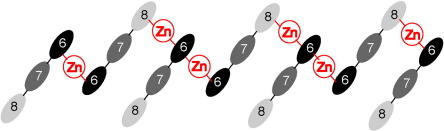
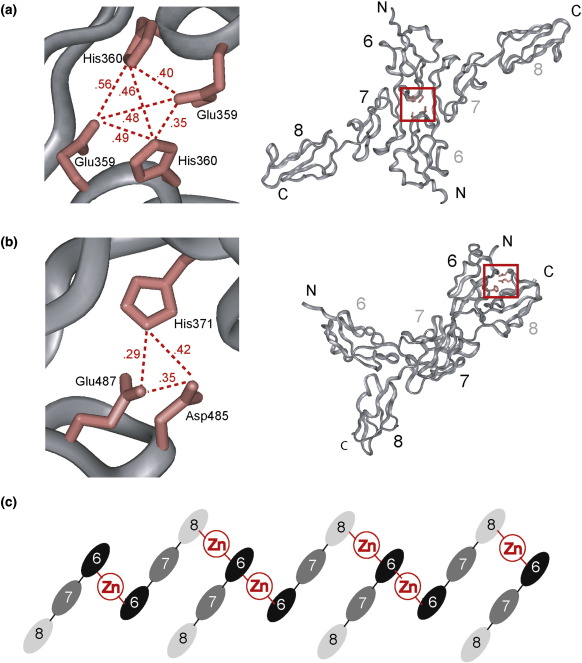
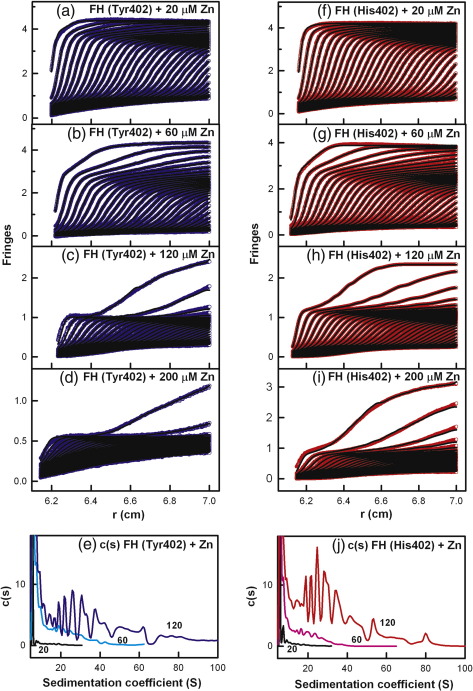
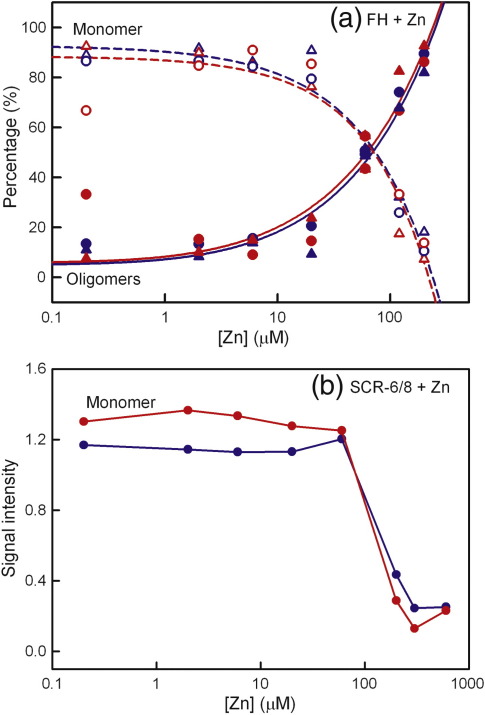
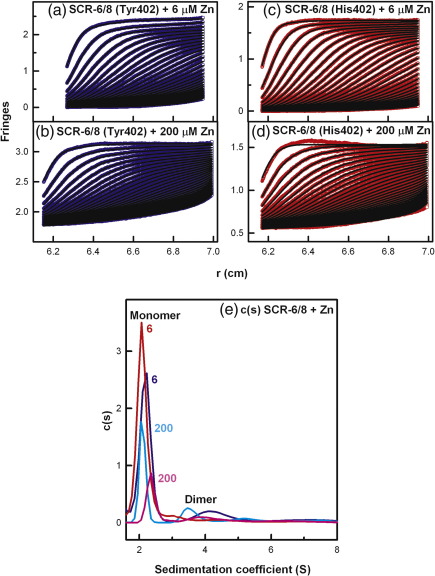
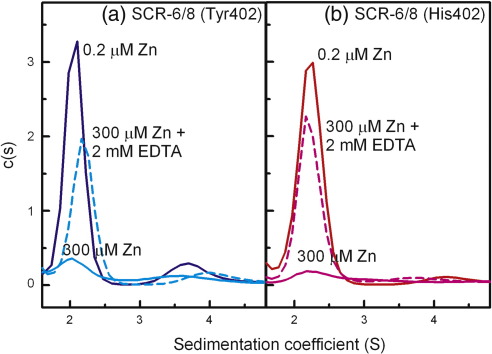
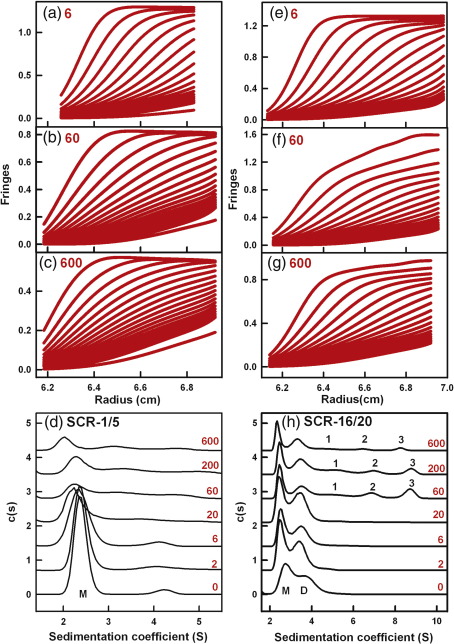
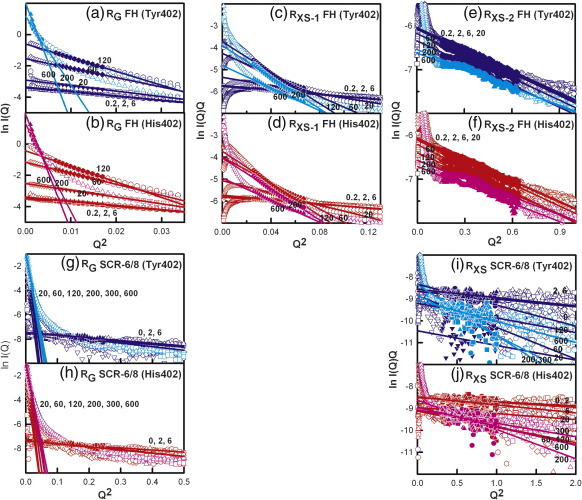
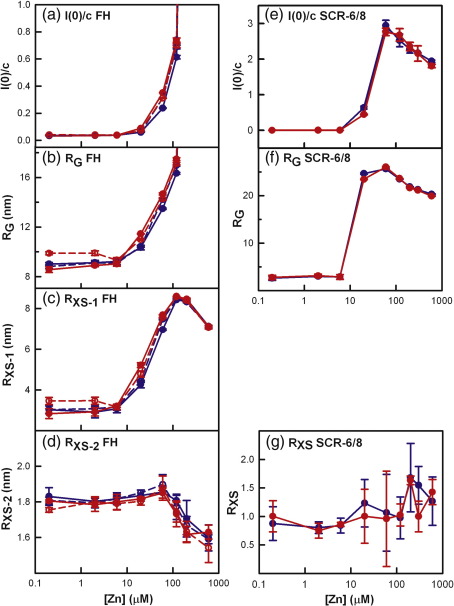
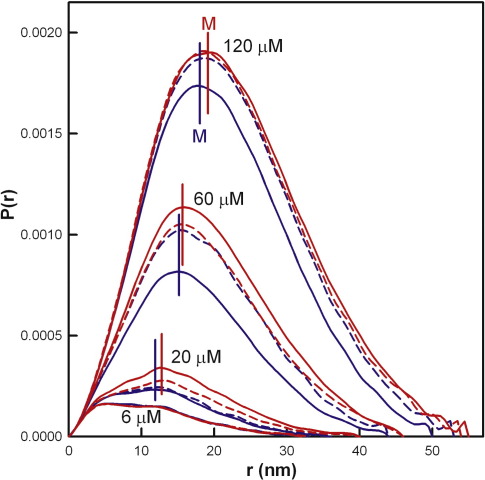
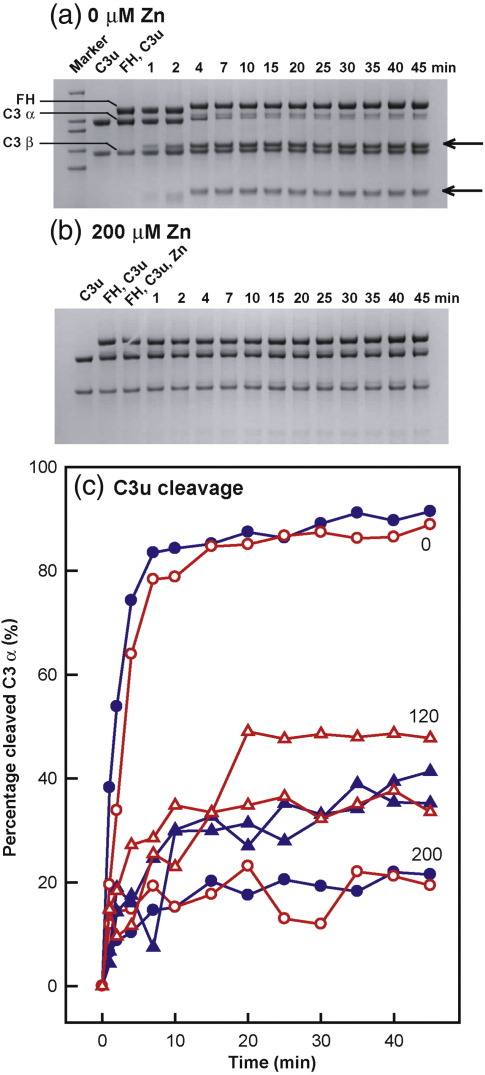
The Tyr402His polymorphism of complement factor H (FH) with 20 short complement regulator (SCR) domains is associated with age-related macular degeneration (AMD). How FH contributes to disease pathology is not clear. Both FH and high concentrations of zinc are found in drusen deposits, the key feature of AMD. Heterozygous FH is inhibited by zinc, which causes FH to aggregate. Here, zinc binding to homozygous FH was studied. By analytical ultracentrifugation, large amounts of oligomers were observed with both the native Tyr402 and the AMD-risk His402 homozygous allotypes of FH and both the recombinant SCR-6/8 allotypes with Tyr/His402. X-ray scattering also showed that both FH and SCR-6/8 allotypes strongly aggregated at >10 μM zinc. The SCR-1/5 and SCR-16/20 fragments were less likely to bind zinc. These observations were supported by bioinformatics predictions. Starting from known zinc binding sites in crystal structures, we predicted 202 putative partial surface zinc binding sites in FH, most of which were in SCR-6. Metal site prediction web servers also suggested that SCR-6 and other domains bind zinc. Predicted SCR-6/8 dimer structures showed that zinc binding sites could be formed at the protein-protein interface that would lead to daisy-chained oligomers. It was concluded that zinc binds weakly to FH at multiple surface locations, most probably within the functionally important SCR-6/8 domains, and this explains why zinc inhibits FH activity. Given the high pathophysiological levels of bioavailable zinc present in subretinal deposits, we discuss how zinc binding to FH may contribute to deposit formation and inflammation associated with AMD.
补体因子 H(FH)的 Tyr402His 多态性与 20 个短补体调节(SCR)结构域相关,与年龄相关性黄斑变性(AMD)有关。FH 如何导致疾病病理尚不清楚。FH 和高浓度的锌都存在于玻璃膜疣沉积物中,这是 AMD 的主要特征。锌抑制杂合 FH,导致 FH 聚集。本研究研究了锌与纯合 FH 的结合。通过分析超速离心,观察到大量的寡聚物,既有天然 Tyr402 和 AMD 风险 His402 纯合同种型的 FH,也有重组 SCR-6/8 同种型的 Tyr/His402。X 射线散射也表明,FH 和 SCR-6/8 同种型在 >10 μM 锌的浓度下强烈聚集。SCR-1/5 和 SCR-16/20 片段不太可能结合锌。这些观察结果得到了生物信息学预测的支持。从晶体结构中的已知锌结合位点开始,我们预测了 FH 中的 202 个可能的部分表面锌结合位点,其中大多数位于 SCR-6 中。金属位点预测网络服务器还表明 SCR-6 和其他结构域结合锌。预测的 SCR-6/8 二聚体结构表明,锌结合位点可以在蛋白质-蛋白质界面形成,导致雏菊链状寡聚物。结论是,锌在多个表面位置弱结合 FH,很可能在功能重要的 SCR-6/8 结构域内,这解释了为什么锌抑制 FH 活性。鉴于玻璃膜下沉积物中存在生物可利用锌的高病理生理水平,我们讨论了锌与 FH 的结合如何导致与 AMD 相关的沉积物形成和炎症。