Chao Suzan K, Horwitz Susan Band, McDaid Hayley M
Department of Molecular Pharmacology, Albert Einstein College of Medicine, Bronx, NY 10461, USA.
Oncotarget. 2011 Jan-Feb;2(1-2):89-98. doi: 10.18632/oncotarget.221.
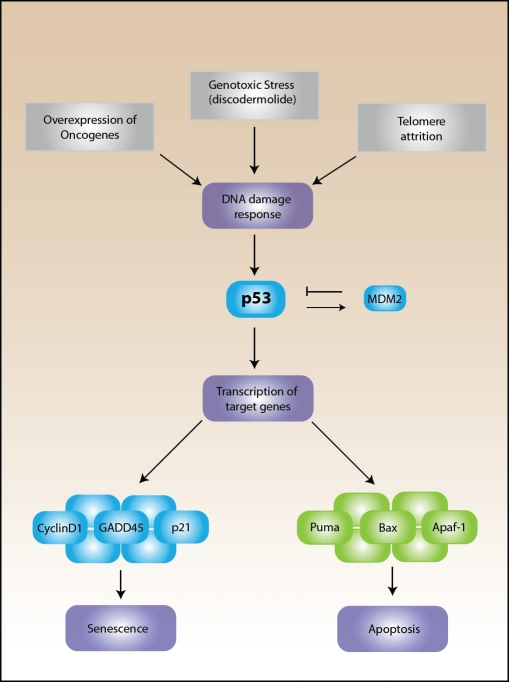
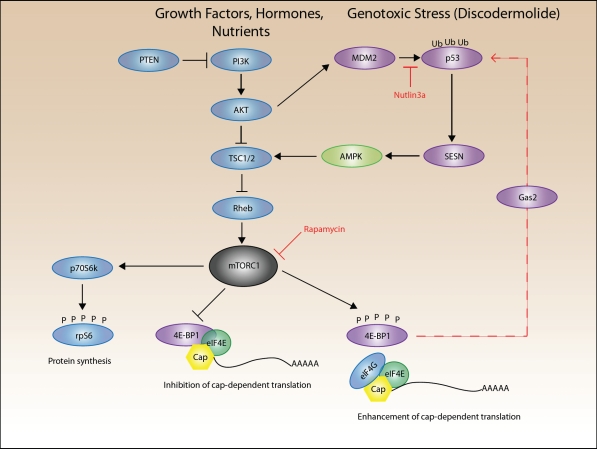
Senescence is a valid tumor suppressive mechanism in cancer. Accelerated cell senescence describes the growth arrested state of cells that have been treated with anti-tumor drugs, such as doxorubicin that induce a DNA damage response. Discodermolide, a microtubule-stabilizing agent, is a potent inducer of accelerated cell senescence. Resistance to discodermolide is mediated via resistance to accelerated cell senescence, and is associated with reduced expression of the mTORC1 substrate, 4E-BP1 and increased expression of p53 [1]. Although the association of p53 with senescence induction is well-characterized, senescence reversion in the presence of high expression of p53 has not been well-documented. Furthermore, studies addressing the role of mTOR signaling in regulating senescence have been limited and recent data implicate a novel, senescence-associated role for 4E-BP1 in crosstalk with the transcription factor p53. This research perspective will address these somewhat contradictory findings and summarize recent research regarding senescence and mTORC1 signaling.
衰老在癌症中是一种有效的肿瘤抑制机制。加速细胞衰老描述了用抗肿瘤药物(如诱导DNA损伤反应的阿霉素)处理后的细胞生长停滞状态。盘状软骨素是一种微管稳定剂,是加速细胞衰老的有效诱导剂。对盘状软骨素的耐药性是通过对加速细胞衰老的耐药性介导的,并且与mTORC1底物4E-BP1的表达降低和p53的表达增加有关[1]。尽管p53与衰老诱导的关联已得到充分表征,但在p53高表达情况下的衰老逆转尚未得到充分记录。此外,关于mTOR信号在调节衰老中的作用的研究有限,最近的数据表明4E-BP1在与转录因子p53的串扰中具有一种新的、与衰老相关的作用。本研究视角将探讨这些有些矛盾的发现,并总结最近关于衰老和mTORC1信号的研究。