Department of Psychiatry and Behavioral Sciences, Stanford University School of Medicine, CA 94305, USA.
BMC Evol Biol. 2011 Mar 14;11:69. doi: 10.1186/1471-2148-11-69.
The process of Greek colonization of the central and western Mediterranean during the Archaic and Classical Eras has been understudied from the perspective of population genetics. To investigate the Y chromosomal demography of Greek colonization in the western Mediterranean, Y-chromosome data consisting of 29 YSNPs and 37 YSTRs were compared from 51 subjects from Provence, 58 subjects from Smyrna and 31 subjects whose paternal ancestry derives from Asia Minor Phokaia, the ancestral embarkation port to the 6th century BCE Greek colonies of Massalia (Marseilles) and Alalie (Aleria, Corsica).
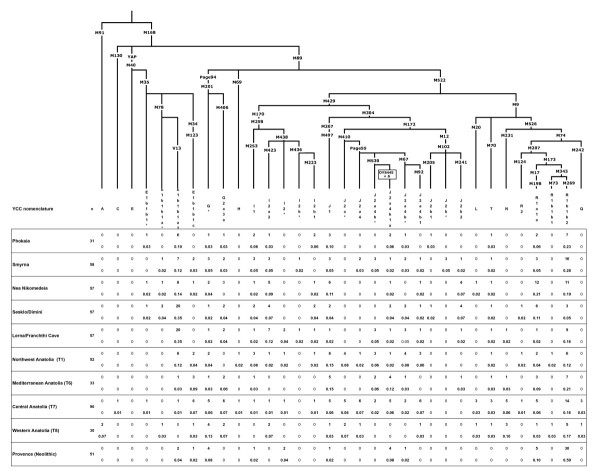
19% of the Phokaian and 12% of the Smyrnian representatives were derived for haplogroup E-V13, characteristic of the Greek and Balkan mainland, while 4% of the Provencal, 4.6% of East Corsican and 1.6% of West Corsican samples were derived for E-V13. An admixture analysis estimated that 17% of the Y-chromosomes of Provence may be attributed to Greek colonization. Using the following putative Neolithic Anatolian lineages: J2a-DYS445 = 6, G2a-M406 and J2a1b1-M92, the data predict a 0% Neolithic contribution to Provence from Anatolia. Estimates of colonial Greek vs. indigenous Celto-Ligurian demography predict a maximum of a 10% Greek contribution, suggesting a Greek male elite-dominant input into the Iron Age Provence population.
Given the origin of viniculture in Provence is ascribed to Massalia, these results suggest that E-V13 may trace the demographic and socio-cultural impact of Greek colonization in Mediterranean Europe, a contribution that appears to be considerably larger than that of a Neolithic pioneer colonization.
在古风和古典时代,希腊人在地中海中部和西部的殖民过程,从人口遗传学的角度来看,还没有得到充分的研究。为了研究希腊人在西地中海殖民过程中的 Y 染色体人口统计学,对来自普罗旺斯的 51 名、士麦那的 58 名和其祖先来自小亚细亚福凯亚的 31 名男性的 Y 染色体数据进行了比较,福凯亚是公元前 6 世纪希腊马赛利亚(马塞)和阿勒利亚(阿莱里亚,科西嘉岛)殖民地的出发港。
福凯亚和士麦那的 19%和 12%的代表属于 E-V13 单倍群,这是希腊和巴尔干大陆的特征,而普罗旺斯的 4%、东科西嘉的 4.6%和西科西嘉的 1.6%属于 E-V13。混合分析估计,普罗旺斯的 17%的 Y 染色体可能归因于希腊殖民。使用以下假设的新石器时代安纳托利亚血统:J2a-DYS445 = 6、G2a-M406 和 J2a1b1-M92,数据预测安纳托利亚对普罗旺斯的新石器时代贡献为 0%。对殖民希腊与本土凯尔特-利古里亚人口统计学的估计预测,希腊的贡献最多为 10%,这表明希腊男性精英主导了铁器时代普罗旺斯的人口。
鉴于普罗旺斯葡萄酒酿造的起源归因于马赛利亚,这些结果表明,E-V13 可能追踪了希腊在地中海欧洲殖民的人口和社会文化影响,这种贡献似乎比新石器时代的先驱殖民要大得多。