Department of Psychiatric Neurophysiology, University Hospital of Psychiatry Bern, University of Bern, 3000 Bern 60, Bolligenstr. 111, Switzerland.
Comput Intell Neurosci. 2011;2011:938925. doi: 10.1155/2011/938925. Epub 2011 Feb 20.
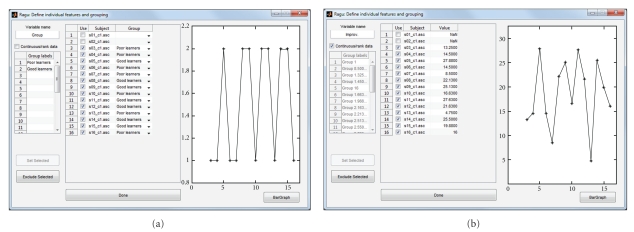
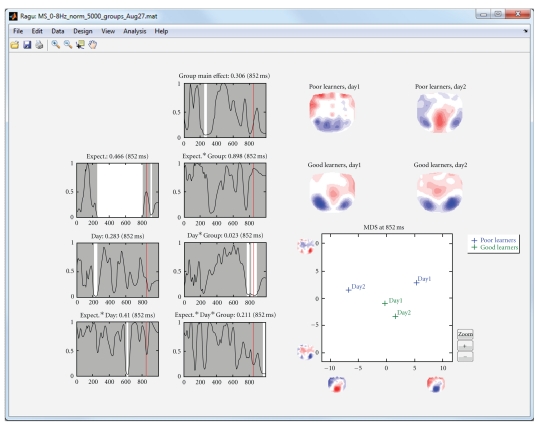
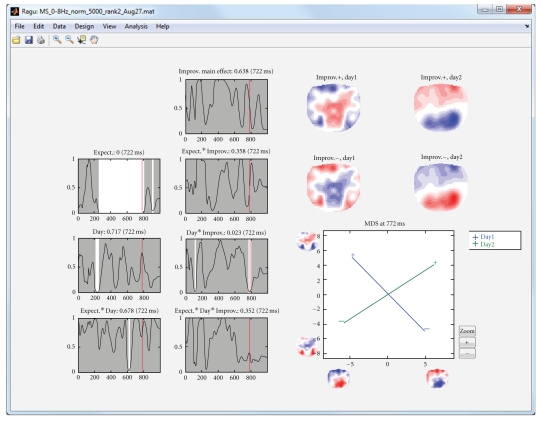
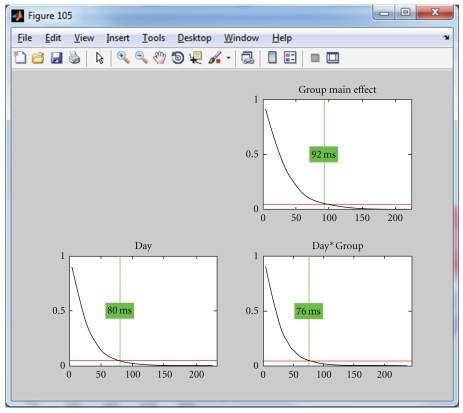
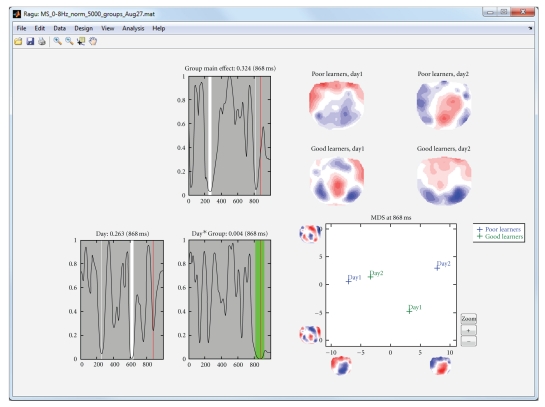
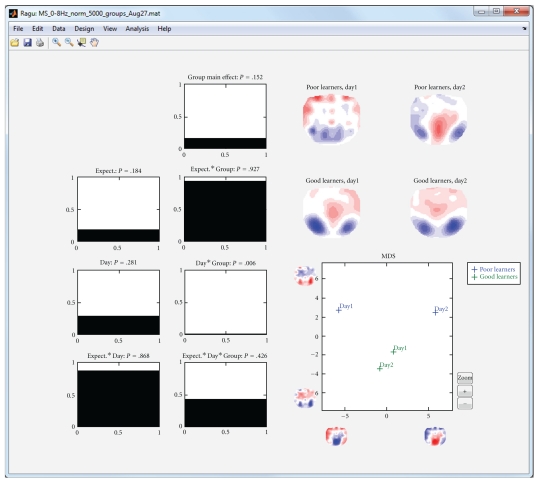
We present a program (Ragu; Randomization Graphical User interface) for statistical analyses of multichannel event-related EEG and MEG experiments. Based on measures of scalp field differences including all sensors, and using powerful, assumption-free randomization statistics, the program yields robust, physiologically meaningful conclusions based on the entire, untransformed, and unbiased set of measurements. Ragu accommodates up to two within-subject factors and one between-subject factor with multiple levels each. Significance is computed as function of time and can be controlled for type II errors with overall analyses. Results are displayed in an intuitive visual interface that allows further exploration of the findings. A sample analysis of an ERP experiment illustrates the different possibilities offered by Ragu. The aim of Ragu is to maximize statistical power while minimizing the need for a-priori choices of models and parameters (like inverse models or sensors of interest) that interact with and bias statistics.
我们介绍了一个用于多通道事件相关 EEG 和 MEG 实验统计分析的程序(Ragu;随机化图形用户界面)。该程序基于头皮场差异的度量,包括所有传感器,并使用强大的、无假设的随机化统计方法,根据整个未经变换和无偏置的测量数据集得出稳健的、具有生理意义的结论。Ragu 最多可容纳两个被试内因素和一个被试间因素,每个因素都有多个水平。显著性作为时间的函数进行计算,并可以通过整体分析来控制第二类错误。结果以直观的可视化界面显示,允许进一步探索发现。一个 ERP 实验的示例分析说明了 Ragu 提供的不同可能性。Ragu 的目的是在最小化先验模型和参数选择(如逆模型或感兴趣的传感器)的交互和偏置统计的同时,最大化统计功效。