Department of Genetics and Microbiology, University of Bari, Italy.
BMC Evol Biol. 2011 Mar 15;11:71. doi: 10.1186/1471-2148-11-71.
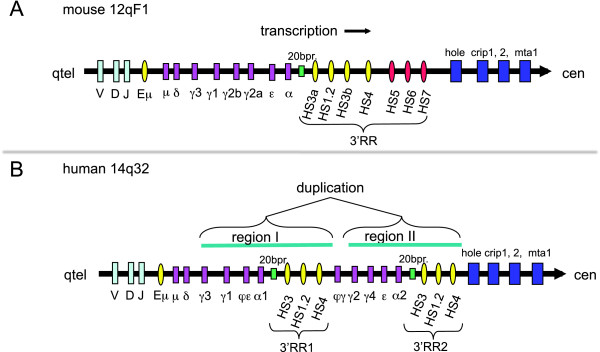
The Immunoglobulin heavy chain (IgH) 3' Regulatory Region (3'RR), located at the 3' of the constant alpha gene, plays a crucial role in immunoglobulin production. In humans, there are 2 copies of the 3'RR, each composed of 4 main elements: 3 enhancers and a 20 bp tandem repeat. The single mouse 3'RR differs from the two human ones for the presence of 4 more regulative elements with the double copy of one enhancer at the border of a palindromic region.
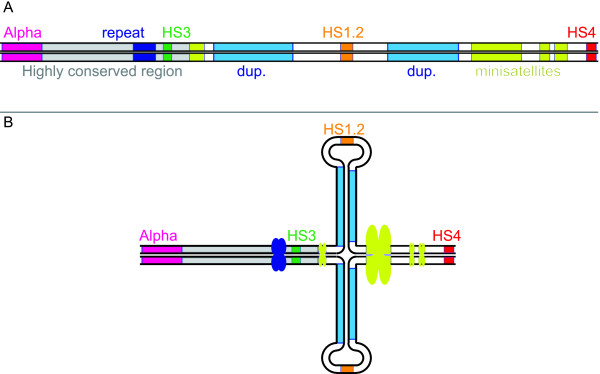
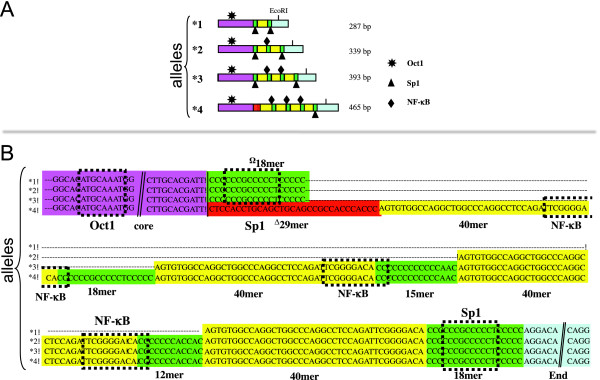
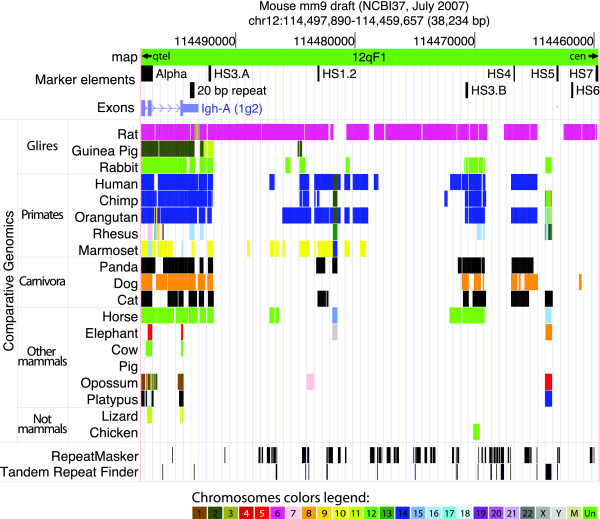
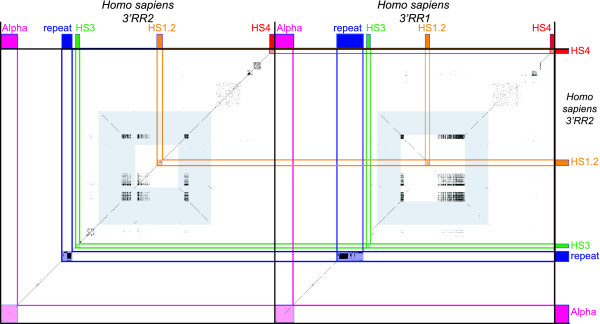
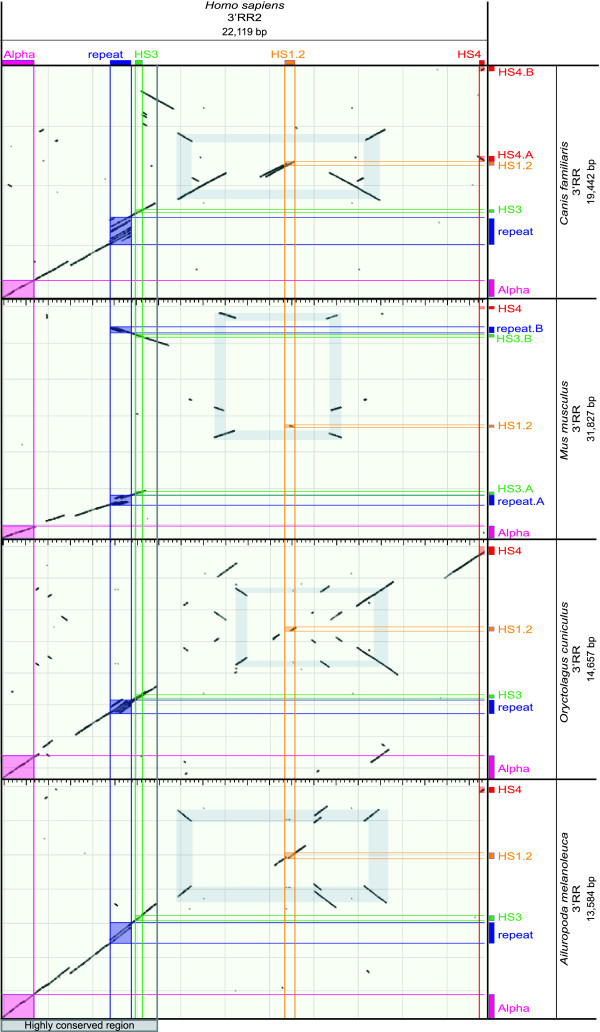
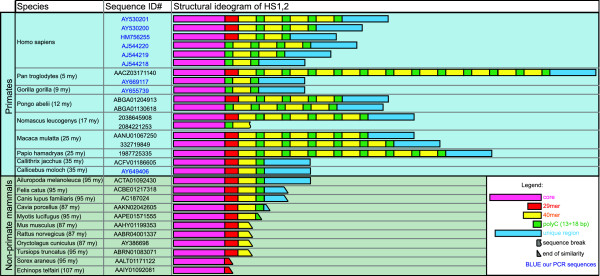
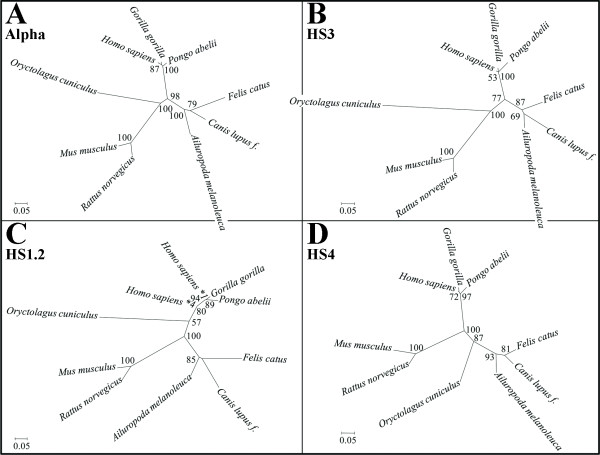
We compared the 3'RR organization in genomes of vertebrates to depict the evolutionary history of the region and highlight its shared features. We found that in the 8 species in which the whole region was included in a fully assembled contig (mouse, rat, dog, rabbit, panda, orangutan, chimpanzee, and human), the shared elements showed synteny and a highly conserved sequence, thus suggesting a strong evolutionary constraint. In these species, the wide 3'RR (~30 kb in human) bears a large palindromic sequence, consisting in two ~3 kb complementary branches spaced by a ~3 kb sequence always including the HS1.2 enhancer. In mouse and rat, HS3 is involved by the palindrome so that one copy of the enhancer is present on each side. A second relevant feature of our present work concerns human polymorphism of the HS1.2 enhancer, associated to immune diseases in our species. We detected a similar polymorphism in all the studied Catarrhini (a primate parvorder). The polymorphism consists of multiple copies of a 40 bp element up to 12 in chimpanzees, 8 in baboons, 6 in macaque, 5 in gibbons, 4 in humans and orangutan, separated by stretches of Cytosine. We show specific binding of this element to nuclear factors.
The nucleotide sequence of the palindrome is not conserved among evolutionary distant species, suggesting pressures for the maintenance of two self-matching regions driving a three-dimensional structure despite of the inter-specific divergence at sequence level. The information about the conservation of the palindromic structure and the settling in primates of the polymorphic feature of HS1.2 show the relevance of these structures in the control and modulation of the Ig production through the formation of possible three-dimensional structures.
免疫球蛋白重链(IgH)3'调控区(3'RR)位于恒定α基因的 3'端,在免疫球蛋白产生中起着至关重要的作用。在人类中,有两个 3'RR 拷贝,每个拷贝由 4 个主要元件组成:3 个增强子和一个 20 个碱基对的串联重复序列。与两个人类 3'RR 不同的是,单鼠 3'RR 在一个回文区域的边界处有 4 个额外的调节元件,其中一个增强子有两个拷贝。
我们比较了脊椎动物基因组中的 3'RR 组织,以描绘该区域的进化历史,并突出其共同特征。我们发现,在 8 个完整组装的基因组中(小鼠、大鼠、狗、兔、熊猫、猩猩、黑猩猩和人),整个区域都包含在一个完全组装的连续体中,共享元件表现出基因座和高度保守的序列,因此表明存在强烈的进化约束。在这些物种中,广泛的 3'RR(人类约 30kb)具有大的回文序列,由两个约 3kb 的互补分支组成,由一个约 3kb 的序列隔开,该序列始终包含 HS1.2 增强子。在小鼠和大鼠中,HS3 参与回文,因此每个增强子的一侧都有一个拷贝。我们目前工作的另一个相关特征涉及人类 HS1.2 增强子的多态性,该多态性与我们人类的免疫疾病有关。我们在所有研究的类人猿(灵长类动物的一个小目)中检测到了类似的多态性。这种多态性由多达 12 个 40bp 元件的重复组成,在黑猩猩中为 12 个,在狒狒中为 8 个,在猕猴中为 6 个,在长臂猿中为 5 个,在人类和猩猩中为 4 个,由胞嘧啶间隔开。我们显示出这个元素与核因子的特异性结合。
尽管在进化上有差异,但回文序列的核苷酸序列在不同物种之间并不保守,这表明维持两个自我匹配区域的压力导致了三维结构的形成,尽管在序列水平上存在种间差异。关于回文结构的保守性以及 HS1.2 多态性在灵长类动物中的定殖的信息表明,这些结构在通过可能的三维结构形成来控制和调节 Ig 产生方面具有重要意义。