Division of Laboratory Sciences, National Center for Environmental Health, Centers for Disease Control and Prevention, Atlanta, Georgia 30341, USA.
Environ Health Perspect. 2011 Jul;119(7):983-8. doi: 10.1289/ehp.1002701. Epub 2011 Mar 15.
Human exposure to bisphenol A (BPA) is widespread. After exposure, BPA is rapidly metabolized and eliminated in urine. Therefore, there is considerable within-person and between-person variability of BPA concentrations in spot urine samples. However, no information exists on the within-day variability of urinary BPA concentrations.
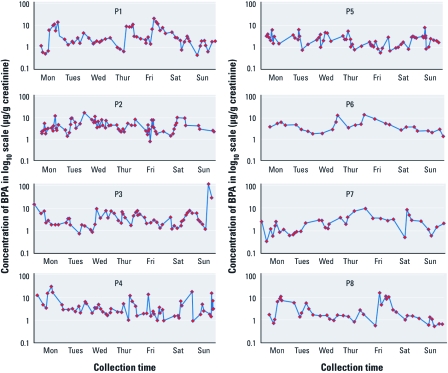
We examined the between-person and within-person and between-day and within-day variability in the urinary BPA concentrations of eight adults who collected all voids for 1 week to investigate the impact of sampling strategy in the exposure assessment of BPA using spot, first morning, or 24-hr urine collections.
We determined the urinary concentrations of BPA using on-line solid-phase extraction coupled to isotope dilution high-performance liquid chromatography/tandem mass spectrometry.
The between-day and within-person variability was the primary contributor to the total variance both for first morning voids (77%) and 24-hr urine collections (88%). For the spot collections, we observed considerable within-day variance (70%), which outweighed the between-person (9%) and between-day and within-person (21%) variances.
Regardless of the type of void (spot, first morning, 24-hr collection), urinary BPA concentrations for a given adult changed considerably--both within a day and for the 7 days of the study period. Single 24-hr urine collections accurately reflect daily exposure but can misrepresent variability in daily exposures over time. Of interest, when the population investigated is sufficiently large and samples are randomly collected relative to meal ingestion times and bladder emptying times, the single spot-sampling approach may adequately reflect the average exposure of the population to BPA.
人体接触双酚 A(BPA)的现象较为普遍。接触后,BPA 会迅速在尿液中代谢和消除。因此,单次尿样中 BPA 浓度的个体内和个体间差异较大。然而,目前尚无关于尿中 BPA 浓度日内变异性的信息。
本研究通过 8 名成年人收集一周内所有尿液,检测单次晨尿和 24 小时尿液采集的个体内和个体间及日内和日间变异性,以研究采样策略对 BPA 暴露评估的影响。
我们采用在线固相萃取结合同位素稀释高效液相色谱/串联质谱法测定 BPA 的尿浓度。
日间和个体内变异性是晨尿(77%)和 24 小时尿液收集(88%)总方差的主要来源。对于单次尿样,我们观察到较大的日内变异性(70%),超过了个体间(9%)和日间和个体内(21%)变异性。
无论采用哪种类型的尿液(单次晨尿、24 小时尿液收集),个体的 BPA 尿液浓度在一天内和研究期间的 7 天内都有很大变化。单次 24 小时尿液收集准确反映了每日暴露情况,但可能会错误地反映一段时间内每日暴露的变异性。有趣的是,当研究人群足够大且样本是随机采集的,与进餐时间和膀胱排空时间相对应时,单次随机尿样采集方法可能足以反映人群对 BPA 的平均暴露情况。