Companion Animal Research, School of Veterinary Medicine, Azabu University, Sagamihara, Kanagawa, Japan.
PLoS One. 2011 Mar 9;6(3):e17721. doi: 10.1371/journal.pone.0017721.
Vocal learning is a central functional constituent of human speech, and recent studies showing that adult male mice emit ultrasonic sound sequences characterized as "songs" have suggested that the ultrasonic courtship sounds of mice provide a mammalian model of vocal learning.
We tested whether mouse songs are learned, by examining the relative role of rearing environment in a cross-fostering experiment.
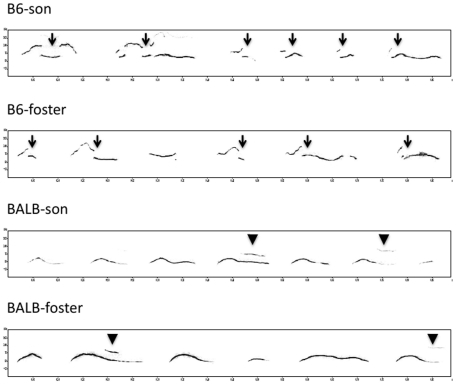
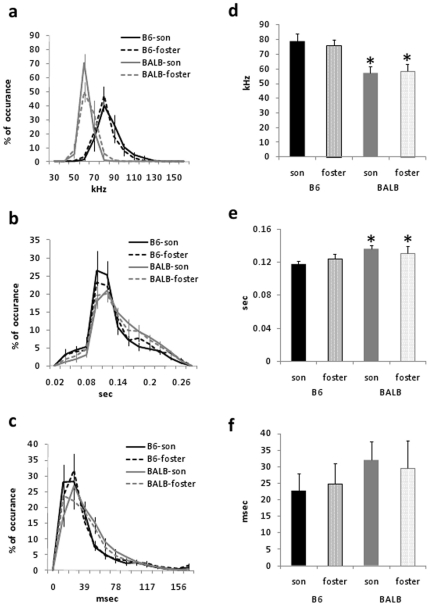
We found that C57BL/6 and BALB/c males emit a clearly different pattern of songs with different frequency and syllable compositions; C57BL/6 males showed a higher peak frequency of syllables, shorter intervals between syllables, and more upward frequency modulations with jumps, whereas BALB/c males produced more "chevron" and "harmonics" syllables. To establish the degree of environmental influences in mouse song development, sons of these two strains were cross-fostered to another strain of parents. Songs were recorded when these cross-fostered pups were fully developed and their songs were compared with those of male mice reared by the genetic parents. The cross-fostered animals sang songs with acoustic characteristics--including syllable interval, peak frequency, and modulation patterns--similar to those of their genetic parents. In addition their song elements retained sequential characteristics similar to those of their genetic parents' songs.
These results do not support the hypothesis that mouse "song" is learned; we found no evidence for vocal learning of any sort under the conditions of this experiment. Our observation that the strain-specific character of the song profile persisted even after changing the developmental auditory environment suggests that the structure of these courtship sound sequences is under strong genetic control. Thus, the usefulness of mouse "song" as a model of mammalian vocal learning is limited, but mouse song has the potential to be an indispensable model to study genetic mechanisms for vocal patterning and behavioral sequences.
发声学习是人类言语的核心功能组成部分,最近的研究表明,发出具有特征性的超声波序列的雄性成年小鼠表现出“歌曲”,这表明小鼠的求偶超声叫声为发声学习提供了一个哺乳动物模型。
通过交叉寄养实验,检测饲养环境的相对作用,我们测试了小鼠的歌曲是否为学习所得。
我们发现 C57BL/6 和 BALB/c 雄性发出的歌曲模式明显不同,具有不同的频率和音节组成;C57BL/6 雄性表现出更高的音节峰值频率、音节之间更短的间隔以及更多的向上频率调制和跳跃,而 BALB/c 雄性产生更多的“V”字形和“泛音”音节。为了确定环境因素对小鼠歌曲发育的影响程度,我们将这两个品系的雄性后代交叉寄养到另一品系的父母中。当这些交叉寄养的幼鼠完全发育时,我们记录它们的歌曲,并将它们的歌曲与由遗传父母饲养的雄性小鼠的歌曲进行比较。交叉寄养的动物发出的歌曲具有与遗传父母相似的声学特征,包括音节间隔、峰值频率和调制模式。此外,它们的歌曲元素保留了与遗传父母歌曲相似的序列特征。
这些结果不支持小鼠“歌曲”是学习所得的假设;我们在实验条件下没有发现任何类型的发声学习的证据。我们的观察结果表明,即使在改变发育听觉环境后,歌曲特征的品系特异性仍然存在,这表明这些求偶声音序列的结构受到强烈的遗传控制。因此,小鼠“歌曲”作为哺乳动物发声学习模型的用途有限,但小鼠歌曲有可能成为研究发声模式和行为序列遗传机制不可或缺的模型。