Laboratory for Social and Neural Systems Research, Department of Economics, University of Zurich, Zurich, Switzerland.
PLoS One. 2011 Mar 9;6(3):e17798. doi: 10.1371/journal.pone.0017798.
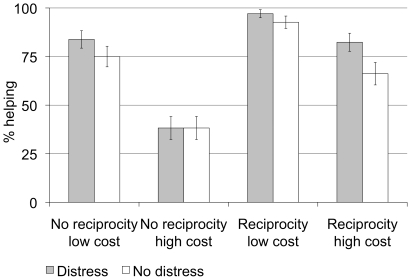
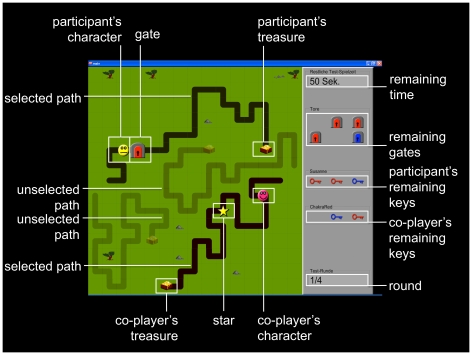
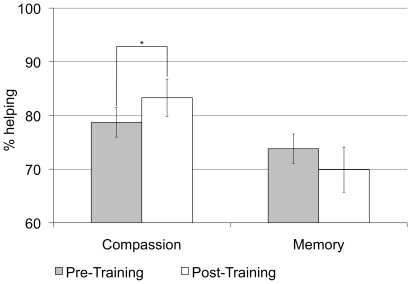
Compassion has been suggested to be a strong motivator for prosocial behavior. While research has demonstrated that compassion training has positive effects on mood and health, we do not know whether it also leads to increases in prosocial behavior. We addressed this question in two experiments. In Experiment 1, we introduce a new prosocial game, the Zurich Prosocial Game (ZPG), which allows for repeated, ecologically valid assessment of prosocial behavior and is sensitive to the influence of reciprocity, helping cost, and distress cues on helping behavior. Experiment 2 shows that helping behavior in the ZPG increased in participants who had received short-term compassion training, but not in participants who had received short-term memory training. Interindividual differences in practice duration were specifically related to changes in the amount of helping under no-reciprocity conditions. Our results provide first evidence for the positive impact of short-term compassion training on prosocial behavior towards strangers in a training-unrelated task.
有人认为同情心是促进亲社会行为的强大动力。虽然研究表明同情训练对情绪和健康有积极影响,但我们不知道它是否也会导致亲社会行为的增加。我们在两项实验中探讨了这个问题。在实验 1 中,我们引入了一种新的亲社会游戏,即苏黎世亲社会游戏(ZPG),它允许对亲社会行为进行重复、生态有效的评估,并且对互惠、帮助成本和痛苦线索对帮助行为的影响敏感。实验 2 表明,接受短期同情训练的参与者在 ZPG 中的帮助行为增加,而接受短期记忆训练的参与者则没有增加。练习持续时间的个体差异与无互惠条件下帮助量的变化特别相关。我们的结果首次提供了短期同情训练对陌生人在与训练无关的任务中的亲社会行为的积极影响的证据。