Institute of Neuroscience and Medicine INM-2, Research Centre Jülich Jülich, Germany.
Front Synaptic Neurosci. 2010 Mar 15;2:2. doi: 10.3389/fnsyn.2010.00002. eCollection 2010.
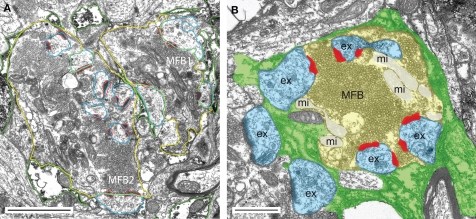
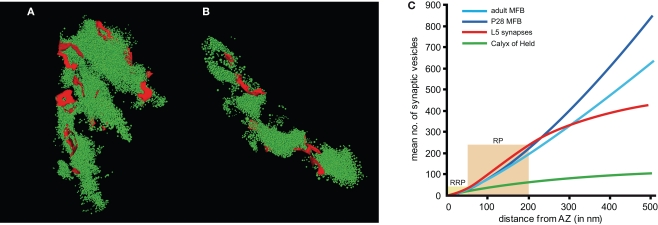
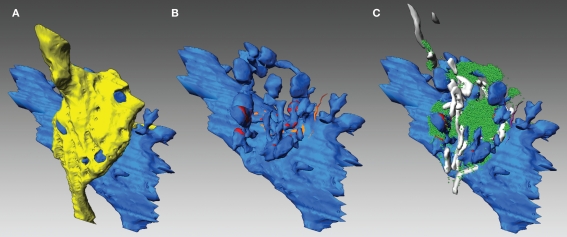
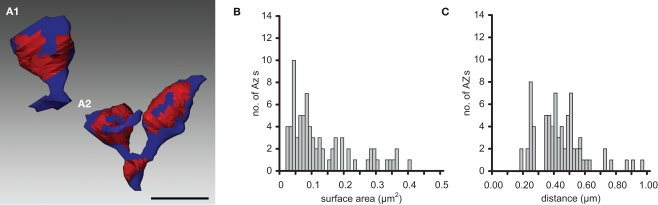
Synapses are the key elements for signal processing and plasticity in the brain. They are composed of nearly the same structural subelements, an apposition zone including a pre- and postsynaptic density, a cleft and a pool of vesicles. It is, however, their actual composition that determines their different behavior in synaptic transmission and plasticity. Here, we describe and discuss the structural factors underlying the unique functional properties of the hippocampal mossy fiber (MF) synapse. Two membrane specializations, active zones (AZs; transmitter release sites), and puncta adherentia (PA), putative adhesion complexes were found. On average, individual boutons had ∼20 AZs with a mean surface area of 0.1 μm(2) and a short distance of 0.45 μm between individual AZs. Mossy fiber boutons (MFBs) and their target structures were isolated from each other by astrocytes, but fine glial processes never reached the AZs. Therefore, two structural factors are likely to promote synaptic cross-talk: the short distance and the absence of fine glial processes between individual AZs. Thus, synaptic crosstalk may contribute to the high efficacy of hippocampal MF synapses. On average, an adult bouton contained ∼16,000 synaptic vesicles; ∼600 vesicles were located within 60 nm from the AZ, ∼4000 between 60 nm and 200 nm, and the remaining beyond 200 nm, suggesting large readily releasable, recycling, and reserve pools. Thus, the size of the three pools together with the number and distribution of AZs underlie the unique extent of synaptic efficacy and plasticity of the hippocampal MF synapse.
突触是大脑中信号处理和可塑性的关键要素。它们由几乎相同的结构亚单元组成,包括一个突触前和突触后密度、一个裂隙和一个囊泡池的毗邻区。然而,正是它们的实际组成决定了它们在突触传递和可塑性中的不同行为。在这里,我们描述和讨论了海马苔藓纤维(MF)突触独特功能特性的结构因素。发现了两个膜特化结构,即活性区(AZ;递质释放位点)和粘着斑(PA),可能是粘着复合物。平均而言,单个末梢有约 20 个 AZ,其平均表面积为 0.1μm2,单个 AZ 之间的距离为 0.45μm。苔藓纤维末梢(MFB)及其靶结构被星形胶质细胞彼此隔离,但细的胶质突起从未到达 AZ。因此,有两个结构因素可能促进突触串扰:个体 AZ 之间的短距离和缺乏细的胶质突起。因此,突触串扰可能有助于海马 MF 突触的高功效。平均而言,一个成年末梢含有约 16000 个突触小泡;约 600 个囊泡位于 AZ 60nm 范围内,约 4000 个位于 60nm 和 200nm 之间,其余的超过 200nm,表明存在大的易释放、再循环和储备池。因此,三个池的大小以及 AZ 的数量和分布,为海马 MF 突触独特的突触功效和可塑性提供了基础。