Department of Pharmacy, School of Pharmacy, Hyogo University of Health Sciences, 1-3-6 Minatojima, Chuo-ku, Kobe, Hyogo, 650-8530, Japan.
Amino Acids. 2012 May;42(5):1529-39. doi: 10.1007/s00726-011-0883-5. Epub 2011 Mar 25.
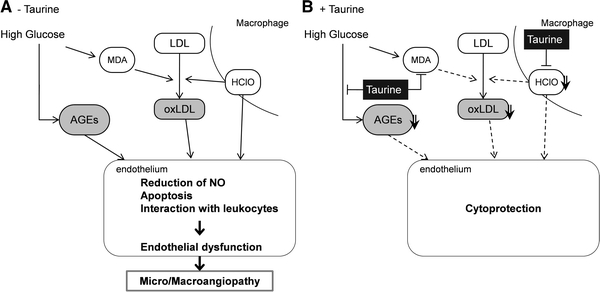
Taurine (2-aminoethanesulfonic acid) is a free amino acid found ubiquitously in millimolar concentrations in all mammalian tissues. Taurine exerts a variety of biological actions, including antioxidation, modulation of ion movement, osmoregulation, modulation of neurotransmitters, and conjugation of bile acids, which may maintain physiological homeostasis. Recently, data is accumulating that show the effectiveness of taurine against diabetes mellitus, insulin resistance and its complications, including retinopathy, nephropathy, neuropathy, atherosclerosis and cardiomyopathy, independent of hypoglycemic effect in several animal models. The useful effects appear due to the multiple actions of taurine on cellular functions. This review summarizes the beneficial effects of taurine supplementation on diabetes mellitus and the molecular mechanisms underlying its effectiveness.
牛磺酸(2-氨基乙磺酸)是一种游离氨基酸,在所有哺乳动物组织中以毫摩尔浓度广泛存在。牛磺酸具有多种生物学作用,包括抗氧化、调节离子运动、渗透压调节、神经递质调节和胆汁酸结合,这些作用可能维持生理内环境稳定。最近的数据表明,牛磺酸在几种动物模型中具有抗糖尿病、胰岛素抵抗及其并发症(包括视网膜病变、肾病、神经病、动脉粥样硬化和心肌病)的作用,且不依赖于降血糖作用。这种有益的作用似乎是由于牛磺酸对细胞功能的多种作用。本文综述了牛磺酸补充对糖尿病的有益作用及其有效性的分子机制。