New England Research Institutes, Watertown, MA 02472, USA.
Eur Urol. 2011 Jun;59(6):1039-47. doi: 10.1016/j.eururo.2011.03.008. Epub 2011 Mar 15.
Whether lower urinary tract symptoms (LUTS), including voiding, storage, and urinary incontinence, are affected by dietary micronutrients is uncertain.
To test the hypothesis that carotenoid, vitamin C, zinc, and calcium intakes are associated with LUTS and urinary incontinence in women.
DESIGN, SETTING, AND PARTICIPANTS: During an observational, cross-sectional, population-based epidemiologic study of 2060 women (30-79 yr of age) in the Boston Area Community Health (BACH) survey (2002-2005), data were collected by validated food frequency questionnaire and in-person interviews and analyzed using multivariate regression.
LUTS, storage, and voiding symptoms were assessed using the American Urological Association Symptom Index (AUASI) and a validated severity index for urinary incontinence.
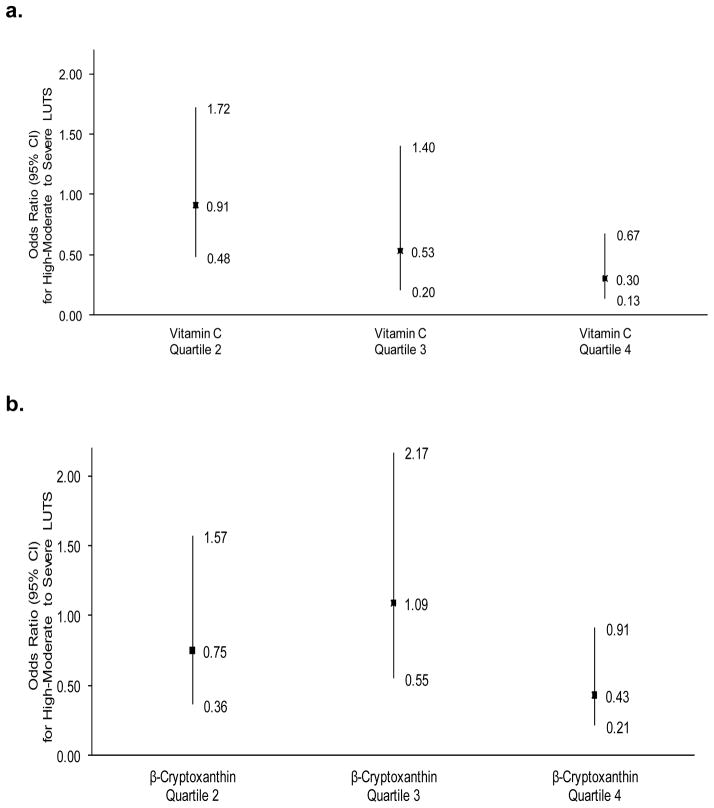
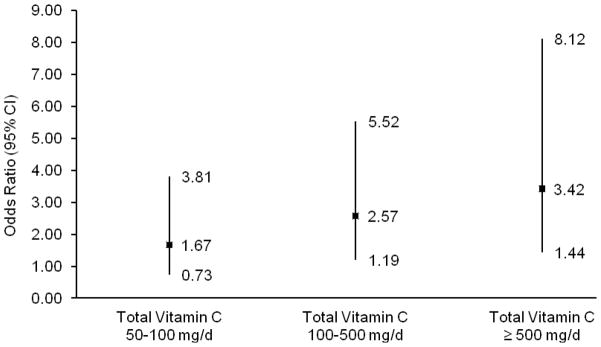
Women who consumed high-dose vitamin C from diet and supplements were more likely to report storage symptoms, especially combined frequency and urgency (≥ 500 vs < 50mg/d; odds ratio [OR]: 3.42; 95% confidence interval [CI], 1.44-8.12). However, greater consumption of dietary vitamin C or β-cryptoxanthin was inversely associated with voiding symptoms (p(trend) ≤ 0.01). Both dietary and supplemental calcium were positively associated with storage symptoms (eg, supplement ≥ 1000 mg/d vs none; OR: 2.04; 95% CI, 1.35-3.09; p(trend)=0.0002). No consistent associations were observed for β-carotene, lycopene, or other carotenoids, although smokers using β-carotene supplements were more likely to report storage problems. Whether the observed associations represent direct causes of diet on LUTS is uncertain.
High-dose intakes of vitamin C and calcium were positively associated with urinary storage or incontinence, whereas vitamin C and β-cryptoxanthin from foods and beverages were inversely associated with voiding symptoms. Results indicate that micronutrient intakes may contribute to LUTS in dose-dependent and symptom-specific ways. Further study is needed to confirm these findings and their relevance to clinical treatment decisions.
下尿路症状(LUTS),包括排尿、储存和尿失禁,是否受膳食微量营养素的影响尚不确定。
检验假设,即类胡萝卜素、维生素 C、锌和钙的摄入量与女性的 LUTS 和尿失禁有关。
设计、地点和参与者:在波士顿地区社区健康(BACH)调查(2002-2005 年)中,对 2060 名(30-79 岁)女性进行了一项观察性、横断面、基于人群的流行病学研究,通过验证后的食物频率问卷和面对面访谈收集数据,并使用多变量回归进行分析。
使用美国泌尿协会症状指数(AUASI)和尿失禁严重程度的验证指数评估 LUTS、储存和排尿症状。
从饮食和补充剂中摄入高剂量维生素 C 的女性更有可能报告储存症状,尤其是合并的频度和紧迫性(≥500 与 <50mg/d;比值比 [OR]:3.42;95%置信区间 [CI]:1.44-8.12)。然而,较高的膳食维生素 C 或β-隐黄质摄入与排尿症状呈负相关(p(趋势)≤0.01)。膳食和补充钙均与储存症状呈正相关(例如,补充剂≥1000mg/d 与无补充剂;OR:2.04;95%CI:1.35-3.09;p(趋势)=0.0002)。β-胡萝卜素、番茄红素或其他类胡萝卜素未观察到一致的关联,尽管使用β-胡萝卜素补充剂的吸烟者更有可能报告储存问题。观察到的关联是否代表饮食对 LUTS 的直接因果关系尚不确定。
高剂量的维生素 C 和钙摄入与尿储存或失禁呈正相关,而来自食物和饮料的维生素 C 和β-隐黄质与排尿症状呈负相关。结果表明,微量营养素的摄入可能以剂量依赖和症状特异性的方式导致 LUTS。需要进一步研究来证实这些发现及其与临床治疗决策的相关性。