Pediatric Neuromuscular Laboratory and the Neuropediatric Unit, Hadassah Hebrew University Hospital, Jerusalem, Israel.
PLoS One. 2011 Mar 22;6(3):e18049. doi: 10.1371/journal.pone.0018049.
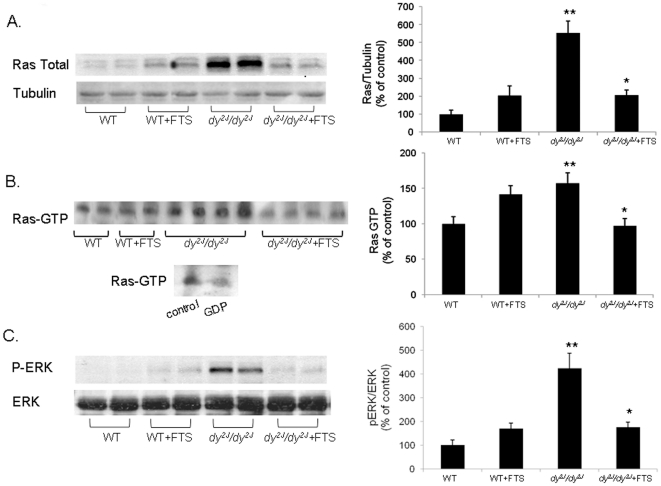
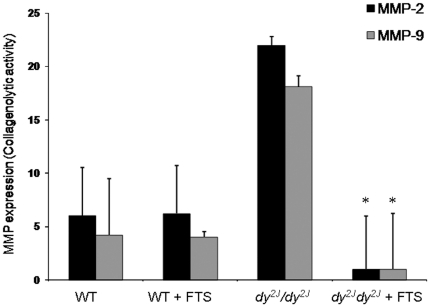
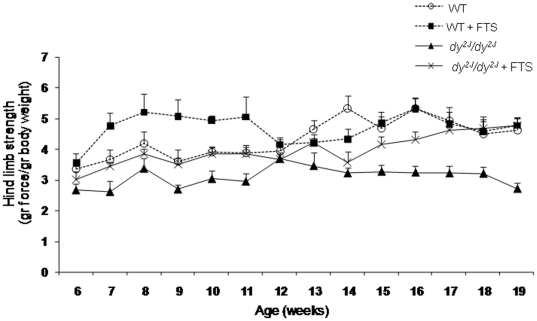
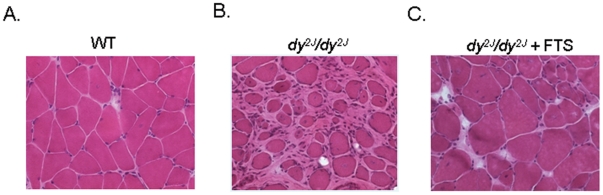
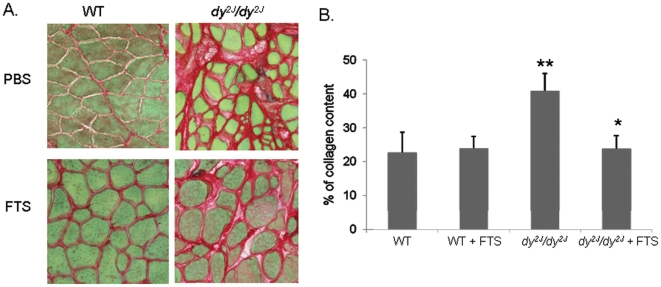
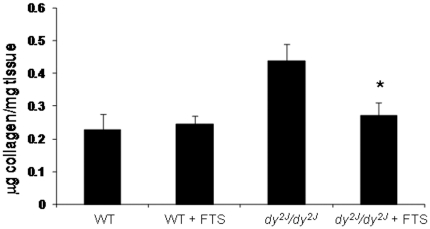
The Ras superfamily of guanosine-triphosphate (GTP)-binding proteins regulates a diverse spectrum of intracellular processes involved in inflammation and fibrosis. Farnesythiosalicylic acid (FTS) is a unique and potent Ras inhibitor which decreased inflammation and fibrosis in experimentally induced liver cirrhosis and ameliorated inflammatory processes in systemic lupus erythematosus, neuritis and nephritis animal models. FTS effect on Ras expression and activity, muscle strength and fibrosis was evaluated in the dy(2J)/dy(2J) mouse model of merosin deficient congenital muscular dystrophy. The dy(2J)/dy(2J) mice had significantly increased RAS expression and activity compared with the wild type mice. FTS treatment significantly decreased RAS expression and activity. In addition, phosphorylation of ERK, a Ras downstream protein, was significantly decreased following FTS treatment in the dy(2J)/dy(2J) mice. Clinically, FTS treated mice showed significant improvement in hind limb muscle strength measured by electronic grip strength meter. Significant reduction of fibrosis was demonstrated in the treated group by quantitative Sirius Red staining and lower muscle collagen content. FTS effect was associated with significantly inhibition of both MMP-2 and MMP-9 activities. We conclude that active RAS inhibition by FTS was associated with attenuated fibrosis and improved muscle strength in the dy(2J)/dy(2J) mouse model of congenital muscular dystrophy.
Ras 家族的鸟嘌呤三磷酸(GTP)结合蛋白调节着广泛的细胞内过程,包括炎症和纤维化。法呢基硫代水杨酸(FTS)是一种独特而有效的 Ras 抑制剂,可降低实验性肝硬变中的炎症和纤维化,并改善系统性红斑狼疮、神经炎和肾炎动物模型中的炎症过程。在 merosin 缺乏型先天性肌肉营养不良的 dy(2J)/dy(2J) 小鼠模型中评估了 FTS 对 Ras 表达和活性、肌肉力量和纤维化的影响。与野生型小鼠相比,dy(2J)/dy(2J) 小鼠的 Ras 表达和活性显著增加。FTS 治疗可显著降低 Ras 表达和活性。此外,在 FTS 治疗后,dy(2J)/dy(2J) 小鼠 Ras 下游蛋白 ERK 的磷酸化明显减少。临床上,通过电子握力计测量,FTS 治疗的小鼠后肢肌肉力量明显改善。用定量 Sirius Red 染色和较低的肌肉胶原蛋白含量显示,治疗组的纤维化明显减少。FTS 的作用与 MMP-2 和 MMP-9 活性的显著抑制有关。我们的结论是,FTS 通过积极抑制 Ras,可减轻先天性肌肉营养不良的 dy(2J)/dy(2J) 小鼠模型中的纤维化和改善肌肉力量。