Westat, Inc., Rockville, Maryland, USA.
Transfusion. 2011 Oct;51(10):2078-91. doi: 10.1111/j.1537-2995.2011.03120.x. Epub 2011 Mar 29.
We used a multicenter retrospective cohort study design to evaluate whether human leukocyte antigen (HLA) antibody donor screening would reduce the risk of transfusion-related acute lung injury (TRALI) or possible TRALI.
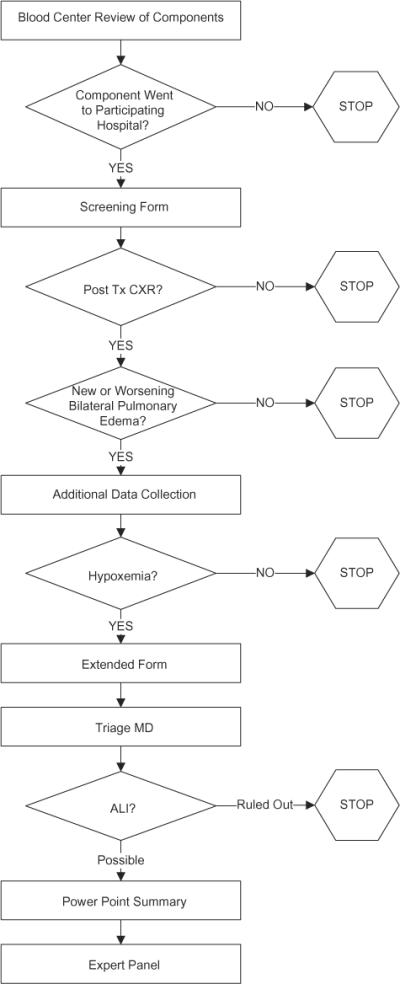
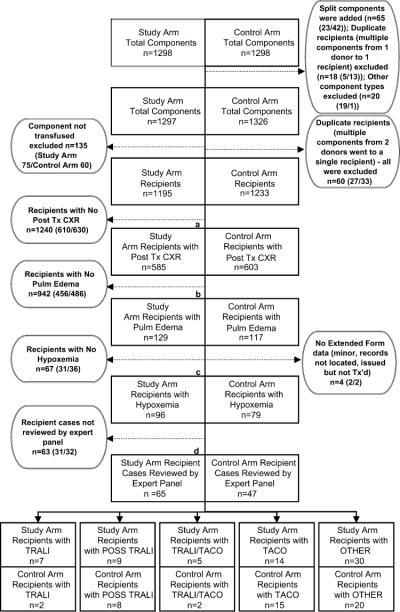
In the Leukocyte Antibody Prevalence Study-II (LAPS-II), we evaluated pulmonary outcomes in recipients of 2596 plasma-rich blood components (transfusable plasma and plateletpheresis) sent to participating hospitals; half of the components were collected from anti-HLA-positive donors (study arm) and half from anti-HLA-negative donors (control arm) matched by sex, parity, and blood center. A staged medical record review process was used. Final recipient diagnosis was based on case review by a blinded expert panel of pulmonary or critical care physicians.
TRALI incidence was 0.59% (seven cases) in study arm recipients versus 0.16% (two cases) in control arm recipients for an odds ratio (OR) of 3.6 (95% confidence interval [CI], 0.7-17.4; p = 0.10). For possible TRALI cases (nine study arm, eight control arm), the OR was 1.2 (95% CI, 0.4-3.0; p = 0.81), and for TRALI and possible TRALI aggregated together, it was 1.7 (95% CI, 0.7-3.7; p = 0.24). Transfusion-associated circulatory overload incidence was identical in the two arms (1.17 and 1.22%, respectively; OR, 1.0; p = 1.0).
TRALI incidence in recipients of anti-HLA-positive components was relatively low for a lookback study (1 in 170) and was higher than in the control arm, but did not reach significance. Based on this trend, the data are consistent with the likelihood that TRALI risk is decreased by selecting high-volume plasma components for transfusion from donors at low risk of having HLA antibodies.
我们采用多中心回顾性队列研究设计,评估人类白细胞抗原(HLA)抗体供者筛查是否会降低输血相关性急性肺损伤(TRALI)或疑似 TRALI 的风险。
在白细胞抗体流行率研究-II(LAPS-II)中,我们评估了 2596 份富含血浆的血液成分(可输血的血浆和血小板采集物)受者的肺部结局;这些成分的一半来自 HLA 阳性供者(研究组),另一半来自 HLA 阴性供者(对照组),通过性别、产次和血库进行匹配。采用分期病历回顾过程。最终受者的诊断基于由肺部或重症监护医师组成的盲法专家小组进行的病例回顾。
研究组受者的 TRALI 发生率为 0.59%(7 例),对照组为 0.16%(2 例),比值比(OR)为 3.6(95%置信区间[CI],0.7-17.4;p=0.10)。对于疑似 TRALI 病例(研究组 9 例,对照组 8 例),OR 为 1.2(95%CI,0.4-3.0;p=0.81),将 TRALI 和疑似 TRALI 病例汇总后,OR 为 1.7(95%CI,0.7-3.7;p=0.24)。两组的输血相关循环超负荷发生率相同(分别为 1.17%和 1.22%;OR,1.0;p=1.0)。
回顾性研究中,接受 HLA 阳性成分输血的受者的 TRALI 发生率相对较低(1/170),且高于对照组,但无统计学意义。基于这一趋势,数据表明,选择低风险 HLA 抗体供者的大容量血浆成分输血可降低 TRALI 风险。