School of Biological Sciences, University of Nebraska, Lincoln, NE 68588, USA.
BMC Evol Biol. 2011 Mar 29;11:80. doi: 10.1186/1471-2148-11-80.
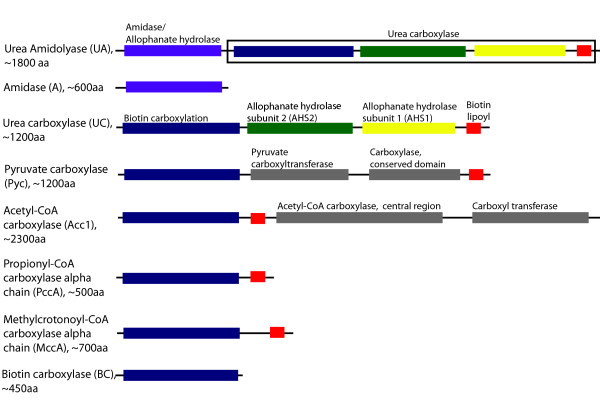
Urea amidolyase breaks down urea into ammonia and carbon dioxide in a two-step process, while another enzyme, urease, does this in a one step-process. Urea amidolyase has been found only in some fungal species among eukaryotes. It contains two major domains: the amidase and urea carboxylase domains. A shorter form of urea amidolyase is known as urea carboxylase and has no amidase domain. Eukaryotic urea carboxylase has been found only in several fungal species and green algae. In order to elucidate the evolutionary origin of urea amidolyase and urea carboxylase, we studied the distribution of urea amidolyase, urea carboxylase, as well as other proteins including urease, across kingdoms.
Among the 64 fungal species we examined, only those in two Ascomycota classes (Sordariomycetes and Saccharomycetes) had the urea amidolyase sequences. Urea carboxylase was found in many but not all of the species in the phylum Basidiomycota and in the subphylum Pezizomycotina (phylum Ascomycota). It was completely absent from the class Saccharomycetes (phylum Ascomycota; subphylum Saccharomycotina). Four Sordariomycetes species we examined had both the urea carboxylase and the urea amidolyase sequences. Phylogenetic analysis showed that these two enzymes appeared to have gone through independent evolution since their bacterial origin. The amidase domain and the urea carboxylase domain sequences from fungal urea amidolyases clustered strongly together with the amidase and urea carboxylase sequences, respectively, from a small number of beta- and gammaproteobacteria. On the other hand, fungal urea carboxylase proteins clustered together with another copy of urea carboxylases distributed broadly among bacteria. The urease proteins were found in all the fungal species examined except for those of the subphylum Saccharomycotina.
We conclude that the urea amidolyase genes currently found only in fungi are the results of a horizontal gene transfer event from beta-, gamma-, or related species of proteobacteria. The event took place before the divergence of the subphyla Pezizomycotina and Saccharomycotina but after the divergence of the subphylum Taphrinomycotina. Urea carboxylase genes currently found in fungi and other limited organisms were also likely derived from another ancestral gene in bacteria. Our study presented another important example showing plastic and opportunistic genome evolution in bacteria and fungi and their evolutionary interplay.
尿素 amidolyase 通过两步过程将尿素分解为氨和二氧化碳,而另一种酶脲酶则通过一步过程完成此过程。尿素 amidolyase 仅在真核生物的某些真菌物种中发现。它包含两个主要结构域:酰胺酶和尿素羧化酶结构域。一种较短形式的尿素 amidolyase 称为尿素羧化酶,没有酰胺酶结构域。真核尿素羧化酶仅在几种真菌和绿藻中发现。为了阐明尿素 amidolyase 和尿素羧化酶的进化起源,我们研究了尿素 amidolyase、尿素羧化酶以及包括脲酶在内的其他蛋白质在各个王国中的分布。
在所检查的 64 种真菌物种中,只有两个子囊菌门(Sordariomycetes 和 Saccharomycetes)的物种具有尿素 amidolyase 序列。尿素羧化酶存在于大多数但不是所有担子菌门和 Pezizomycotina 亚门(子囊菌门)的物种中。它完全不存在于子囊菌门 Saccharomycetes (子囊菌门;子囊菌门 Saccharomycotina 亚门)。我们检查的四个 Sordariomycetes 物种都具有尿素羧化酶和尿素 amidolyase 序列。系统发育分析表明,自细菌起源以来,这两种酶似乎经历了独立的进化。真菌尿素 amidolyase 的酰胺酶结构域和尿素羧化酶结构域序列分别与少数β-和γ-变形杆菌的酰胺酶和尿素羧化酶序列强烈聚集在一起。另一方面,真菌尿素羧化酶蛋白与广泛分布于细菌中的另一个尿素羧化酶副本聚集在一起。除了 Saccharomycotina 亚门的真菌物种外,所有检查的真菌物种都发现了脲酶蛋白。
我们得出的结论是,目前仅在真菌中发现的尿素 amidolyase 基因是来自β-、γ-或相关的变形杆菌的水平基因转移事件的结果。该事件发生在 Pezizomycotina 和 Saccharomycotina 亚门分化之前,但在 Taphrinomycotina 亚门分化之后。目前在真菌和其他有限生物中发现的尿素羧化酶基因也可能源自细菌中的另一个祖先基因。我们的研究提供了另一个重要例证,表明了细菌和真菌的可塑性和机会主义基因组进化及其进化相互作用。