The Blavatnik School of Computer Science, Tel Aviv University, Tel Aviv, Israel.
Mol Syst Biol. 2011 Mar 29;7:479. doi: 10.1038/msb.2011.11.
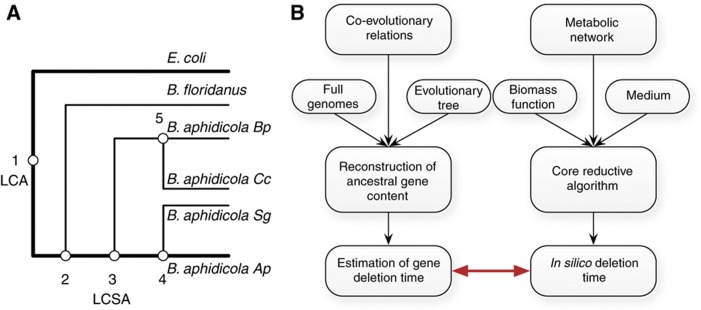
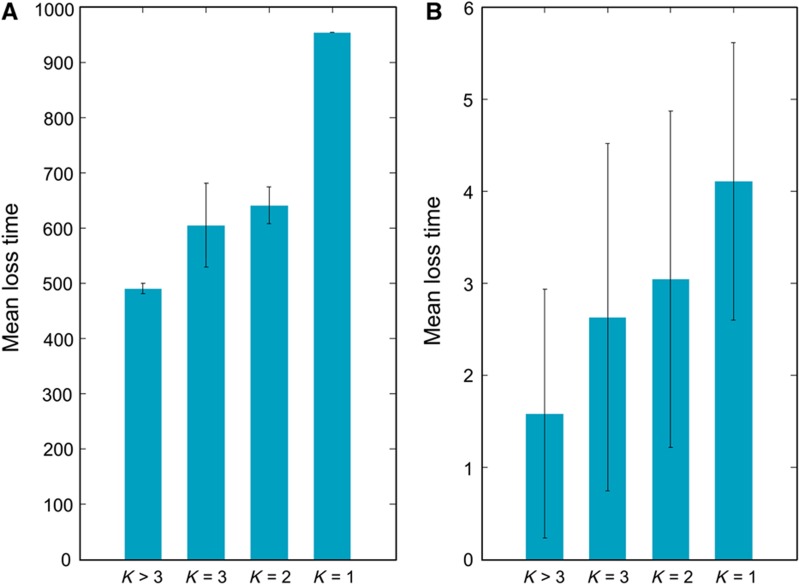
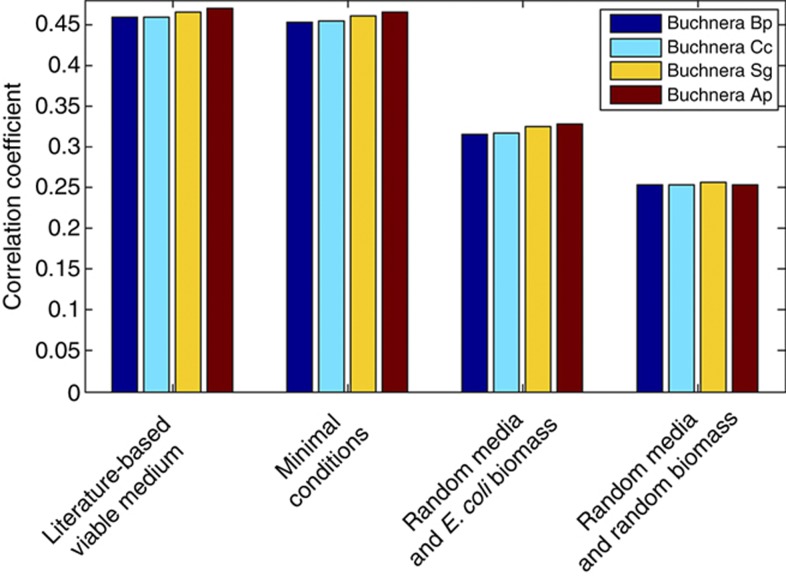
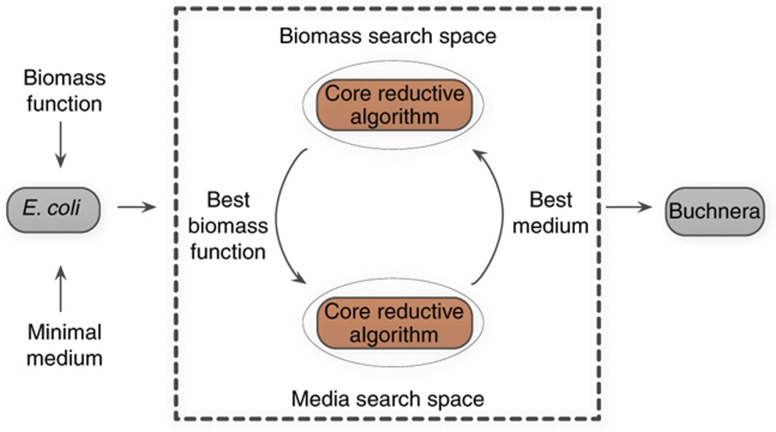
A fundamental challenge in Systems Biology is whether a cell-scale metabolic model can predict patterns of genome evolution by realistically accounting for associated biochemical constraints. Here, we study the order in which genes are lost in an in silico evolutionary process, leading from the metabolic network of Escherichia coli to that of the endosymbiont Buchnera aphidicola. We examine how this order correlates with the order by which the genes were actually lost, as estimated from a phylogenetic reconstruction. By optimizing this correlation across the space of potential growth and biomass conditions, we compute an upper bound estimate on the model's prediction accuracy (R=0.54). The model's network-based predictive ability outperforms predictions obtained using genomic features of individual genes, reflecting the effect of selection imposed by metabolic stoichiometric constraints. Thus, while the timing of gene loss might be expected to be a completely stochastic evolutionary process, remarkably, we find that metabolic considerations, on their own, make a marked 40% contribution to determining when such losses occur.
系统生物学的一个基本挑战是,细胞尺度的代谢模型是否可以通过真实地考虑相关的生化约束来预测基因组进化的模式。在这里,我们研究了在一个从大肠杆菌的代谢网络到共生体 Buchnera aphidicola 的代谢网络的计算机进化过程中基因丢失的顺序。我们研究了这个顺序与从系统发育重建中估计的实际丢失的基因顺序之间的相关性。通过在潜在的生长和生物量条件的空间上优化这个相关性,我们计算出了模型预测准确性的上限估计值(R=0.54)。该模型基于网络的预测能力优于使用单个基因的基因组特征获得的预测,这反映了代谢化学计量约束施加的选择效应。因此,尽管基因丢失的时间可能被认为是一个完全随机的进化过程,但令人惊讶的是,我们发现仅代谢方面的考虑就对确定何时发生这些丢失做出了显著的 40%贡献。