Department of Physical Medicine and Rehabilitation, Faculty of Medicine and Health Sciences, Ghent Universitary Hospital, De Pintelaan 185, 9000 Ghent, Belgium.
BMC Musculoskelet Disord. 2011 Mar 31;12:65. doi: 10.1186/1471-2474-12-65.
No consensus exists on how rehabilitation programs for lumbar discectomy patients with persistent complaints after surgery should be composed. A better understanding of normal and abnormal postoperative trunk muscle condition might help direct the treatment goals.
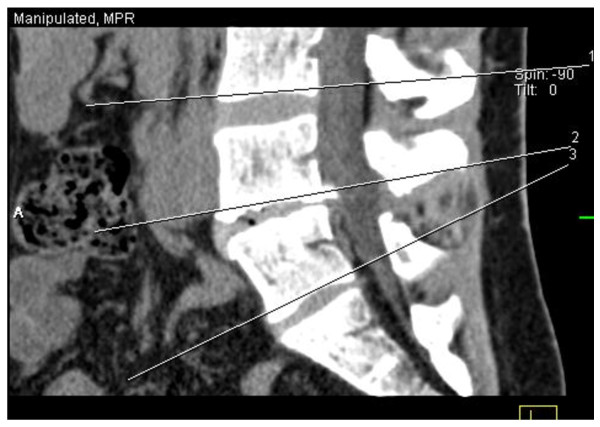
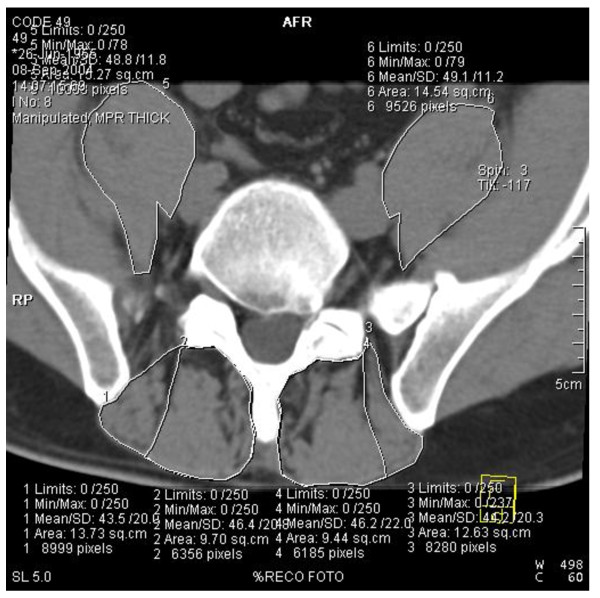
A three-dimensional CT scan of the lumbar spine was obtained in 18 symptomatic and 18 asymptomatic patients who had undergone a lumbar discectomy 42 months to 83 months (median 63 months) previously. The psoas muscle (PS), the paraspinal muscle mass (PA) and the multifidus muscle (MF) were outlined at the L3, L4 and L5 level. Of these muscles, fat free Cross Sectional Area (CSA) and fat CSA were determined. CSA of the lumbar erector spinae (LES = longissimus thoracis + iliocostalis lumborum) was calculated by subtracting MF CSA from PA CSA. Mean muscle CSA of the left and right sides was calculated at each level. To normalize the data for interpersonal comparison, the mean CSA was divided by the CSA of the L3 vertebral body (mCSA = normalized fat-free muscle CSA; fCSA = normalized fat CSA). Differences in CSA between the pain group and the pain free group were examined using a General Linear Model (GLM). Three levels were examined to investigate the possible role of the level of operation.
In lumbar discectomy patients with pain, the mCSA of the MF was significantly smaller than in pain-free subjects (p = 0.009) independently of the level. The mCSA of the LES was significantly smaller in pain patients, but only on the L3 slice (p = 0.018). No significant difference in mCSA of the PS was found between pain patients and pain-free patients (p = 0.462). The fCSA of the MF (p = 0.186) and of the LES (p = 0.256) were not significantly different between both populations. However, the fCSA of the PS was significantly larger in pain patients than in pain-free patients. (p = 0.012).The level of operation was never a significant factor.
CT comparison of MF, LES and PS muscle condition between lumbar discectomy patients without pain and patients with protracted postoperative pain showed a smaller fat-free muscle CSA of the MF at all levels examined, a smaller fat- free muscle CSA of the LES at the L3 level, and more fat in the PS in patients with pain. The level of operation was not found to be of importance. The present results suggest a general lumbar muscle dysfunction in the pain group, in particular of the deep stabilizing muscle system.
对于腰椎间盘切除术后持续存在症状的患者,如何构建康复计划尚无共识。更好地了解术后躯干肌肉的正常和异常状态可能有助于指导治疗目标。
对 18 例有症状和 18 例无症状患者进行了腰椎间盘切除术后 42 个月至 83 个月(中位数 63 个月)的三维 CT 扫描。在 L3、L4 和 L5 水平勾画了腰大肌(PS)、脊柱旁肌肉质量(PA)和多裂肌(MF)。在这些肌肉中,确定了无脂肪的横截面积(CSA)和脂肪 CSA。通过从 PA CSA 中减去 MF CSA 来计算腰椎竖脊肌(LES = 胸最长肌+髂肋肌)的 CSA。在每个水平计算左侧和右侧的平均肌肉 CSA。为了对人与人之间的比较进行数据归一化,将 CSA 除以 L3 椎体 CSA(mCSA=标准化无脂肪肌肉 CSA;fCSA=标准化脂肪 CSA)。使用一般线性模型(GLM)检查疼痛组和无疼痛组之间 CSA 的差异。检查了三个水平以研究手术水平的可能作用。
在腰椎间盘切除术后疼痛的患者中,MF 的 mCSA 明显小于无疼痛患者(p=0.009),而与水平无关。疼痛患者的 LES 的 mCSA 明显较小,但仅在 L3 切片上(p=0.018)。疼痛患者和无疼痛患者的 PS 的 mCSA 无显著差异(p=0.462)。MF(p=0.186)和 LES(p=0.256)的 fCSA 在两组人群之间无显著差异。然而,疼痛患者的 PS 的 fCSA 明显大于无疼痛患者(p=0.012)。手术水平从未成为重要因素。
对无疼痛和术后持续性疼痛的腰椎间盘切除术后患者的 MF、LES 和 PS 肌肉状况进行 CT 比较,显示所有检查水平的 MF 无脂肪肌肉 CSA 较小,L3 水平的 LES 无脂肪肌肉 CSA 较小,疼痛患者的 PS 中脂肪较多。未发现手术水平的重要性。目前的结果表明,疼痛组存在一般的腰椎肌肉功能障碍,特别是深部稳定肌肉系统。