Grima Pierfrancesco, Guido Marcello, Chiavaroli Roberto, De Donno Antonella, Tana Mariangela, Zizza Antonella
Division of Infectious Diseases, HIV Centre, S. Caterina Novella Hospital, via Roma, 73013 Galatina, Italy.
Cardiovasc Ultrasound. 2011 Apr 1;9:9. doi: 10.1186/1476-7120-9-9.
Human immunodeficiency virus (HIV) infection and antiretroviral treatment are associated with metabolic and cardiovascular complications that potentially increase the risk of atherosclerosis and cardiovascular disease in this population. Measurement of arterial wall thickness has been used as a surrogate of extent, severity and progression of atherosclerosis. A cross-sectional cohort study was performed to compare the validity of two non-invasive arterial measures: carotid intima-media thickness (IMT), a parameter of atherosclerosis, and ophthalmic artery resistance index (OARI), an index of occlusive carotid artery disease.
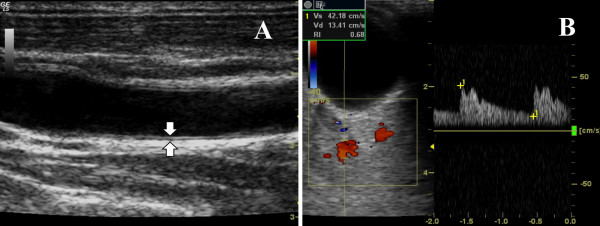
A total of 95 patients receiving highly active antiretroviral therapy (HAART) for more than 12 months were consecutively enrolled. IMT and OARI were measured by 7.5 MHz linear probe.
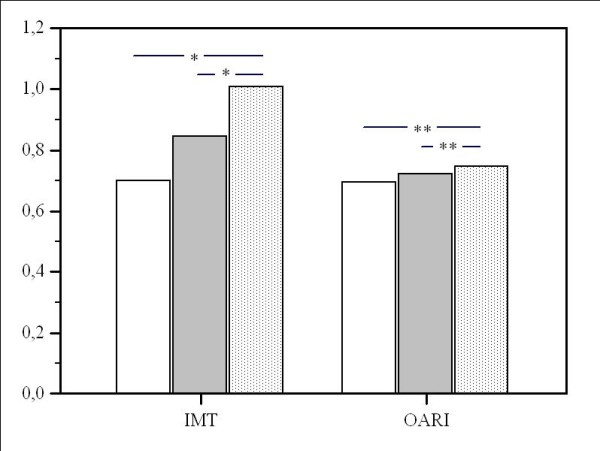
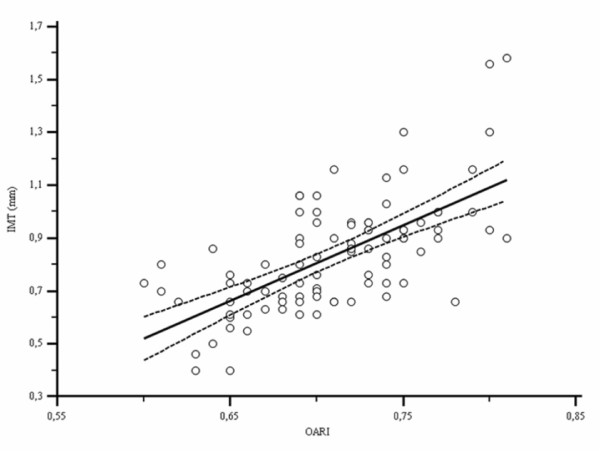
There was a significant linear increase in IMT and OARI values as the grade of cardiovascular risk (0.70 and 0.69 for very low risk, 0.86 and 0.72 for low risk and 0.98 and 0.74 for medium/high risk, p < 0.001). A IMT > 0.83 and an OARI > 0.72 were the most discriminatory values for predicting a cardiovascular risk ≥ 10% (sensibility 89.6% and 75.8%; sensitivity 70.5% and 68.4%; p < 0.001).
Our data indicate that OARI may have a potential as a new precocious marker of subclinical atherosclerosis in HIV-1-infected patients.
人类免疫缺陷病毒(HIV)感染及抗逆转录病毒治疗与代谢及心血管并发症相关,这些并发症可能增加该人群动脉粥样硬化和心血管疾病的风险。动脉壁厚度的测量已被用作动脉粥样硬化程度、严重程度及进展的替代指标。进行了一项横断面队列研究,以比较两种非侵入性动脉测量方法的有效性:颈动脉内膜中层厚度(IMT),一种动脉粥样硬化参数;以及眼动脉阻力指数(OARI),一种颈动脉硬化性疾病指标。
连续纳入95例接受高效抗逆转录病毒治疗(HAART)超过12个月的患者。使用7.5MHz线性探头测量IMT和OARI。
随着心血管风险等级升高,IMT和OARI值呈显著线性增加(极低风险时分别为0.70和0.69,低风险时分别为0.86和0.72,中/高风险时分别为0.98和0.74,p<0.001)。IMT>0.83和OARI>0.72是预测心血管风险≥10%的最具鉴别性的值(敏感性分别为89.6%和75.8%;特异性分别为70.5%和68.4%;p<0.001)。
我们的数据表明,OARI可能有潜力作为HIV-1感染患者亚临床动脉粥样硬化的一种新的早期标志物。