Department of Allergy and Immunology, National Research Institute for Child Health and Development, Tokyo, Japan.
Allergy Asthma Immunol Res. 2011 Apr;3(2):81-8. doi: 10.4168/aair.2011.3.2.81. Epub 2011 Feb 15.
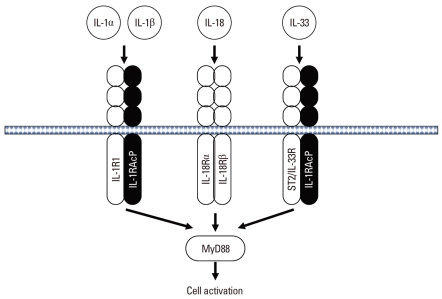
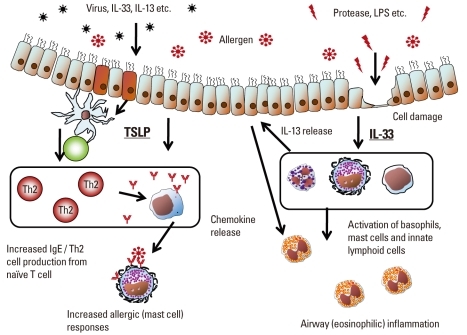
Interleukin-33 (IL-33) is the 11th member of IL-1 cytokine family which includes IL-1 and IL-18. Unlike IL-1β and IL-18, IL-33 is suggested to function as an alarmin that is released upon endothelial or epithelial cell damage and may not enhance acquired immune responses through activation of inflammasome. ST2, a IL-33 receptor component, is preferentially expressed by T-helper type (Th) 2 cells, mast cells, eosinophils and basophils, compared to Th1 cells, Th17 cells and neutrophils. Thus, IL-33 profoundly enhances allergic inflammation through increased expression of proallergic cytokines and chemokines. Indeed, IL-33 and its receptor genes are recognized as the most susceptible genes for asthma by several recent genomewide association studies. It has also recently been shown that IL-33 plays a crucial role in innate eosinophilic airway inflammation rather than acquired immune responses such as IgE production. As such, IL-33 provides a unique therapeutic way for asthma, i.e., ameliorating innate airway inflammation.
白细胞介素-33(IL-33)是白细胞介素 1 细胞因子家族的第 11 个成员,该家族还包括白细胞介素 1β 和白细胞介素 18。与白细胞介素 1β 和白细胞介素 18 不同,白细胞介素 33 被认为是一种警报素,在血管内皮细胞或上皮细胞受损时释放,并可能不会通过激活炎症小体增强获得性免疫反应。白细胞介素 33 的受体成分 ST2,与 Th1 细胞、Th17 细胞和中性粒细胞相比,优先在 Th2 细胞、肥大细胞、嗜酸性粒细胞和嗜碱性粒细胞中表达。因此,白细胞介素 33 通过增加过敏细胞因子和趋化因子的表达,显著增强过敏炎症。事实上,几项全基因组关联研究已经将白细胞介素 33 和其受体基因识别为哮喘最易感的基因。最近还表明,白细胞介素 33 在先天嗜酸性气道炎症中发挥关键作用,而不是像 IgE 产生那样的获得性免疫反应。因此,白细胞介素 33 为哮喘提供了一种独特的治疗方法,即改善先天气道炎症。