Xian Mu, Ma Siyuan, Wang Kuiji, Lou Hongfei, Wang Yang, Zhang Luo, Wang Chengshuo, Akdis Cezmi A
Department of Otolaryngology Head and Neck Surgery, Beijing TongRen Hospital, Capital Medical University, Beijing, China.
Beijing Key Laboratory of Nasal Diseases, Beijing Institute of Otolaryngology, Beijing, China.
Allergy Asthma Immunol Res. 2020 Jan;12(1):56-71. doi: 10.4168/aair.2020.12.1.56.
The effect of air pollution-related particulate matter (PM) on epithelial barrier function and tight junction (TJ) expression in human nasal mucosa has not been studied to date. This study therefore aimed to assess the direct impact of PM with an aerodynamic diameter less than 2.5 μ (PM2.5) on the barrier function and TJ molecular expression of human nasal epithelial cells.
Air-liquid interface cultures were established with epithelial cells derived from noninflammatory nasal mucosal tissue collected from patients undergoing paranasal sinus surgery. Confluent cultures were exposed to 50 or 100 μg/mL PM2.5 for up to 72 hours, and assessed for 1) epithelial barrier integrity as measured by transepithelial resistance (TER) and permeability of fluorescein isothiocyanate (FITC) 4 kDa; 2) expression of TJs using real-time quantitative polymerase chain reaction and immunofluorescence staining, and 3) proinflammatory cytokines by luminometric bead array or enzyme-linked immunosorbent assay.
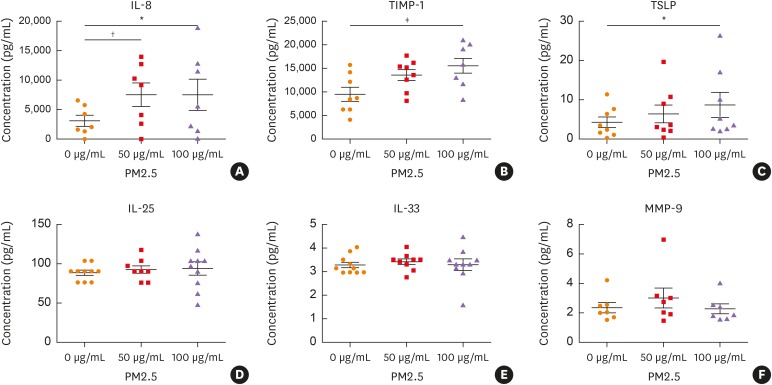
Compared to control medium, 50 and/or 100 μg/mL PM2.5-treatment 1) significantly decreased TER and increased FITC permeability, which could not be restored by budesonide pretreatment; 2) significantly decreased the expression of claudin-1 messenger RNA, claudin-1, occludin and ZO-1 protein; and 3) significantly increased production of the cytokines interleukin-8, TIMP metallopeptidase inhibitor 1 and thymic stromal lymphopoietin.
Exposure to PM2.5 may lead to loss of barrier function in human nasal epithelium through decreased expression of TJ proteins and increased release of proinflammatory cytokines. These results suggest an important mechanism of susceptibility to rhinitis and rhinosinusitis in highly PM2.5-polluted areas.
空气污染相关颗粒物(PM)对人鼻黏膜上皮屏障功能和紧密连接(TJ)表达的影响迄今尚未见研究报道。因此,本研究旨在评估空气动力学直径小于2.5微米的颗粒物(PM2.5)对人鼻上皮细胞屏障功能和TJ分子表达的直接影响。
采用来自接受鼻窦手术患者的非炎性鼻黏膜组织的上皮细胞建立气液界面培养体系。将融合的培养物暴露于50或100μg/mL的PM2.5中长达72小时,并进行以下评估:1)通过跨上皮电阻(TER)和异硫氰酸荧光素(FITC)4 kDa的通透性来测定上皮屏障完整性;2)使用实时定量聚合酶链反应和免疫荧光染色来检测TJ的表达;3)通过发光微球阵列或酶联免疫吸附测定法检测促炎细胞因子。
与对照培养基相比,50和/或100μg/mL PM2.5处理:1)显著降低TER并增加FITC通透性,布地奈德预处理无法使其恢复;2)显著降低claudin-1信使核糖核酸、claudin-1、闭合蛋白和ZO-1蛋白的表达;3)显著增加细胞因子白细胞介素-8、金属蛋白酶组织抑制因子1和胸腺基质淋巴细胞生成素的产生。
暴露于PM2.5可能通过降低TJ蛋白表达和增加促炎细胞因子释放导致人鼻上皮屏障功能丧失。这些结果提示了在PM2.5污染严重地区易患鼻炎和鼻窦炎的重要机制。