Kim Hyoung Woo, Ko Young Hwii, Kang Seok Ho, Lee Jeong Gu
Department of Urology, Sahmyook Medical Center, Seoul, Korea.
Korean J Urol. 2011 Mar;52(3):166-71. doi: 10.4111/kju.2011.52.3.166. Epub 2011 Mar 18.
This study was conducted to identify the predictive factors for prostate cancer in patients with prostate-specific antigen (PSA) levels equal to or less than 4 ng/ml.
A retrospective study of medical records was conducted on 292 patients with initial serum PSA ≤4 ng/ml among 2,305 patients who underwent prostate biopsy from January 2003 to December 2008. Prostate biopsy was performed on patients with PSA ≤4 ng/ml in the case of abnormal findings in the digital rectal examination (DRE) or transrectal ultrasonography (TRUS) or in those with a PSA level higher than the age-adjusted PSA levels. The patients were divided into the group diagnosed with prostate cancer and the non-prostate-cancer group. Subsequently, the variables of the two groups were compared.
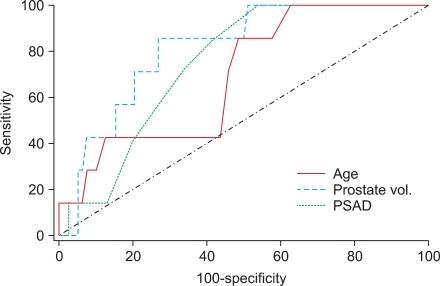
The patients' mean age was significantly higher in the prostate cancer group (n=28) than in the non-prostate-cancer group (n=264; p=0.033). In addition, for the patients with a PSA range of 2.0-2.9 ng/ml, their age (p=0.049) and PSA density (PSAD; p=0.042) were significantly higher and the prostate volume (p=0.028) was significantly smaller in the prostate cancer group than in the non-prostate-cancer group.
Of the patients with PSA ≤4 ng/ml, the age of the patients who showed abnormal findings in the DRE or TRUS or who had a PSA level higher than the age-adjusted PSA level was a significant predictive factor for prostate cancer. In particular, for the PSA range of 2.0-2.9 ng/ml, a thorough screening test for prostate cancer was required if the patients had conditions such as higher age, smaller prostate, and higher PSAD.
本研究旨在确定前列腺特异性抗原(PSA)水平等于或低于4 ng/ml的患者中前列腺癌的预测因素。
对2003年1月至2008年12月接受前列腺活检的2305例患者中的292例初始血清PSA≤4 ng/ml的患者进行病历回顾性研究。对于直肠指检(DRE)或经直肠超声检查(TRUS)有异常发现或PSA水平高于年龄校正PSA水平的PSA≤4 ng/ml的患者进行前列腺活检。将患者分为前列腺癌诊断组和非前列腺癌组。随后,比较两组的变量。
前列腺癌组(n = 28)患者的平均年龄显著高于非前列腺癌组(n = 264;p = 0.033)。此外,对于PSA范围为2.0 - 2.9 ng/ml的患者,前列腺癌组的年龄(p = 0.049)和PSA密度(PSAD;p = 0.042)显著更高,前列腺体积(p = 0.028)显著更小。
在PSA≤4 ng/ml的患者中,DRE或TRUS有异常发现或PSA水平高于年龄校正PSA水平的患者年龄是前列腺癌的重要预测因素。特别是对于PSA范围为2.0 - 2.9 ng/ml的患者,如果患者有年龄较大、前列腺较小和PSAD较高等情况,则需要进行全面的前列腺癌筛查试验。