Liu Gang, Qutub Amina A, Vempati Prakash, Mac Gabhann Feilim, Popel Aleksander S
Systems Biology Laboratory, Department of Biomedical Engineering, School of Medicine, Johns Hopkins University, Baltimore, MD 21205, USA.
Theor Biol Med Model. 2011 Apr 4;8:6. doi: 10.1186/1742-4682-8-6.
Mathematical modeling of angiogenesis has been gaining momentum as a means to shed new light on the biological complexity underlying blood vessel growth. A variety of computational models have been developed, each focusing on different aspects of the angiogenesis process and occurring at different biological scales, ranging from the molecular to the tissue levels. Integration of models at different scales is a challenging and currently unsolved problem.
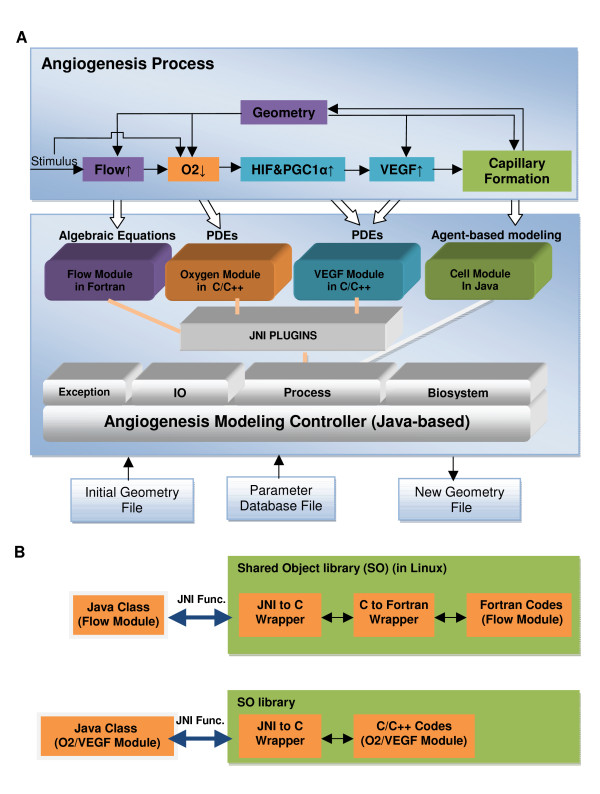
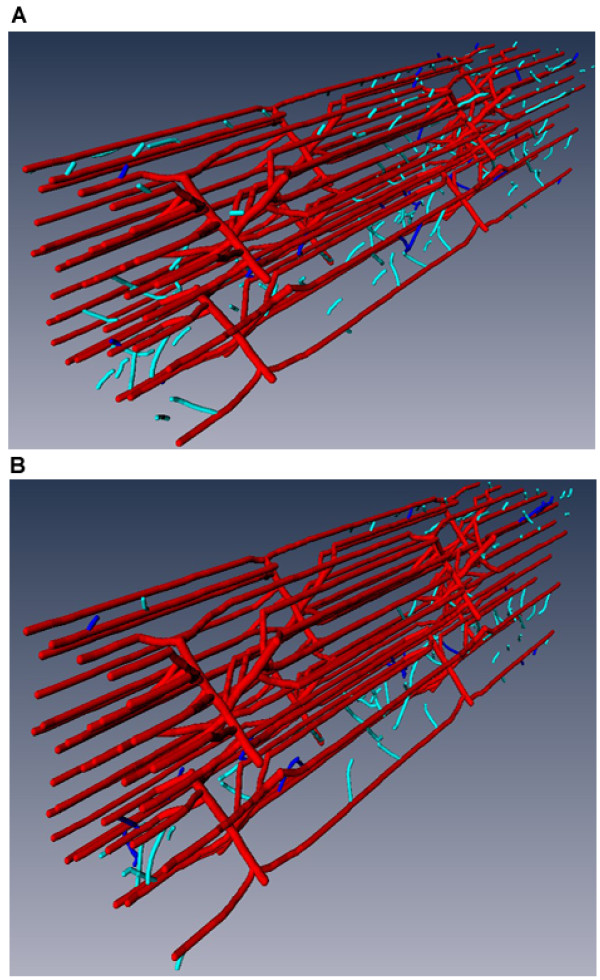
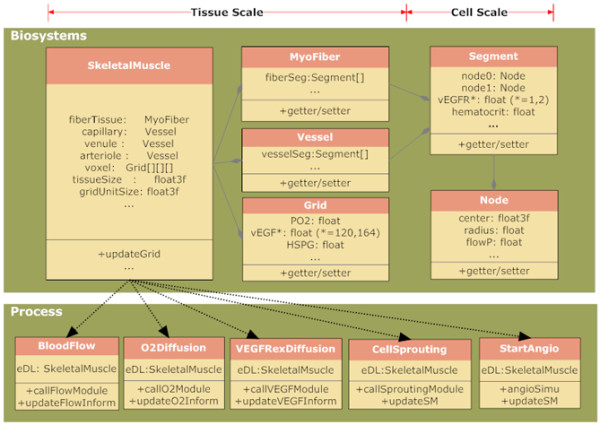
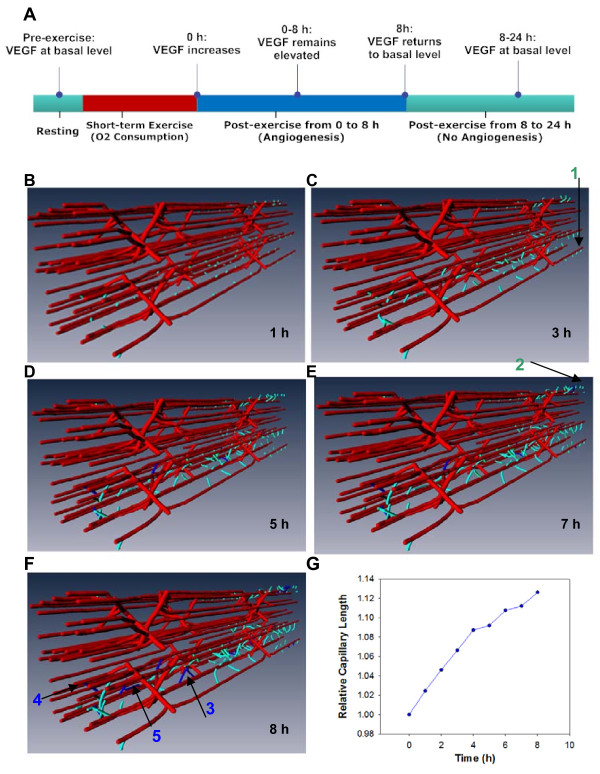
We present an object-oriented module-based computational integration strategy to build a multiscale model of angiogenesis that links currently available models. As an example case, we use this approach to integrate modules representing microvascular blood flow, oxygen transport, vascular endothelial growth factor transport and endothelial cell behavior (sensing, migration and proliferation). Modeling methodologies in these modules include algebraic equations, partial differential equations and agent-based models with complex logical rules. We apply this integrated model to simulate exercise-induced angiogenesis in skeletal muscle. The simulation results compare capillary growth patterns between different exercise conditions for a single bout of exercise. Results demonstrate how the computational infrastructure can effectively integrate multiple modules by coordinating their connectivity and data exchange. Model parameterization offers simulation flexibility and a platform for performing sensitivity analysis.
This systems biology strategy can be applied to larger scale integration of computational models of angiogenesis in skeletal muscle, or other complex processes in other tissues under physiological and pathological conditions.
血管生成的数学建模作为一种揭示血管生长背后生物学复杂性的手段,正日益受到关注。已经开发了多种计算模型,每个模型都聚焦于血管生成过程的不同方面,且发生在从分子水平到组织水平的不同生物尺度上。不同尺度模型的整合是一个具有挑战性且目前尚未解决的问题。
我们提出了一种基于面向对象模块的计算整合策略,以构建一个连接现有模型的血管生成多尺度模型。作为一个示例,我们使用这种方法整合了代表微血管血流、氧气运输、血管内皮生长因子运输和内皮细胞行为(感知、迁移和增殖)的模块。这些模块中的建模方法包括代数方程、偏微分方程以及具有复杂逻辑规则的基于智能体的模型。我们应用这个整合模型来模拟骨骼肌中运动诱导的血管生成。模拟结果比较了单次运动不同运动条件下的毛细血管生长模式。结果表明计算基础设施如何通过协调模块之间的连接性和数据交换来有效地整合多个模块。模型参数化提供了模拟灵活性以及进行敏感性分析的平台。
这种系统生物学策略可应用于骨骼肌血管生成计算模型的更大规模整合,或生理和病理条件下其他组织中的其他复杂过程。