New York University School of Medicine, Tuxedo, New York 10987, USA.
Environ Health Perspect. 2011 Apr;119(4):467-73. doi: 10.1289/ehp.1002667.
Recent time-series studies have indicated that both cardiovascular disease (CVD)mortality and hospitalizations are associated with particulate matter (PM). However, seasonal patterns of PM associations with these outcomes are not consistent, and PM components responsible for these associations have not been determined. We investigated this issue in New York City (NYC), where PM originates from regional and local combustion sources.
In this study, we examined the role of particulate matter with aerodynamic diameter ≤ 2.5 µm (PM(2.5)) and its key chemical components on both CVD hospitalizations and on mortality in NYC.
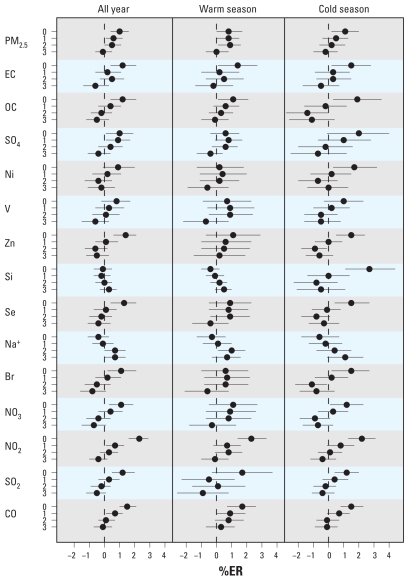
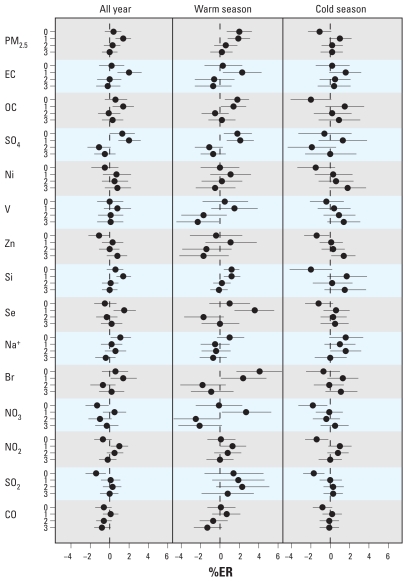
We analyzed daily deaths and emergency hospitalizations for CVDs among persons ≥ 40 years of age for associations with PM(2.5), its chemical components, nitrogen dioxide (NO(2)), carbon monoxide, and sulfur dioxide for the years 2000-2006 using a Poisson time-series model adjusting for temporal and seasonal trends, temperature effects, and day of the week. We estimated excess risks per interquartile-range increases at lags 0 through 3 days for warm (April through September) and cold (October through March) seasons.
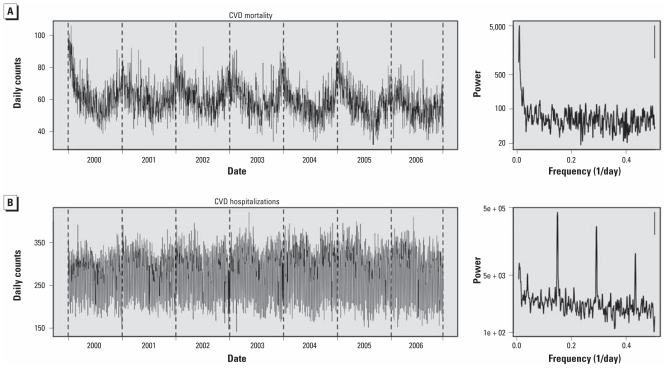
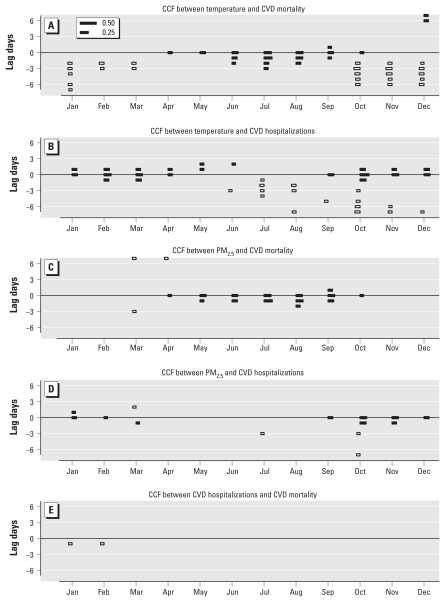
The CVD mortality series exhibit strong seasonal trends, whereas the CVD hospitalization series show a strong day-of-week pattern. These outcome series were not correlated with each other but were individually associated with a number of PM(2.5) chemical components from regional and local sources, each with different seasonal patterns and lags. Coal-combustion-related components (e.g., selenium) were associated with CVD mortality in summer and CVD hospitalizations in winter, whereas elemental carbon and NO(2) showed associations with these outcomes in both seasons.
Local combustion sources, including traffic and residual oil burning, may play a year-round role in the associations between air pollution and CVD outcomes, but transported aerosols may explain the seasonal variation in associations shown by PM(2.5) mass.
最近的时间序列研究表明,心血管疾病(CVD)死亡率和住院率与颗粒物(PM)有关。然而,PM 与这些结果的季节性模式并不一致,也没有确定导致这些关联的 PM 成分。我们在纽约市(NYC)调查了这个问题,那里的 PM 来源于区域和本地燃烧源。
在这项研究中,我们研究了 PM(直径≤2.5 µm 的颗粒物)及其主要化学成分对纽约市 CVD 住院和死亡率的作用。
我们使用泊松时间序列模型分析了 2000 年至 2006 年期间≥40 岁人群中与 PM(直径≤2.5 µm 的颗粒物)及其化学成分、二氧化氮(NO(2))、一氧化碳和二氧化硫相关的每日 CVD 死亡和急诊住院的关联,模型调整了时间和季节性趋势、温度效应以及星期几。我们估计了在暖季(4 月至 9 月)和冷季(10 月至 3 月)中,滞后 0 至 3 天的每四分位距增加的超额风险。
CVD 死亡率系列表现出强烈的季节性趋势,而 CVD 住院系列则表现出强烈的星期几模式。这些结果系列彼此之间没有相关性,但都与来自区域和本地来源的 PM(直径≤2.5 µm 的颗粒物)的许多化学成分有关,每个化学成分都有不同的季节性模式和滞后时间。煤燃烧相关成分(如硒)与夏季 CVD 死亡率和冬季 CVD 住院率相关,而元素碳和 NO(2)在两个季节都与这些结果相关。
包括交通和残余油燃烧在内的本地燃烧源可能在空气污染与 CVD 结果之间的关联中发挥全年作用,但气溶胶的传输可能解释了 PM(直径≤2.5 µm 的颗粒物)质量显示的关联的季节性变化。