Ma Yuan, Huang Yuxiang, Li Li, Yu Li, Xiao Pei, Wang Qian
Department of Medical Record Management, West China Second University Hospital, Sichuan University, Chengdu, Sichuan, China.
Key Laboratory of Birth Defects and Related Diseases of Women and Children (Sichuan University), Ministry of Education, Chengdu, Sichuan, China.
Front Public Health. 2025 Mar 5;13:1517507. doi: 10.3389/fpubh.2025.1517507. eCollection 2025.
In China, coronary heart disease (CHD) is a significant public health issue affecting the population's health. Evidence suggests that outdoor PM2.5 is a crucial environmental risk factor for CHD mortality. This study aims to provide scientific evidence for the prevention and treatment of CHD by analyzing the trend of CHD mortality attributed to outdoor PM2.5 in China from 1994 to 2019.
Data were obtained from the Global Burden of Disease Study (GBD) 2019. CHD mortality attributed to outdoor PM2.5 in China from 1994 to 2019 was extracted from the GBD Data tool. We used an age-period-cohort (APC) model based on the intrinsic estimator (IE) algorithm to decompose the age, period, and cohort effects related to CHD mortality attributed to outdoor PM2.5.
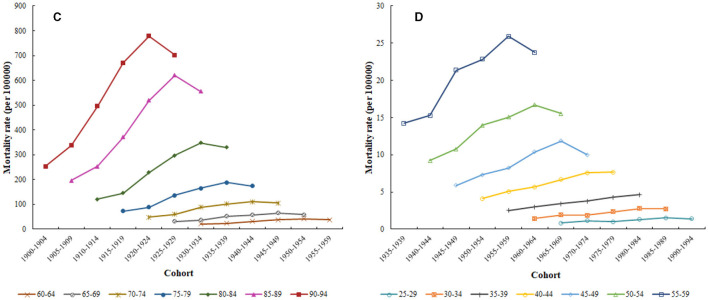
From 1994 to 2019, the crude mortality rates (CMRs) and age-standardized mortality rates (ASMRs) of CHD attributed to outdoor PM2.5 in China showed an overall upward trend. The APC model analysis showed that the relative risk of CHD mortality attributed to outdoor PM2.5 increased exponentially with age, reaching 89.284 (95% CI: 48.669, 163.793) in the 90-95 age group. The period effect increased monotonically, with a relative risk of 3.699 (95% CI: 3.639, 3.760) in 2019. The cohort effect decreased monotonically, with the lowest relative risk of CHD mortality attributed to outdoor PM2.5 in residents born between 1990 and 1994, at 0.135 (95% CI: 0.031, 0.588).
The older adult, a high-risk population, should receive more attention. In the future, continuous efforts should be made to strengthen environmental air pollution control and implement targeted health interventions to reduce the impact of outdoor PM2.5 on CHD mortality.
在中国,冠心病(CHD)是一个影响民众健康的重大公共卫生问题。有证据表明,室外细颗粒物(PM2.5)是冠心病死亡率的一个关键环境风险因素。本研究旨在通过分析1994年至2019年中国室外PM2.5所致冠心病死亡率的趋势,为冠心病的防治提供科学依据。
数据来自《2019年全球疾病负担研究》(GBD 2019)。从GBD数据工具中提取1994年至2019年中国室外PM2.5所致冠心病死亡率。我们使用基于内在估计器(IE)算法的年龄-时期-队列(APC)模型,对与室外PM2.5所致冠心病死亡率相关的年龄、时期和队列效应进行分解。
1994年至2019年,中国室外PM2.5所致冠心病的粗死亡率(CMRs)和年龄标准化死亡率(ASMRs)总体呈上升趋势。APC模型分析表明,室外PM2.5所致冠心病死亡率的相对风险随年龄呈指数增长,在90-95岁年龄组达到89.284(95%CI:48.669, 163.793)。时期效应单调增加,2019年的相对风险为3.699(95%CI:3.639, 3.760)。队列效应单调下降,1990年至1994年出生的居民中,室外PM2.5所致冠心病死亡率的相对风险最低,为0.135(95%CI:0.031, 0.588)。
老年人群作为高危人群应受到更多关注。未来,应持续努力加强环境空气污染控制,并实施有针对性的健康干预措施,以降低室外PM2.5对冠心病死亡率的影响。