Division of Epidemiology and Community Health, School of Public Health, University of Minnesota, 1300S Second Street, Suite 300, Minneapolis, MN 55454-1015, USA.
Stroke. 2011 Jun;42(6):1556-62. doi: 10.1161/STROKEAHA.110.605600. Epub 2011 Apr 7.
The purposes of this study were to track mortality and rehospitalizations over 5 years poststroke in a stroke cohort (SC) and compare long-term risks of complications to a matched nonstroke cohort (NSC).
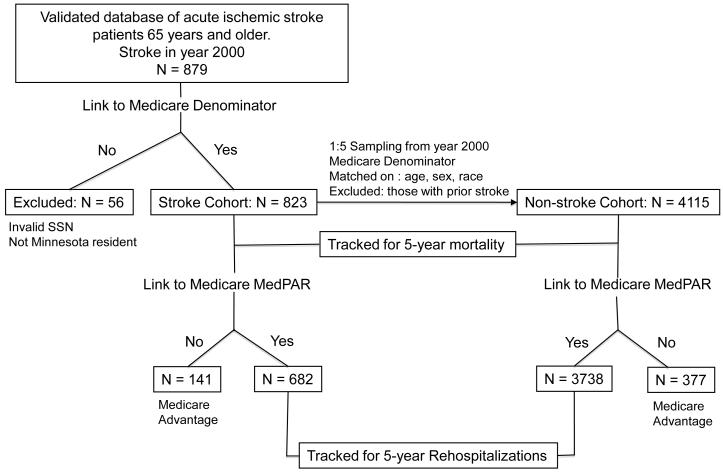
A cohort design with a matched NSC comparison was used. The SC constituted a validated database of acute ischemic stroke patients, ≥65 years, hospitalized across 19 Minnesota hospitals in the year 2000. The NSC was constructed from the year 2000 General Medicare Population by matching SC members on age, race, and sex. Both cohorts were tracked across 5 years of Medicare claims data to identify dates and causes of rehospitalization and death dates. Kaplan-Meier survival curves estimated cumulative incidence rates. Cox models calculated adjusted hazard ratios.
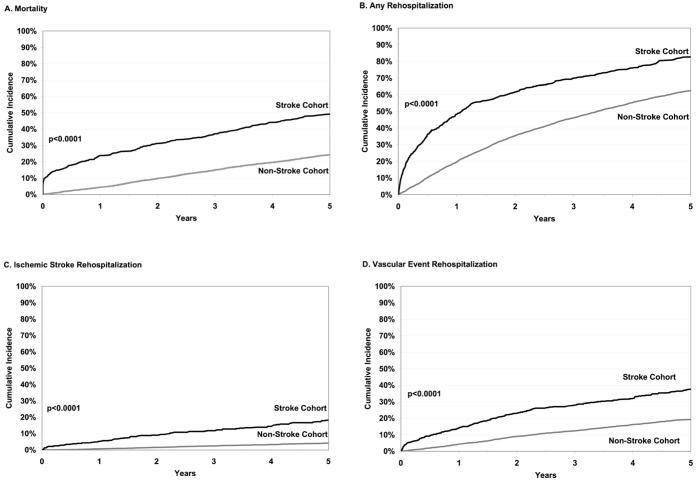
Event rates and adjusted hazard ratios were: mortality: 1 year SC=24%, NSC=4%; 5 years SC=49%, NSC=24% (hazard ratio, 4.4; 95% CI, 3.6 to 5.5). Overall rehospitalization rates were: 1 year SC=49%, NSC=20%; 5 years SC=83%; NSC=63% (hazard ratio, 2.6; 95% CI, 2.2 to 3.0). Cause-specific 5-year rehospitalization rates were significantly higher in SC versus NSC for recurrent ischemic stroke, heart failure, cardiac events, any vascular events, pneumonia, and hip fractures. The excess risk of mortality and rehospitalizations in the SC persisted beyond the initial aftermath of the acute stroke (i.e., beyond 30 days poststroke) and persisted even after 1 year poststroke. Average acute care Medicare charges in SC were more than doubled those in NSC.
The high rates of acute care poststroke readmissions indicate a need for trials to prevent long-term complications in stroke survivors.
本研究旨在对卒中队列(SC)进行 5 年以上的死亡率和再住院情况追踪,并与匹配的非卒中队列(NSC)进行长期并发症风险比较。
采用队列设计并与匹配的 NSC 进行比较。SC 是由 2000 年明尼苏达州 19 家医院的急性缺血性卒中患者的验证数据库组成。NSC 是通过在年龄、种族和性别上与 SC 成员相匹配,从 2000 年的普通医疗保险人群中构建的。两个队列都通过 5 年的医疗保险理赔数据进行跟踪,以确定再住院和死亡日期以及原因。Kaplan-Meier 生存曲线估计累积发生率。Cox 模型计算调整后的危险比。
事件发生率和调整后的危险比分别为:死亡率:1 年 SC=24%,NSC=4%;5 年 SC=49%,NSC=24%(危险比,4.4;95%CI,3.6 至 5.5)。总的再住院率分别为:1 年 SC=49%,NSC=20%;5 年 SC=83%,NSC=63%(危险比,2.6;95%CI,2.2 至 3.0)。SC 与 NSC 相比,5 年时的特定原因再住院率在复发性缺血性卒中、心力衰竭、心脏事件、任何血管事件、肺炎和髋部骨折方面显著更高。SC 中死亡率和再住院率的额外风险持续存在于急性卒中后的最初阶段之外(即,超过 30 天后),甚至在卒中后 1 年仍持续存在。SC 的急性医疗保健 Medicare 费用平均是 NSC 的两倍多。
高的急性卒中后再住院率表明需要进行试验来预防卒中幸存者的长期并发症。