Department of Health Services & Outcomes Research, National Healthcare Group, Singapore, Singapore.
BMC Neurol. 2013 Oct 3;13:133. doi: 10.1186/1471-2377-13-133.
Stroke is the 4th leading cause of death and 1st leading cause of disability in Singapore. However the information on long-term post stroke outcomes for Singaporean patients was limited. This study aimed to investigate the post stroke outcomes of 5-year survival and rehospitalization due to stroke recurrence for hemorrhagic and ischemic stroke patients in Singapore. The outcomes were stratified by age, ethnic group, gender and stroke types. The causes of death and stroke recurrence were also explored in the study.
A multi-site retrospective cohort study. Patients admitted for stroke at any of the three hospitals in the National Healthcare Group of Singapore were included in the study. All study patients were followed up to 5 years. Kaplan-Meier was applied to study the time to first event, death or rehospitalization due to stroke recurrence. Cox proportional hazard model was applied to study the time to death with adjustment for stroke type, age, sex, ethnic group, and admission year. Cumulative incidence model with competing risk was applied for comparing the risks of rehospitalization due to stroke recurrence with death as the competing risk.
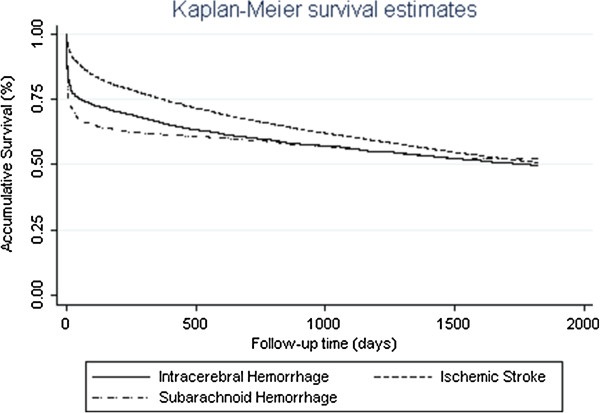
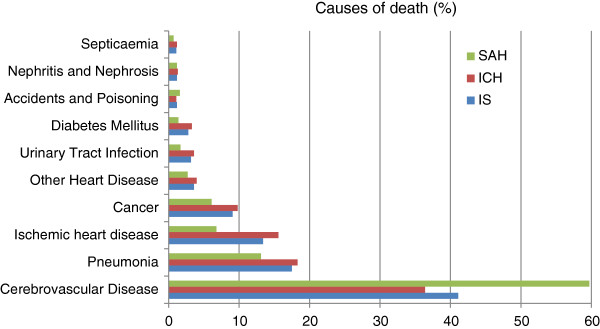
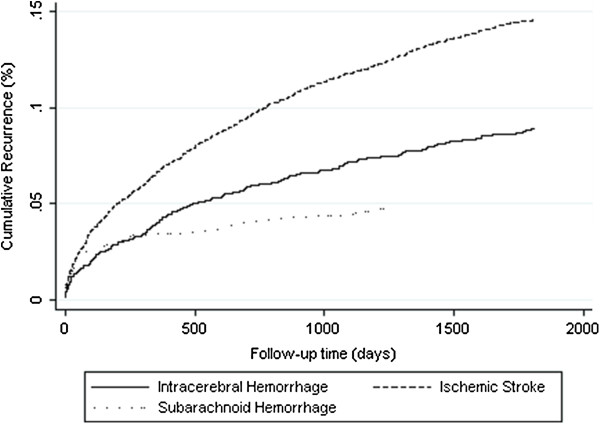
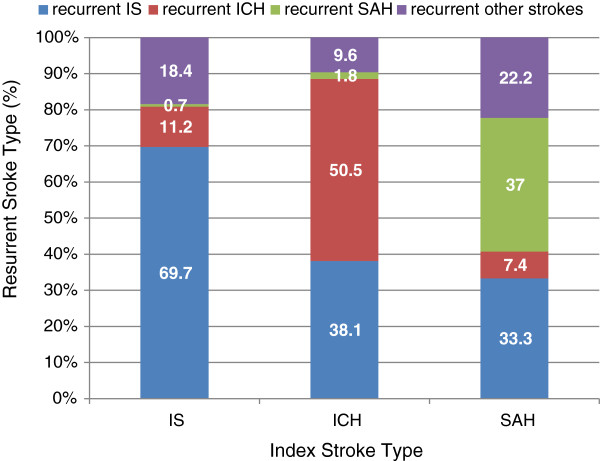
Totally 12,559 stroke patients were included in the study. Among them, 59.3% survived for 5 years; 18.4% were rehospitalized due to stroke recurrence in 5 years. The risk of stroke recurrence and mortality increased with age in all stroke types. Gender, ethnic group and admitting year were not significantly associated with the risk of mortality or stroke recurrence in hemorrhagic stroke. Male or Malay patient had higher risk of stroke recurrence and mortality in ischemic stroke. Hemorrhagic stroke had higher early mortality while ischemic stroke had higher recurrence and late mortality. The top cause of death among died stroke patients was cerebrovascular diseases, followed by pneumonia and ischemic heart diseases. The recurrent stroke was most likely to be the same type as the initial stroke among rehospitalized stroke patients.
Five year post-stroke survival and rehospitalization due to stroke recurrence as well as their associations with patient demographics were studied for different stroke types in Singapore. Specific preventive strategies are needed to target the high risk groups to improve their long-term outcomes after acute stroke.
中风是新加坡第 4 大死因和第 1 大致残原因。然而,新加坡患者中风后长期预后的相关信息有限。本研究旨在调查新加坡出血性和缺血性中风患者 5 年生存率和因中风复发而再住院的情况。研究根据年龄、种族、性别和中风类型对结果进行分层。本研究还探讨了死亡和中风复发的原因。
本研究为多地点回顾性队列研究。在新加坡国家医疗保健集团的三家医院中任何一家因中风入院的患者均纳入本研究。所有研究患者均随访 5 年。应用 Kaplan-Meier 法研究首次发生事件、死亡或因中风复发而再住院的时间。应用 Cox 比例风险模型研究调整中风类型、年龄、性别、种族和入院年份后死亡的时间。应用竞争风险累积发病率模型比较因中风复发而再住院与死亡的风险。
共纳入 12559 例中风患者。其中,59.3%的患者存活 5 年;18.4%的患者在 5 年内因中风复发而再住院。所有中风类型的中风复发和死亡风险均随年龄增长而增加。性别、种族和入院年份与出血性中风的死亡率或中风复发风险无显著相关性。男性或马来族患者发生缺血性中风的复发和死亡风险更高。出血性中风早期死亡率较高,而缺血性中风复发和晚期死亡率较高。中风死亡患者的首要死因是脑血管疾病,其次是肺炎和缺血性心脏病。再住院的中风患者中,最有可能是与初次中风相同类型的中风复发。
本研究对新加坡不同类型中风患者的 5 年中风后生存率和因中风复发而再住院的情况及其与患者人口统计学特征的关系进行了研究。需要制定特定的预防策略,针对高风险人群,以改善急性中风后患者的长期预后。