Chua Yee Liu, Hagen Thilo
Department of Biochemistry, Yong Loo Lin School of Medicine, National University of Singapore, 117597 Singapore.
BMC Res Notes. 2011 Apr 12;4:117. doi: 10.1186/1756-0500-4-117.
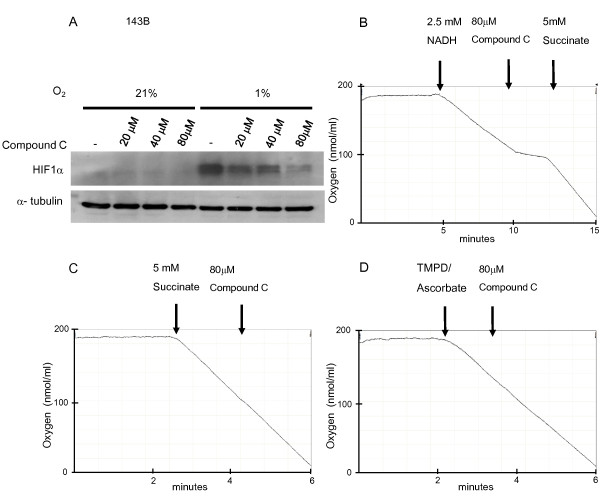
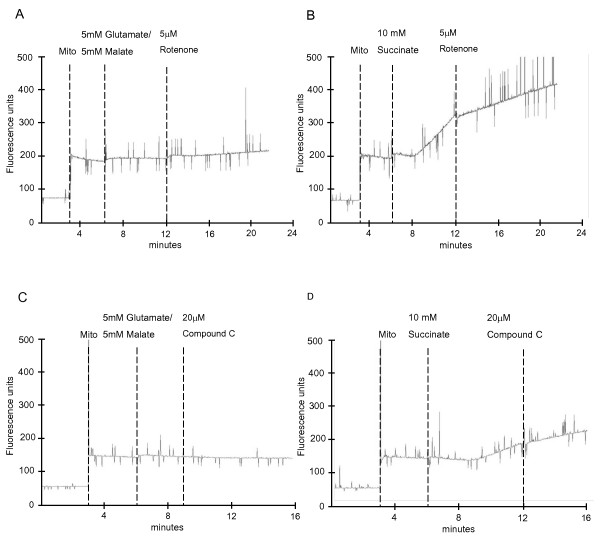
The transcription factor Hypoxia-Inducible Factor-1α is a master regulator of the cellular response to low oxygen concentration. Compound C, an inhibitor of AMP-activated kinase, has been reported to inhibit hypoxia dependent Hypoxia-Inducible Factor-1α activation via a mechanism that is independent of AMP-activated kinase but dependent on its interaction with the mitochondrial electron transport chain. The objective of this study is to characterize the interaction of Compound C with the mitochondrial electron transport chain and to determine the mechanism through which the drug influences the stability of the Hypoxia-Inducible Factor-1α protein.We found that Compound C functions as an inhibitor of complex I of the mitochondrial electron transport chain as demonstrated by its effect on mitochondrial respiration. It also prevents hypoxia-induced Hypoxia-Inducible Factor-1α stabilization in a dose dependent manner. In addition, Compound C does not have significant effects on reactive oxygen species production from complex I via both forward and reverse electron flux.This study provides evidence that similar to other mitochondrial electron transport chain inhibitors, Compound C regulates Hypoxia-Inducible Factor-1α stability by controlling the cellular oxygen concentration.
转录因子缺氧诱导因子-1α是细胞对低氧浓度反应的主要调节因子。化合物C是一种AMP激活激酶的抑制剂,据报道它通过一种独立于AMP激活激酶但依赖于其与线粒体电子传递链相互作用的机制来抑制缺氧依赖性缺氧诱导因子-1α的激活。本研究的目的是表征化合物C与线粒体电子传递链的相互作用,并确定该药物影响缺氧诱导因子-1α蛋白稳定性的机制。我们发现,化合物C作为线粒体电子传递链复合体I的抑制剂发挥作用,这一点通过其对线粒体呼吸的影响得到了证明。它还以剂量依赖的方式阻止缺氧诱导的缺氧诱导因子-1α的稳定。此外,化合物C对通过正向和反向电子通量从复合体I产生的活性氧没有显著影响。这项研究提供了证据,表明与其他线粒体电子传递链抑制剂类似,化合物C通过控制细胞氧浓度来调节缺氧诱导因子-1α的稳定性。