Kaltsas Aris, Zikopoulos Athanasios, Dimitriadis Fotios, Sheshi Danja, Politis Magdalena, Moustakli Efthalia, Symeonidis Evangelos N, Chrisofos Michael, Sofikitis Nikolaos, Zachariou Athanasios
Third Department of Urology, Attikon University Hospital, School of Medicine, National and Kapodistrian University of Athens, 12462 Athens, Greece.
Department of Obstetrics and Gynecology, Royal Cornwall Hospital, Truro TR1 3LJ, UK.
Curr Issues Mol Biol. 2024 Aug 14;46(8):8807-8834. doi: 10.3390/cimb46080521.
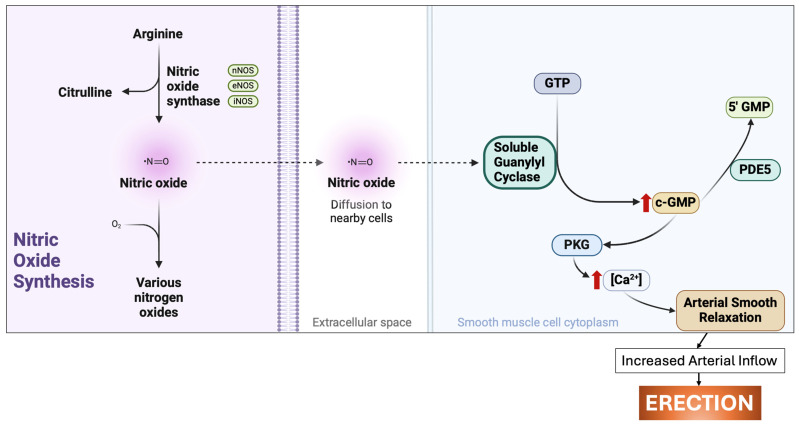
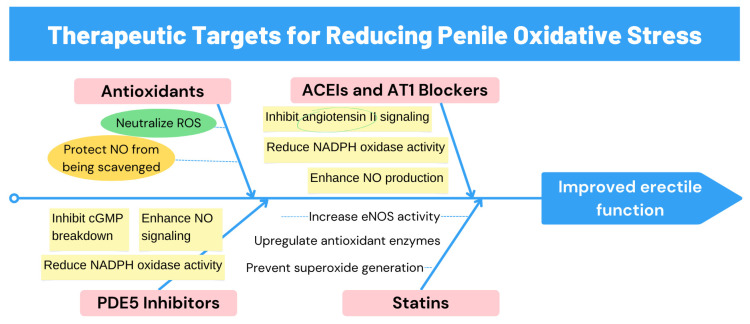
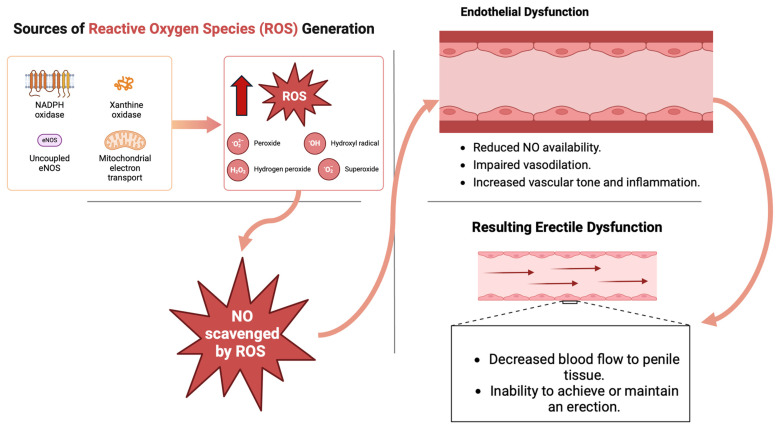
Erectile dysfunction (ED) is a prevalent condition affecting men's sexual health, with oxidative stress (OS) having recently been identified as a significant contributing causative factor. This narrative review aims to elucidate the role of OS in the pathophysiology of ED, focusing on impact, mechanisms, and potential therapeutic interventions. Key findings indicate that OS disrupts endothelial function and nitric oxide (NO) signaling, crucial for erectile function. Various sources of reactive oxygen species (ROS) and their detrimental effects on penile tissue are discussed, including aging, diabetes mellitus, hypertension, hyperlipidemia, smoking, obesity, alcohol consumption, psychological stress, hyperhomocysteinemia, chronic kidney disease, and sickle cell disease. Major sources of ROS, such as NADPH oxidase, xanthine oxidase, uncoupled endothelial NO synthase (eNOS), and mitochondrial electron transport, are identified. NO is scavenged by these ROS, leading to endothelial dysfunction characterized by reduced NO availability, impaired vasodilation, increased vascular tone, and inflammation. This ultimately results in ED due to decreased blood flow to penile tissue and the inability to achieve or maintain an erection. Furthermore, ROS impact the transmission of nitrergic neurotransmitters by causing the death of nitrergic neurons and reducing the signaling of neuronal NO synthase (nNOS), exacerbating ED. Therapeutic approaches targeting OS, including antioxidants and lifestyle modifications, show promise in ameliorating ED symptoms. The review underscores the need for further research to develop effective treatments, emphasizing the interplay between OS and vascular health in ED. Integrating pharmacological and non-pharmacological strategies could enhance clinical outcomes for ED patients, advocating for OS management in ED treatment protocols to improve patient quality of life.
勃起功能障碍(ED)是一种影响男性性健康的常见病症,氧化应激(OS)最近被确定为一个重要的致病因素。本叙述性综述旨在阐明OS在ED病理生理学中的作用,重点关注其影响、机制和潜在的治疗干预措施。主要研究结果表明,OS会破坏对勃起功能至关重要的内皮功能和一氧化氮(NO)信号传导。文中讨论了活性氧(ROS)的各种来源及其对阴茎组织的有害影响,包括衰老、糖尿病、高血压、高脂血症、吸烟、肥胖、饮酒、心理压力、高同型半胱氨酸血症、慢性肾病和镰状细胞病。确定了ROS的主要来源,如NADPH氧化酶、黄嘌呤氧化酶、解偶联内皮型一氧化氮合酶(eNOS)和线粒体电子传递。这些ROS会清除NO,导致内皮功能障碍,其特征是NO可用性降低、血管舒张受损、血管张力增加和炎症。这最终会导致ED,原因是阴茎组织血流量减少以及无法勃起或维持勃起状态。此外,ROS通过导致含氮能神经元死亡和减少神经元型一氧化氮合酶(nNOS)的信号传导来影响含氮能神经递质的传递,从而加剧ED。针对OS的治疗方法,包括抗氧化剂和生活方式改变,在改善ED症状方面显示出前景。该综述强调需要进一步研究以开发有效的治疗方法,强调OS与ED中血管健康之间的相互作用。整合药物和非药物策略可以提高ED患者的临床疗效,倡导在ED治疗方案中管理OS以改善患者生活质量。