De Robertis Mariangela, Massi Emanuela, Poeta Maria Luana, Carotti Simone, Morini Sergio, Cecchetelli Loredana, Signori Emanuela, Fazio Vito Michele
Laboratory of Molecular Medicine and Biotechnology, CIR, Campus Bio-Medico University of Rome, Via Álvaro del Portillo 21 - 00128 Rome, Italy.
J Carcinog. 2011 Mar 24;10:9. doi: 10.4103/1477-3163.78279.
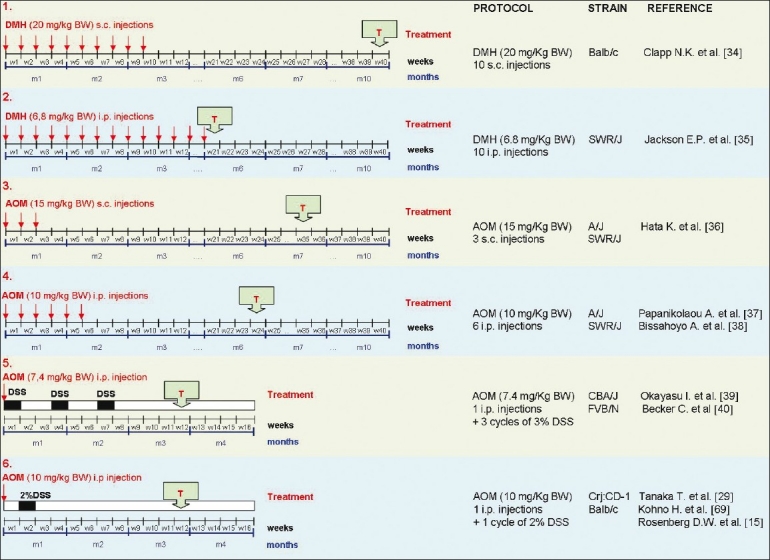
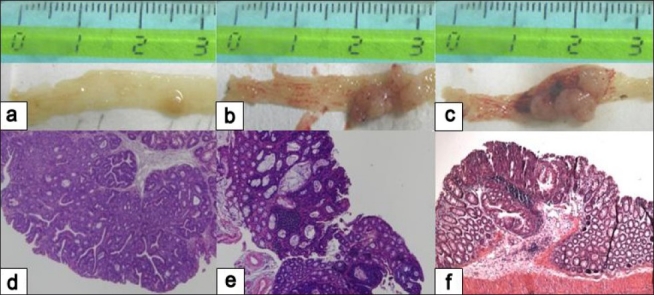
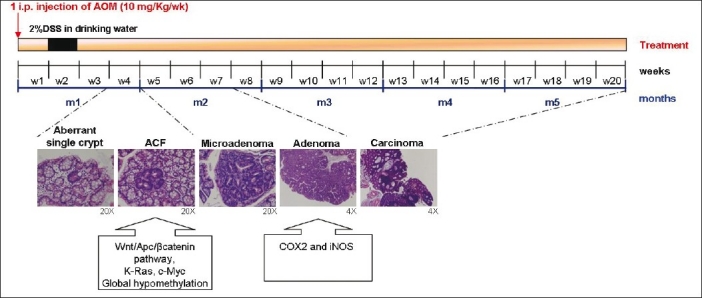
Colorectal cancer (CRC) is a major health problem in industrialized countries. Although inflammation-linked carcinogenesis is a well accepted concept and is often observed within the gastrointestinal tract, the underlying mechanisms remain to be elucidated. Inflammation can indeed provide initiating and promoting stimuli and mediators, generating a tumour-prone microenvironment. Many murine models of sporadic and inflammation-related colon carcinogenesis have been developed in the last decade, including chemically induced CRC models, genetically engineered mouse models, and xenoplants. Among the chemically induced CRC models, the combination of a single hit of azoxymethane (AOM) with 1 week exposure to the inflammatory agent dextran sodium sulphate (DSS) in rodents has proven to dramatically shorten the latency time for induction of CRC and to rapidly recapitulate the aberrant crypt foci-adenoma-carcinoma sequence that occurs in human CRC. Because of its high reproducibility and potency, as well as the simple and affordable mode of application, the AOM/DSS has become an outstanding model for studying colon carcinogenesis and a powerful platform for chemopreventive intervention studies. In this article we highlight the histopathological and molecular features and describe the principal genetic and epigenetic alterations and inflammatory pathways involved in carcinogenesis in AOM/DSS-treated mice; we also present a general overview of recent experimental applications and preclinical testing of novel therapeutics in the AOM/DSS model.
结直肠癌(CRC)在工业化国家是一个重大的健康问题。尽管炎症相关致癌作用是一个被广泛接受的概念,且在胃肠道中经常可见,但其潜在机制仍有待阐明。炎症确实可以提供引发和促进肿瘤的刺激因素及介质,从而产生易于发生肿瘤的微环境。在过去十年中,已经建立了许多散发性和炎症相关的结肠癌发生的小鼠模型,包括化学诱导的CRC模型、基因工程小鼠模型和异种移植模型。在化学诱导的CRC模型中,啮齿动物单次注射氧化偶氮甲烷(AOM)并暴露于炎症因子葡聚糖硫酸钠(DSS)1周的联合处理已被证明可显著缩短CRC诱导的潜伏期,并迅速重现人类CRC中出现的异常隐窝灶-腺瘤-癌序列。由于其高重现性和有效性,以及简单且经济的应用方式,AOM/DSS已成为研究结肠癌发生的优秀模型和化学预防干预研究的强大平台。在本文中,我们重点介绍了组织病理学和分子特征,并描述了AOM/DSS处理小鼠致癌过程中涉及的主要遗传和表观遗传改变以及炎症途径;我们还概述了AOM/DSS模型中新型疗法的近期实验应用和临床前测试情况。