Immunisation, Hepatitis and Blood Safety Department, Health Protection Agency, London, United Kingdom.
PLoS Med. 2011 Apr;8(4):e1001017. doi: 10.1371/journal.pmed.1001017. Epub 2011 Apr 5.
We investigated the effect of the 7-valent pneumococcal conjugate vaccine (PCV7) programme in England on serotype-specific carriage and invasive disease to help understand its role in serotype replacement and predict the impact of higher valency vaccines.
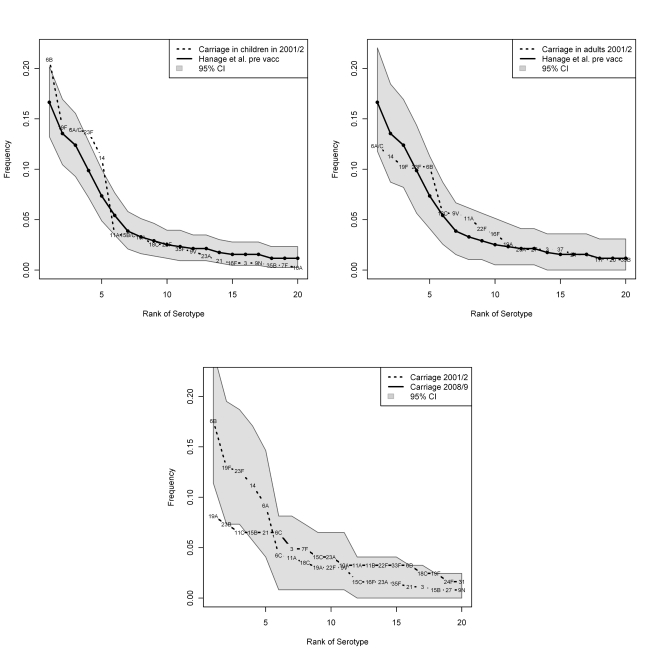
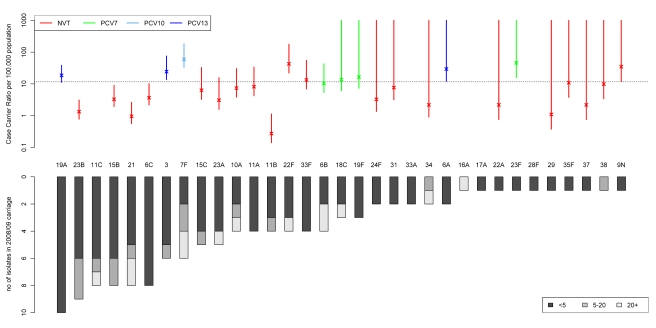
Nasopharyngeal swabs were taken from children <5 y old and family members (n=400) 2 y after introduction of PCV7 into routine immunization programs. Proportions carrying Streptococcus pneumoniae and serotype distribution among carried isolates were compared with a similar population prior to PCV7 introduction. Serotype-specific case carrier ratios (CCRs) were estimated using national data on invasive disease. In vaccinated children and their contacts vaccine-type (VT) carriage decreased, but was offset by an increase in non-VT carriage, with no significant overall change in carriage prevalence, odds ratio 1.06 (95% confidence interval 0.76-1.49). The lower CCRs of the replacing serotypes resulted in a net reduction in invasive disease in children. The additional serotypes covered by higher valency vaccines had low carriage but high disease prevalence. Serotype 11C emerged as predominant in carriage but caused no invasive disease whereas 8, 12F, and 22F emerged in disease but had very low carriage prevalence.
Because the additional serotypes included in PCV10/13 have high CCRs but low carriage prevalence, vaccinating against them is likely to significantly reduce invasive disease with less risk of serotype replacement. However, a few serotypes with high CCRs could mitigate the benefits of higher valency vaccines. Assessment of the effect of PCV on carriage as well as invasive disease should be part of enhanced surveillance activities for PCVs. Please see later in the article for the Editors' Summary.
我们研究了 7 价肺炎球菌结合疫苗(PCV7)计划在英格兰对血清型特异性传播和侵袭性疾病的影响,以帮助了解其在血清型替代中的作用,并预测更高价疫苗的影响。
在 PCV7 纳入常规免疫计划后,我们从 <5 岁的儿童及其家庭成员(n=400)中采集鼻咽拭子。与 PCV7 引入前的类似人群相比,比较了携带肺炎链球菌的比例和携带分离株的血清型分布。使用国家侵袭性疾病数据估计了血清型特异性病例携带者比值(CCR)。在接种疫苗的儿童及其接触者中,疫苗型(VT)携带减少,但非 VT 携带增加,携带率无显著总体变化,比值比为 1.06(95%置信区间 0.76-1.49)。替代血清型的较低 CCR 导致儿童侵袭性疾病的净减少。更高价疫苗涵盖的其他血清型携带率较低,但疾病患病率较高。血清型 11C 在传播中占主导地位,但未引起侵袭性疾病,而 8、12F 和 22F 在疾病中出现,但携带率极低。
由于 PCV10/13 中包含的额外血清型具有较高的 CCR 但携带率较低,接种疫苗可能会显著降低侵袭性疾病的发病率,而血清型替代的风险较小。然而,一些具有高 CCR 的血清型可能会减轻高价疫苗的益处。对 PCV 对传播和侵袭性疾病的影响的评估应作为 PCV 强化监测活动的一部分。请在文章后面查看编辑摘要。