Department of Immunology and Infectious Diseases, Harvard School of Public Health, Boston, Massachusetts, USA.
Clin Infect Dis. 2010 Sep 15;51(6):692-9. doi: 10.1086/655828.
The 92 capsular serotypes of Streptococcus pneumoniae differ greatly in nasopharyngeal carriage prevalence, invasiveness, and disease incidence. There has been some debate, though, regarding whether serotype independently affects the outcome of invasive pneumococcal disease (IPD). Published studies have shown variable results with regard to case-fatality ratios for specific serotypes and the role of host factors in affecting these relationships. We evaluated whether risk of death due to IPD is a stable serotype-associated property across studies and then compared the pooled effect estimates with epidemiologic and biological correlates.
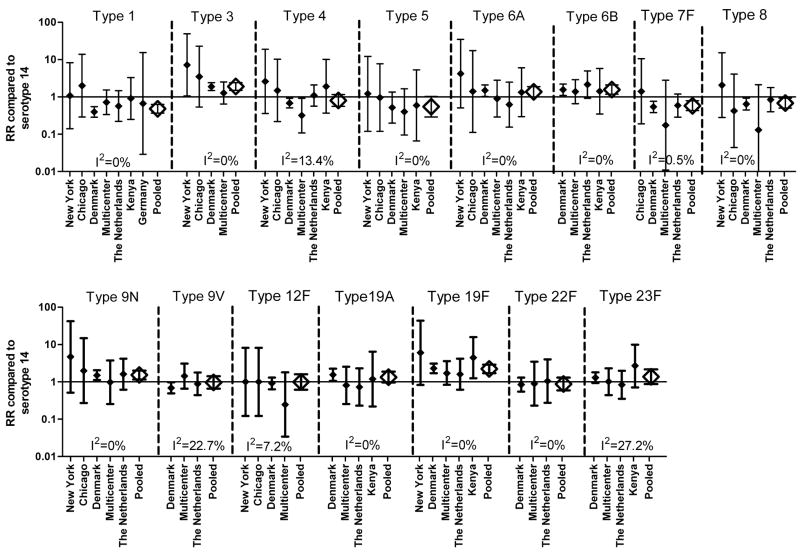
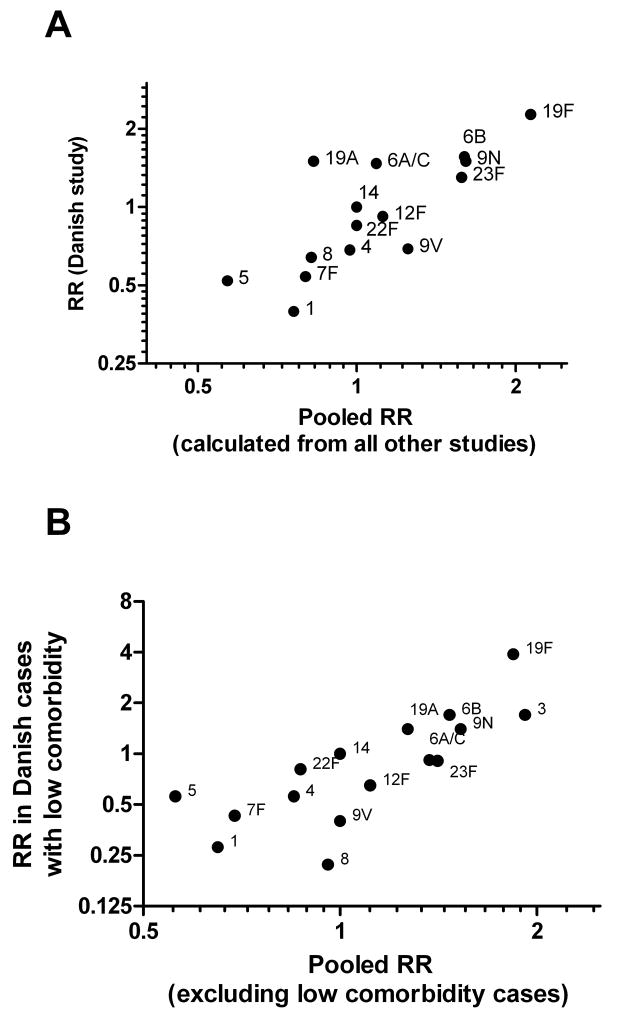
We performed a systematic review and meta-analysis of serotype-specific disease outcomes for patients with pneumonia and meningitis. Study-specific estimates of risk of death (risk ratio [RR]) were pooled from 9 studies that provided serotype-specific data on pneumonia and meningitis using a random-effects method with serotype 14 as the reference. Pooled RRs were compared with RRs from adults with low comorbidity scores to evaluate potential confounding by host factors.
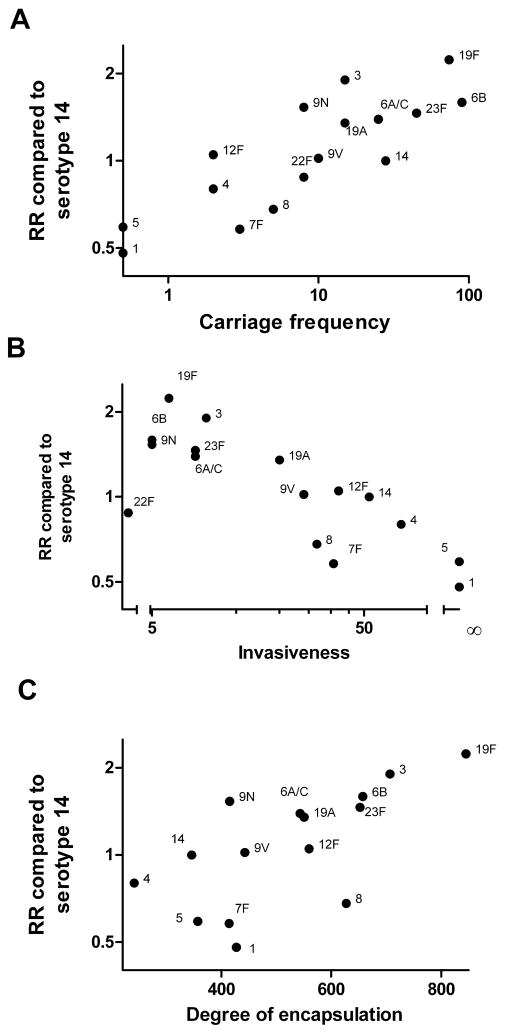
Significant differences were found in the RR estimates among serotypes in patients with bacteremic pneumonia. Overall, serotypes 1, 7F, and 8 were associated with decreased RRs, and serotypes 3, 6A, 6B, 9N, and 19F were associated with increased RRs. Outcomes among meningitis patients did not differ significantly among serotypes. Serotypes with increased RRs had a high carriage prevalence, had low invasiveness, and were more heavily encapsulated in vitro.
These results suggest that IPD outcome, like other epidemiologic measures, is a stable serotype-associated property.
肺炎链球菌的 92 种荚膜血清型在鼻咽携带率、侵袭性和疾病发病率方面差异很大。然而,关于血清型是否独立影响侵袭性肺炎球菌病(IPD)的结果存在一些争议。已发表的研究表明,特定血清型的病死率比和宿主因素在影响这些关系方面的作用存在差异。我们评估了由于 IPD 导致死亡的风险是否是一个跨研究稳定的血清型相关特性,然后将汇总的效应估计值与流行病学和生物学相关性进行了比较。
我们对肺炎和脑膜炎患者的特定血清型疾病结果进行了系统评价和荟萃分析。使用随机效应方法,对提供了肺炎和脑膜炎的特定血清型数据的 9 项研究,将以血清型 14 为参照的死亡风险(风险比 [RR])的研究特定估计值进行了汇总。将汇总的 RR 与低合并症评分的成年人的 RR 进行了比较,以评估宿主因素潜在的混杂作用。
在细菌性肺炎患者中,各血清型的 RR 估计值存在显著差异。总体而言,血清型 1、7F 和 8 与 RR 降低相关,而血清型 3、6A、6B、9N 和 19F 与 RR 升高相关。脑膜炎患者的结局在各血清型之间无显著差异。RR 升高的血清型具有较高的携带率、侵袭性低,并且在体外更具囊泡性。
这些结果表明,IPD 结局与其他流行病学指标一样,是一个稳定的血清型相关特性。