Division of Biology, Computation and Neural Systems, California Institute of Technology, Pasadena, California, United States of America.
PLoS One. 2011 Apr 4;6(4):e18224. doi: 10.1371/journal.pone.0018224.
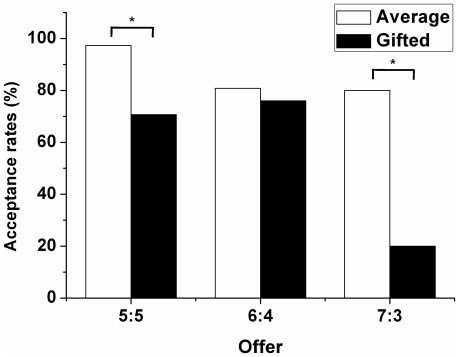
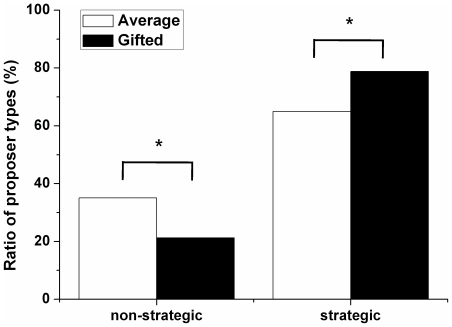
Many mathematically gifted adolescents are characterized as being indolent, underachieving and unsuccessful despite their high cognitive ability. This is often due to difficulties with social and emotional development. However, research on social and emotional interactions in gifted adolescents has been limited. The purpose of this study was to observe differences in complex social strategic behaviors between gifted and average adolescents of the same age using the repeated Ultimatum Game. Twenty-two gifted adolescents and 24 average adolescents participated in the Ultimatum Game. Two adolescents participate in the game, one as a proposer and the other as a responder. Because of its simplicity, the Ultimatum Game is an apt tool for investigating complex human emotional and cognitive decision-making in an empirical setting. We observed strategic but socially impaired offers from gifted proposers and lower acceptance rates from gifted responders, resulting in lower total earnings in the Ultimatum Game. Thus, our results indicate that mathematically gifted adolescents have deficiencies in social valuation and mentalization.
许多在数学方面有天赋的青少年被认为是懒惰、成绩不佳和不成功的,尽管他们的认知能力很高。这往往是由于社会和情感发展的困难。然而,对天才青少年社会和情感互动的研究一直很有限。本研究的目的是使用重复的最后通牒游戏观察相同年龄的天才青少年和普通青少年在复杂社会策略行为上的差异。22 名天才青少年和 24 名普通青少年参加了最后通牒游戏。两名青少年参与游戏,一名是提议者,另一名是回应者。由于其简单性,最后通牒游戏是一种合适的工具,可以在实证环境中研究复杂的人类情感和认知决策。我们观察到天才提议者提出的策略性但社交受损的提议,以及天才回应者较低的接受率,导致最后通牒游戏的总收益降低。因此,我们的结果表明,数学天才青少年在社会评估和心理化方面存在缺陷。