Laboratori de Patologia Mitocondrial, Institut de Recerca Hospital Universitari Vall d'Hebron, Universitat Autònoma de Barcelona, Barcelona, Spain.
PLoS Genet. 2011 Mar;7(3):e1002035. doi: 10.1371/journal.pgen.1002035. Epub 2011 Mar 31.
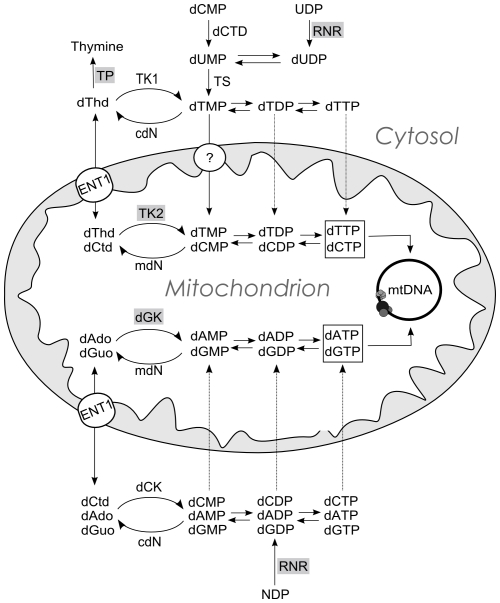
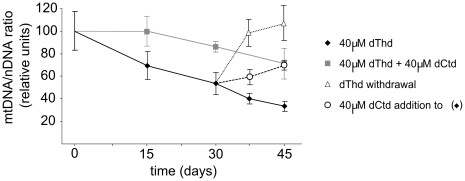
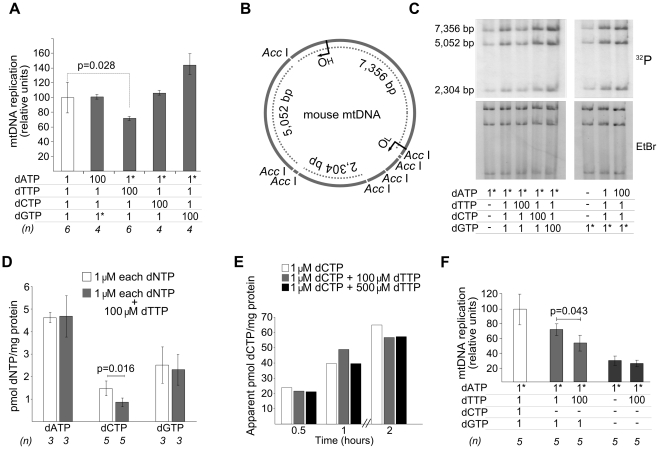
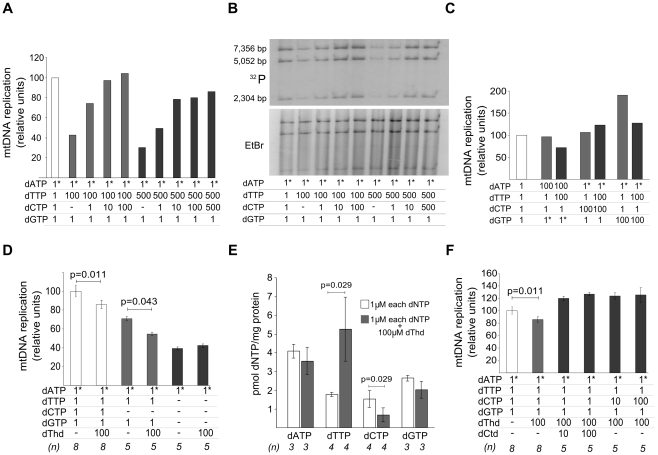
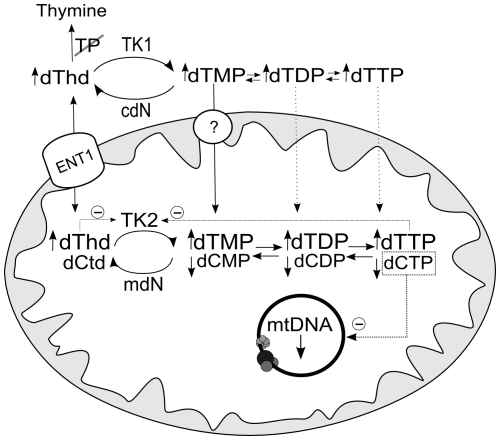
Mitochondrial neurogastrointestinal encephalomyopathy (MNGIE) is a severe human disease caused by mutations in TYMP, the gene encoding thymidine phosphorylase (TP). It belongs to a broader group of disorders characterized by a pronounced reduction in mitochondrial DNA (mtDNA) copy number in one or more tissues. In most cases, these disorders are caused by mutations in genes involved in deoxyribonucleoside triphosphate (dNTP) metabolism. It is generally accepted that imbalances in mitochondrial dNTP pools resulting from these mutations interfere with mtDNA replication. Nonetheless, the precise mechanistic details of this effect, in particular, how an excess of a given dNTP (e.g., imbalanced dTTP excess observed in TP deficiency) might lead to mtDNA depletion, remain largely unclear. Using an in organello replication experimental model with isolated murine liver mitochondria, we observed that overloads of dATP, dGTP, or dCTP did not reduce the mtDNA replication rate. In contrast, an excess of dTTP decreased mtDNA synthesis, but this effect was due to secondary dCTP depletion rather than to the dTTP excess in itself. This was confirmed in human cultured cells, demonstrating that our conclusions do not depend on the experimental model. Our results demonstrate that the mtDNA replication rate is unaffected by an excess of any of the 4 separate dNTPs and is limited by the availability of the dNTP present at the lowest concentration. Therefore, the availability of dNTP is the key factor that leads to mtDNA depletion rather than dNTP imbalances. These results provide the first test of the mechanism that accounts for mtDNA depletion in MNGIE and provide evidence that limited dNTP availability is the common cause of mtDNA depletion due to impaired anabolic or catabolic dNTP pathways. Thus, therapy approaches focusing on restoring the deficient substrates should be explored.
线粒体神经胃肠型脑肌病(MNGIE)是一种由 TYMP 基因突变引起的严重人类疾病,该基因编码胸苷磷酸化酶(TP)。它属于一组更广泛的疾病,其特征是一个或多个组织中线粒体 DNA(mtDNA)拷贝数明显减少。在大多数情况下,这些疾病是由参与脱氧核苷三磷酸(dNTP)代谢的基因突变引起的。人们普遍认为,这些突变导致线粒体 dNTP 池失衡,从而干扰 mtDNA 复制。尽管如此,这种影响的确切机制细节,特别是过量的特定 dNTP(例如,TP 缺乏症中观察到的不平衡 dTTP 过剩)如何导致 mtDNA 耗竭,在很大程度上仍不清楚。我们使用分离的鼠肝线粒体的体外复制实验模型观察到,dATP、dGTP 或 dCTP 的过载不会降低 mtDNA 复制速率。相比之下,dTTP 过剩会降低 mtDNA 合成,但这种效应是由于 dCTP 继发性耗竭而不是 dTTP 过剩本身所致。在人类培养细胞中得到了证实,证明我们的结论不依赖于实验模型。我们的结果表明,mtDNA 复制速率不受任何 4 种单独的 dNTP 过量的影响,并且受到最低浓度的 dNTP 可用性的限制。因此,dNTP 的可用性是导致 mtDNA 耗竭的关键因素,而不是 dNTP 失衡。这些结果首次检验了导致 MNGIE 中 mtDNA 耗竭的机制,并提供了证据,表明有限的 dNTP 可用性是由于受损的合成代谢或分解代谢 dNTP 途径导致 mtDNA 耗竭的共同原因。因此,应探索专注于恢复缺陷底物的治疗方法。