Research Institute for Medicines and Pharmaceutical Sciences (iMed.UL), Faculty of Pharmacy, University of Lisbon, Lisbon, Portugal.
PLoS One. 2011 Mar 31;6(3):e18421. doi: 10.1371/journal.pone.0018421.
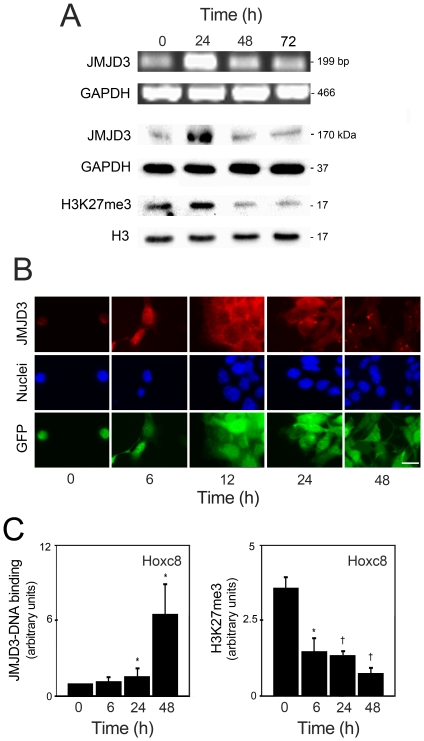
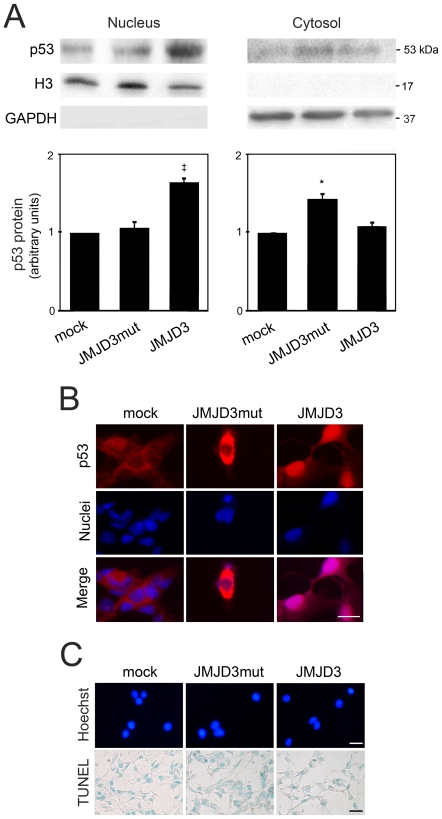
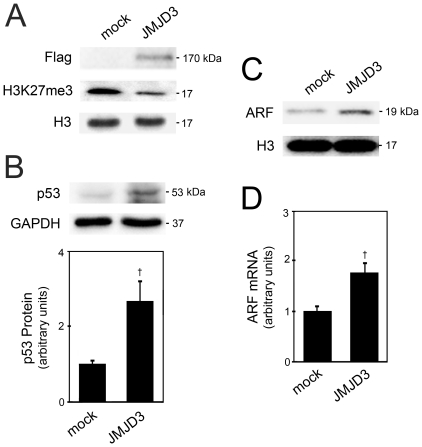
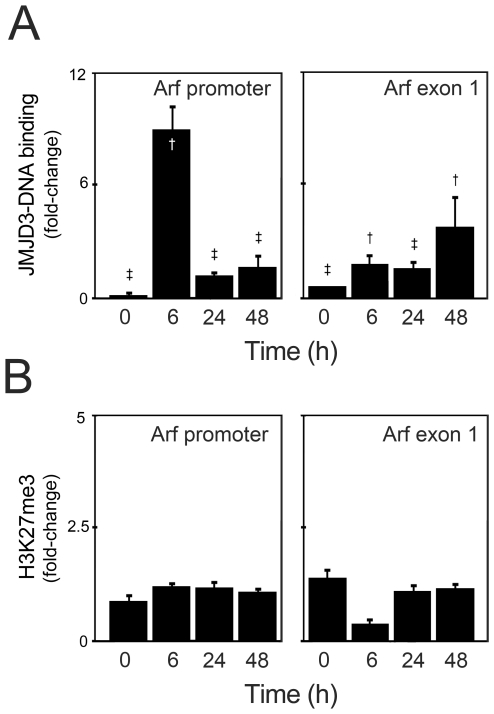
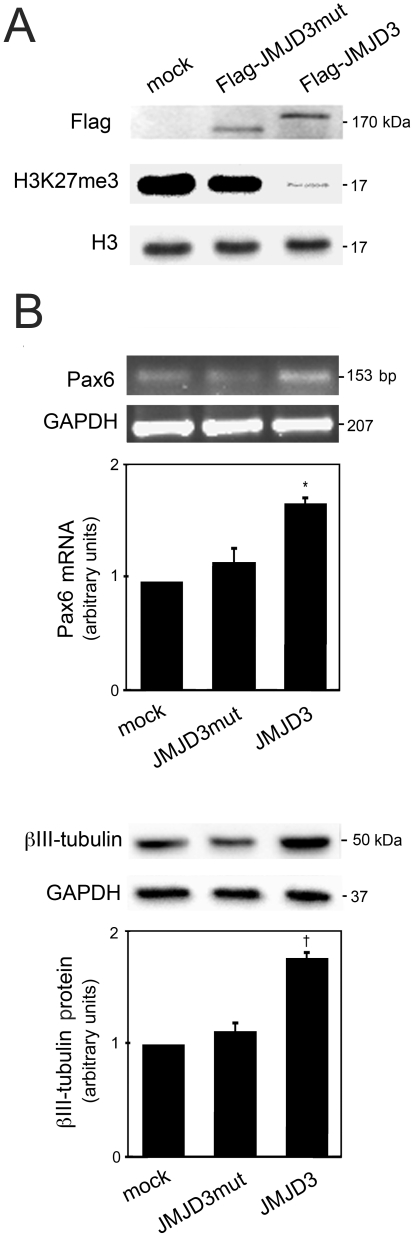
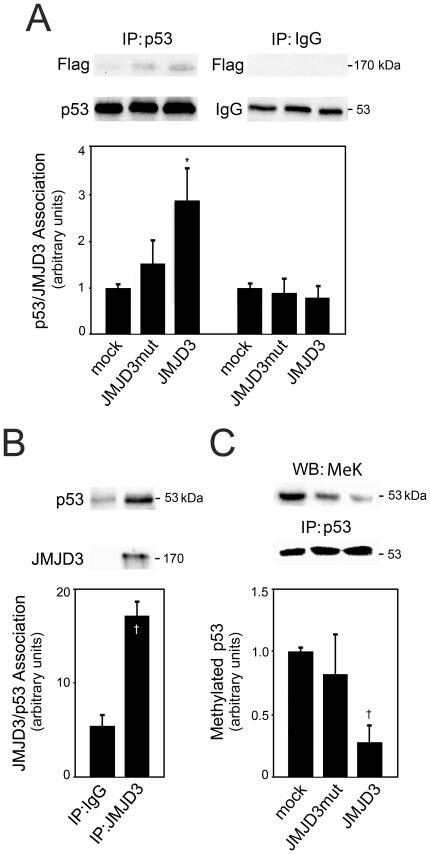
Conserved elements of apoptosis are also integral components of cellular differentiation. In this regard, p53 is involved in neurogenesis, being required for neurite outgrowth in primary neurons and for axonal regeneration in mice. Interestingly, demethylases regulate p53 activity and its interaction with co-activators by acting on non-histone proteins. In addition, the histone H3 lysine 27-specific demethylase JMJD3 induces ARF expression, thereby stabilizing p53 in mouse embryonic fibroblasts. We hypothesized that p53 interacts with key regulators of neurogenesis to redirect stem cells to differentiation, as an alternative to cell death. Specifically, we investigated the potential cross-talk between p53 and JMJD3 during mouse neural stem cell (NSC) differentiation. Our results demonstrated that JMJD3 mRNA and protein levels were increased early in mouse NSC differentiation, when JMJD3 activity was readily detected. Importantly, modulation of JMJD3 in NSCs resulted in changes of total p53 protein, coincident with increased ARF mRNA and protein expression. ChIP analysis revealed that JMJD3 was present at the promoter and exon 1 regions of ARF during neural differentiation, although without changes in H3K27me3. Immunoprecipitation assays demonstrated a direct interaction between p53 and JMJD3, independent of the C-terminal region of JMJD3, and modulation of p53 methylation by JMJD3-demethylase activity. Finally, transfection of mutant JMJD3 showed that the demethylase activity of JMJD3 was crucial in regulating p53 cellular distribution and function. In conclusion, JMJD3 induces p53 stabilization in mouse NSCs through ARF-dependent mechanisms, directly interacts with p53 and, importantly, causes nuclear accumulation of p53. This suggests that JMJD3 and p53 act in a common pathway during neurogenesis.
凋亡的保守元件也是细胞分化的组成部分。在这方面,p53 参与神经发生,是原代神经元中神经突生长和小鼠轴突再生所必需的。有趣的是,去甲基酶通过作用于非组蛋白蛋白来调节 p53 的活性及其与共激活因子的相互作用。此外,组蛋白 H3 赖氨酸 27 特异性去甲基酶 JMJD3 诱导 ARF 的表达,从而稳定小鼠胚胎成纤维细胞中的 p53。我们假设 p53 与神经发生的关键调节剂相互作用,将干细胞重定向分化,作为细胞死亡的替代途径。具体而言,我们研究了 p53 和 JMJD3 在小鼠神经干细胞 (NSC) 分化过程中的潜在串扰。我们的结果表明,JMJD3 的 mRNA 和蛋白水平在小鼠 NSC 分化早期增加,此时很容易检测到 JMJD3 活性。重要的是,在 NSCs 中调节 JMJD3 会导致总 p53 蛋白发生变化,同时 ARF mRNA 和蛋白表达增加。ChIP 分析显示,JMJD3 在神经分化过程中存在于 ARF 的启动子和外显子 1 区域,尽管 H3K27me3 没有变化。免疫沉淀分析表明,p53 和 JMJD3 之间存在直接相互作用,与 JMJD3 的 C 端区域无关,并且 JMJD3-去甲基酶活性调节 p53 甲基化。最后,转染突变 JMJD3 表明,JMJD3 的去甲基酶活性对于调节 p53 的细胞分布和功能至关重要。总之,JMJD3 通过 ARF 依赖性机制诱导小鼠 NSCs 中 p53 的稳定,与 p53 直接相互作用,并且重要的是,导致 p53 的核积累。这表明 JMJD3 和 p53 在神经发生过程中起共同作用。