Yoon Sorah, Wu Xiwei, Armstrong Brian, Habib Nagy, Rossi John J
Department of Molecular and Cellular Biology, Beckman Research Institute of City of Hope, Duarte, CA 91010, USA.
Integrative Genomic Core, City of Hope, Duarte, CA 91010, USA.
Mol Ther Nucleic Acids. 2019 Mar 1;14:131-141. doi: 10.1016/j.omtn.2018.11.012. Epub 2018 Dec 1.
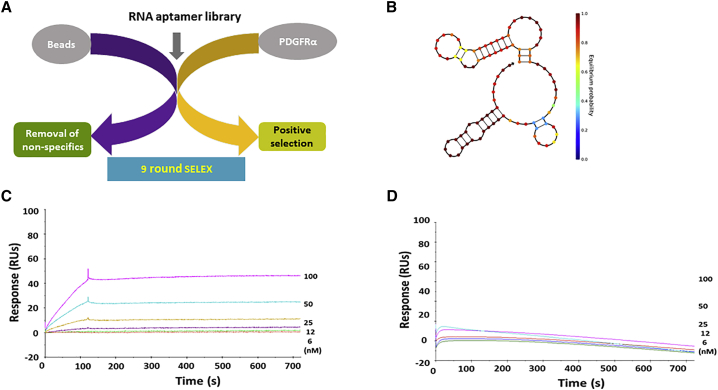
Human glioblastoma (GBM) is the most aggressive malignancy of the CNS, with less than 5% survival. Despite great efforts to find effective therapeutics, current options remain very limited. To develop a targeted cancer therapeutic, we selected RNA aptamers against platelet-derived growth factor receptor α (PDGFRα), which is a receptor tyrosine kinase. One RNA aptamer (PDR3) with high affinity (0.25 nM) showed PDGFRα specificity and was internalized in U251-MG cells. Following treatment with the PDR3 aptamer, expression of the transcription factor STAT3 (signal transducer and activator of transcription 3) was inhibited, whereas the expression of the histone demethylase JMJD3 and the tumor suppressor p53 were upregulated. PDR3 also upregulated serine phosphorylation of p53, which subsequently mediated apoptosis through the death receptors: tumor necrosis factor (TNF)-related apoptosis-inducing ligand receptors 1/2 (TRAIL-R1/R2), Fas-associated via death domain (FADD), and Fas. PDR3 significantly decreased cell viability in a dose-dependent manner. Furthermore, translocation of PDR3 into the nucleus induced hypomethylation at the promoters of cyclin D2. To assess the feasibility of targeted delivery, we conjugated PDR3 aptamer with STAT3-siRNA for a chimera. The PDR3-siSTAT3 chimera successfully inhibited the expression of target genes and showed significant inhibition of cell viability. In summary, our results show that well-tailored RNA aptamers targeting the PDGFRα-STAT3 axis have the potential to act as anti-cancer therapeutics in GBM.
人类胶质母细胞瘤(GBM)是中枢神经系统中最具侵袭性的恶性肿瘤,生存率不足5%。尽管人们付出了巨大努力寻找有效的治疗方法,但目前的选择仍然非常有限。为了开发一种靶向癌症治疗药物,我们选择了针对血小板衍生生长因子受体α(PDGFRα)的RNA适配体,它是一种受体酪氨酸激酶。一种具有高亲和力(0.25 nM)的RNA适配体(PDR3)表现出对PDGFRα的特异性,并被内化到U251-MG细胞中。用PDR3适配体处理后,转录因子信号转导和转录激活因子3(STAT3)的表达受到抑制,而组蛋白去甲基化酶JMJD3和肿瘤抑制因子p53的表达上调。PDR3还上调了p53的丝氨酸磷酸化,随后通过死亡受体介导细胞凋亡:肿瘤坏死因子(TNF)相关凋亡诱导配体受体1/2(TRAIL-R1/R2)、通过死亡结构域相关的Fas(FADD)和Fas。PDR3以剂量依赖性方式显著降低细胞活力。此外,PDR3易位到细胞核中诱导细胞周期蛋白D2启动子处的低甲基化。为了评估靶向递送的可行性,我们将PDR3适配体与STAT3-siRNA偶联形成嵌合体。PDR3-siSTAT3嵌合体成功抑制了靶基因的表达,并显著抑制了细胞活力。总之,我们的结果表明,精心设计的靶向PDGFRα-STAT3轴的RNA适配体有潜力作为GBM的抗癌治疗药物。