Vanderbilt Kennedy Center for Research on Human Development, Vanderbilt University, 230 Appleton Place, Peabody Box 74, Nashville, TN, 37203, USA,
J Neurodev Disord. 2011 Mar;3(1):28-38. doi: 10.1007/s11689-010-9064-1. Epub 2010 Oct 7.
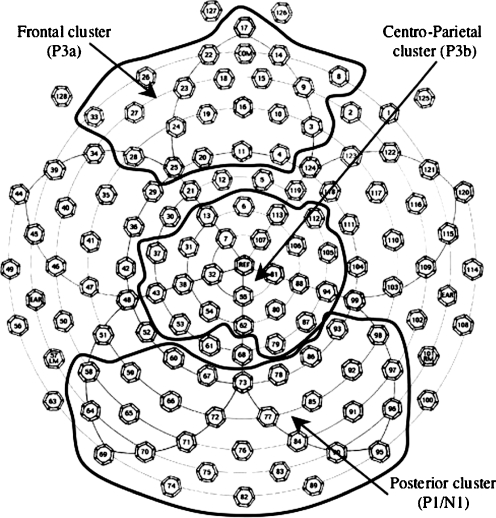
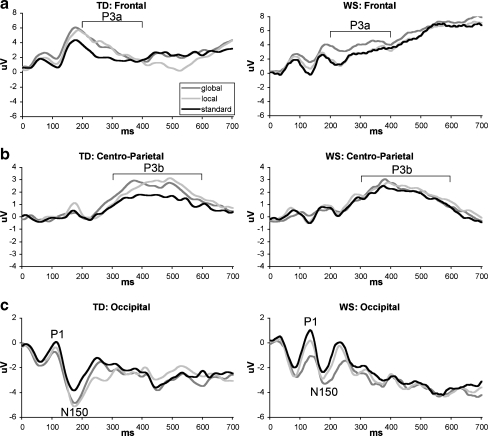
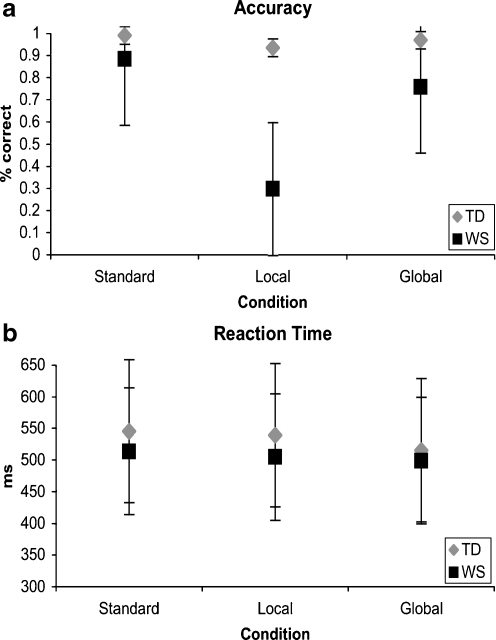
Persons with Williams syndrome (WS) demonstrate pronounced deficits in visuo-spatial processing. The purpose of the current study was to examine the preferred level of perceptual analysis in young adults with WS (n = 21) and the role of attention in the processing of hierarchical stimuli. Navon-like letter stimuli were presented to adults with WS and age-matched typical controls in an oddball paradigm where local and global targets could appear with equal probability. Participants received no explicit instruction to direct their attention toward a particular stimulus level. Behavioral and event-related potential (ERP) data were recorded. Behavioral data indicated presence of a global precedence effect in persons with WS. However, their ERP responses revealed atypical brain mechanisms underlying attention to local information. During the early perceptual analysis, global targets resulted in reduced P1 and enhanced N150 responses in both participant groups. However, only the typical comparison group demonstrated a larger N150 to local targets. At the more advanced stages of cognitive processing, a larger P3b response to global and local targets was observed in the typical group but not in persons with WS, who instead demonstrated an enhanced P3a to global targets only. The results indicate that in a perceptual task, adults with WS may experience greater than typical global-to-local interference and not allocate sufficient attentional resources to local information.
威廉姆斯综合征(WS)患者在视空间加工方面表现出明显的缺陷。本研究的目的是探讨年轻 WS 患者(n=21)的知觉分析偏好水平,以及注意在处理层次刺激中的作用。在类似于纳冯的字母刺激中,以相同的概率呈现局部和全局目标,向 WS 成年患者和年龄匹配的典型对照组呈现。参与者没有被明确指示将注意力集中在特定的刺激水平上。记录了行为和事件相关电位(ERP)数据。行为数据表明,WS 患者存在全局优先效应。然而,他们的 ERP 反应揭示了注意局部信息的异常大脑机制。在早期的知觉分析中,全局目标导致两组参与者的 P1 减小和 N150 增强。然而,只有典型对照组显示出对局部目标更大的 N150。在认知加工的更高级阶段,典型组对全局和局部目标的 P3b 反应更大,但 WS 患者没有,他们对全局目标只有更大的 P3a 反应。研究结果表明,在知觉任务中,WS 成年患者可能会经历比典型的全局到局部的干扰更大,并且不会为局部信息分配足够的注意力资源。