Department of Global Biostatistics and Epidemiology, Amgen Inc, Thousand Oaks, CA, USA;
Clin Epidemiol. 2011 Mar 1;3:91-9. doi: 10.2147/CLEP.S17146.
Cancer patients receiving chemotherapy are at increased risk of anemia. We conducted a population-based historical cohort study in newly diagnosed cancer patients with chemotherapy-associated anemia in order to characterize red blood cell transfusion (RBCT) use.
This study evaluated cancer patients diagnosed between January 1, 1998 and December 31, 2003 using Danish National Patient Registry data. Patients were receiving chemotherapy and had a hemoglobin level ≤10.9 g/dL during the 4 months following cancer diagnosis. We characterized patterns of RBCT use and inpatient and outpatient hospitalization for transfusion. Adjusted Poisson regression models were used to evaluate the likelihood of RBCT, estimated by relative risk (RR), based on demographic and clinical factors.
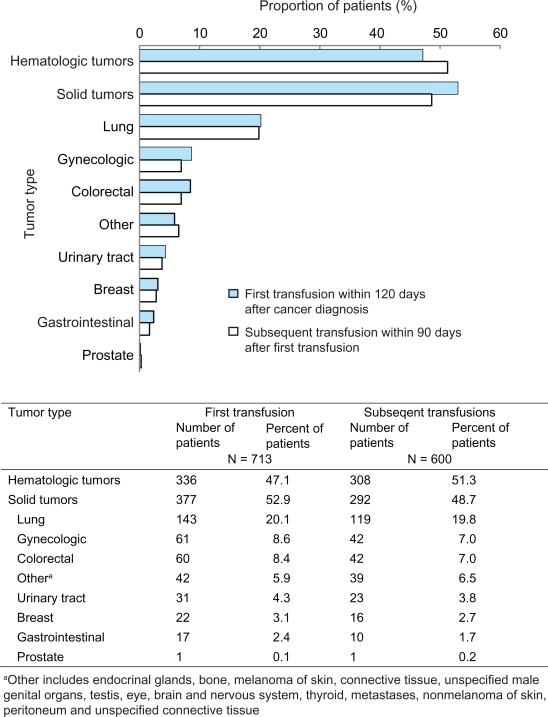
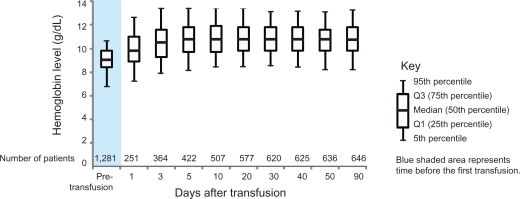
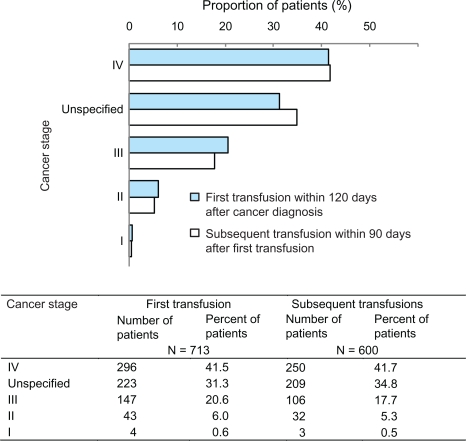
Women constituted 58% of 1782 patients studied; the median age was 58 years. Two-thirds (67%) had solid tumors; 67% had stage III or IV disease at diagnosis. Overall, 713 (40%) patients received an RBCT within 120 days of cancer diagnosis, of which 94% were administered in the inpatient setting; 84% of these patients required subsequent transfusions. The median (Q1, Q3) pretransfusion hemoglobin level was 9.0 (8.4, 9.8) g/dL. Patients aged <20 years were more likely to receive an RBCT than older patients (RR 1.89; 95% confidence interval [CI] 1.44-2.49). Compared with stage IV disease, those with stage II or III disease had a lower likelihood of RBCT (stage II: RR 0.52, 95% CI: 0.37-0.72; stage III: RR 0.68, 95% CI: 0.55-0.83). Patients diagnosed with breast cancer were less likely to receive an RBCT than patients with hematologic cancers (RR 0.34, 95% CI: 0.21-0.55).
In this study, 40% of cancer patients with chemotherapy-associated anemia in Western Denmark received an RBCT, usually in the inpatient setting; of these, most required subsequent transfusions. Younger age increased the likelihood of receiving an RBCT, and earlier stage or breast cancer decreased RBCT likelihood.
接受化疗的癌症患者贫血风险增加。我们进行了一项基于人群的历史队列研究,以描述与化疗相关的贫血的新诊断癌症患者的红细胞输注(RBCT)使用情况。
本研究使用丹麦国家患者登记处的数据评估了 1998 年 1 月 1 日至 2003 年 12 月 31 日期间诊断的癌症患者。患者正在接受化疗,并且在癌症诊断后 4 个月内血红蛋白水平≤10.9g/dL。我们描述了 RBCT 使用情况以及输血的住院和门诊住院情况。使用调整后的泊松回归模型,根据人口统计学和临床因素,以相对风险(RR)评估 RBCT 的可能性。
1782 名研究患者中,女性占 58%;中位年龄为 58 岁。三分之二(67%)为实体瘤;67%的患者在诊断时患有 III 或 IV 期疾病。总体而言,713 名(40%)患者在癌症诊断后 120 天内接受了 RBCT,其中 94%在住院环境中进行;这些患者中有 84%需要后续输血。输血前血红蛋白中位数(Q1,Q3)为 9.0(8.4,9.8)g/dL。年龄<20 岁的患者比年龄较大的患者更有可能接受 RBCT(RR 1.89;95%置信区间[CI]1.44-2.49)。与 IV 期疾病相比,II 期或 III 期疾病患者接受 RBCT 的可能性较低(II 期:RR 0.52,95%CI:0.37-0.72;III 期:RR 0.68,95%CI:0.55-0.83)。与血液系统癌症相比,诊断为乳腺癌的患者接受 RBCT 的可能性较低(RR 0.34,95%CI:0.21-0.55)。
在这项研究中,丹麦西部 40%的化疗相关贫血癌症患者接受了 RBCT,通常在住院环境中;其中大多数患者需要后续输血。年龄较小增加了接受 RBCT 的可能性,而早期阶段或乳腺癌则降低了 RBCT 的可能性。