Karolinska Institutet, Center for Biosciences, Department of Biosciences and Nutrition, Novum, 141 83 Huddinge, Sweden.
Evol Bioinform Online. 2011 Mar 22;7:7-19. doi: 10.4137/EBO.S6179.
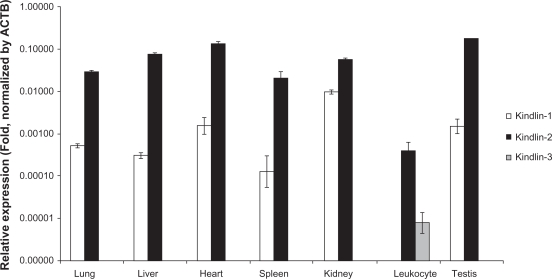
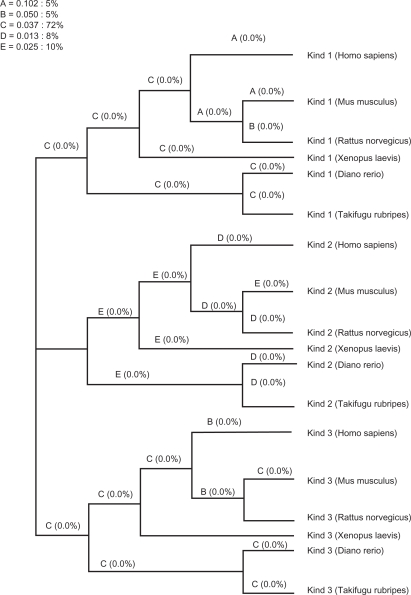
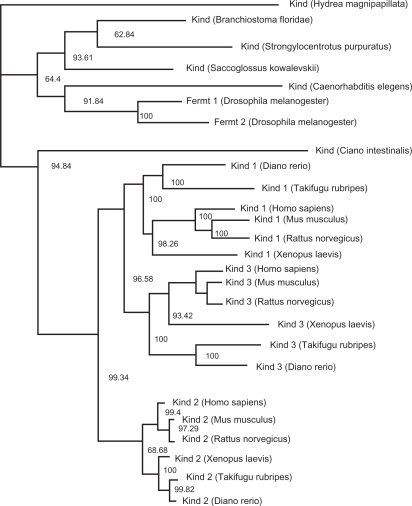
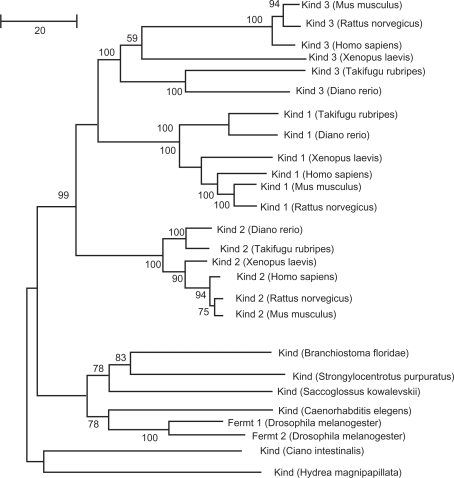
Kindlin proteins represent a newly discovered family of evolutionarily conserved FERM domain-containing proteins. This family includes three highly conserved proteins: Kindlin-1, Kindlin-2 and Kindlin-3. All three Kindlin proteins are associated with focal adhesions and are involved in integrin activation. The FERM domain of each Kindlin is bipartite and plays a key role in integrin activation. We herein explore for the first time the evolutionary history of these proteins. The phylogeny of the Kindlins suggests a single ancestral Kindlin protein present in even the earliest metazoan ie, hydra. This protein then underwent duplication events in insects and also experienced genome duplication in vertebrates, leading to the Kindlin family. A comparative study of the Kindlin paralogs showed that Kindlin-2 is the slowest evolving protein among the three family members. The analysis of synonymous and non-synonymous substitutions in orthologous Kindlin sequences in different species showed that all three Kindlins have been evolving under the influence of purifying selection. The expression pattern of Kindlins along with phylogenetic studies supports the subfunctionalization model of gene duplication.
黏着斑相关蛋白是一个新发现的家族,它包括三个高度保守的蛋白:黏着斑蛋白-1(Kindlin-1)、黏着斑蛋白-2(Kindlin-2)和黏着斑蛋白-3(Kindlin-3)。这三种黏着斑蛋白都与黏着斑有关,并且参与整合素的激活。每个黏着斑蛋白的 FERM 结构域都是二部分的,并且在整合素的激活中起着关键作用。我们首次探索了这些蛋白的进化历史。黏着斑蛋白的系统发育表明,即使是在最早的后生动物(例如水螅)中,也存在一个单一的祖先黏着斑蛋白。然后,该蛋白在昆虫中经历了复制事件,并且在脊椎动物中也经历了基因组复制,从而产生了黏着斑蛋白家族。对黏着斑蛋白的平行同源物的比较研究表明,在这三个家族成员中,黏着斑蛋白-2 是进化最慢的蛋白。在不同物种的同源黏着斑序列中同义和非同义替换的分析表明,所有三种黏着斑蛋白都受到纯化选择的影响而进化。黏着斑蛋白的表达模式与系统发育研究支持基因复制的亚功能化模型。