Xin Honglei, Huang Jiansong, Song Zhiqun, Mao Jianhua, Xi Xiaodong, Shi Xiaofeng
Department of Hematology, Second Affiliated Hospital of Nanjing Medical University, Nanjing, Jiangsu, 210003, China.
Department of Hematology, The First Affiliated Hospital, Zhejiang University School of Medicine, Zhejiang, Hangzhou, 310003, China.
Thromb J. 2023 Feb 13;21(1):18. doi: 10.1186/s12959-023-00463-w.
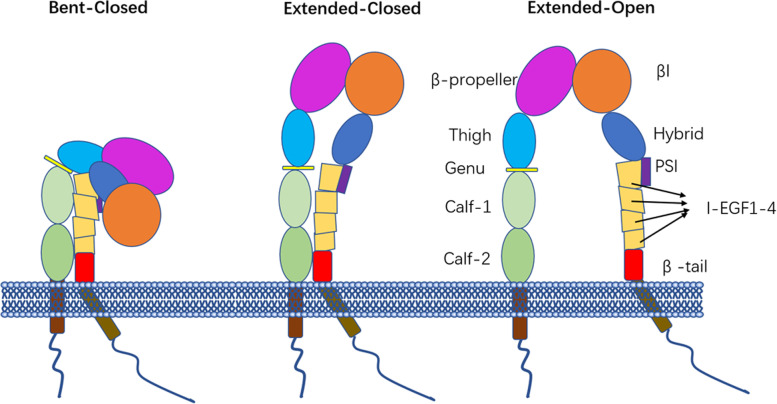
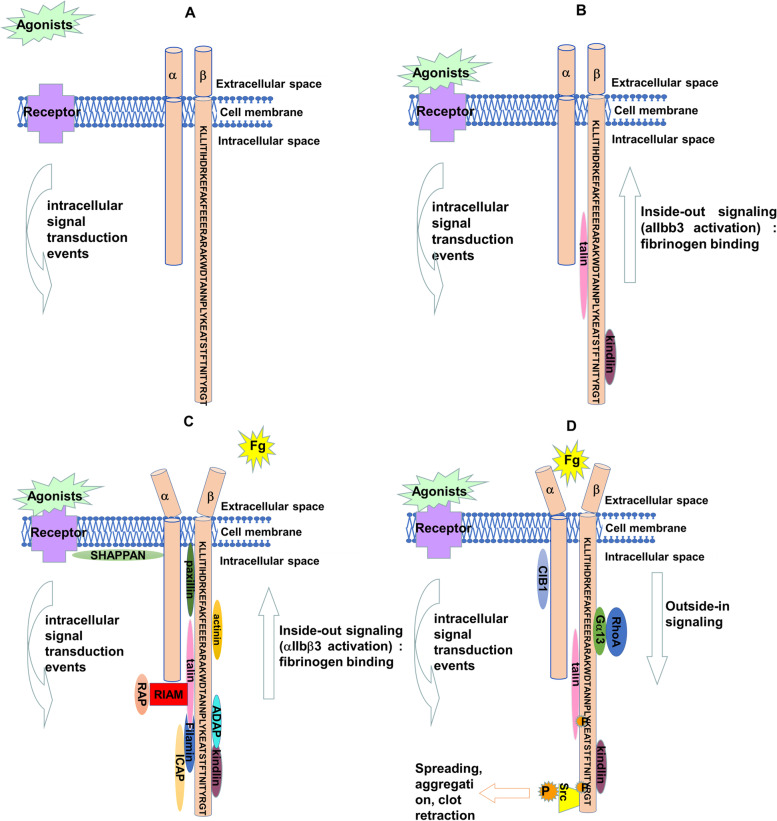
Integrins are heterodimeric receptors comprising α and β subunits. They are expressed on the cell surface and play key roles in cell adhesion, migration, and growth. Several types of integrins are expressed on the platelets, including αvβ3, αIIbβ3, α2β1, α5β1, and α6β1. Among these, physically αIIbβ3 is exclusively expressed on the platelet surface and their precursor cells, megakaryocytes. αIIbβ3 adopts at least three conformations: i) bent-closed, ii) extended-closed, and iii) extended-open. The transition from conformation i) to iii) occurs when αIIbβ3 is activated by stimulants. Conformation iii) possesses a high ligand affinity, which triggers integrin clustering and platelet aggregation. Platelets are indispensable for maintaining vascular system integrity and preventing bleeding. However, excessive platelet activation can result in myocardial infarction (MI) and stroke. Therefore, finding a novel strategy to stop bleeding without accelerating the risk of thrombosis is important. Regulation of αIIbβ3 activation is vital for this strategy. There are a large number of molecules that facilitate or inhibit αIIbβ3 activation. The interference of these molecules can accurately control the balance between hemostasis and thrombosis. This review describes the structure and signal transduction of αIIbβ3, summarizes the molecules that directly or indirectly affect integrin αIIbβ3 activation, and discusses some novel antiαIIbβ3 drugs. This will advance our understanding of the activation of αIIbβ3 and its essential role in platelet function and tumor development.
整合素是由α和β亚基组成的异二聚体受体。它们在细胞表面表达,在细胞黏附、迁移和生长中起关键作用。血小板上表达多种类型的整合素,包括αvβ3、αIIbβ3、α2β1、α5β1和α6β1。其中,αIIbβ3仅在血小板表面及其前体细胞巨核细胞上表达。αIIbβ3至少采用三种构象:i)弯曲闭合构象、ii)伸展闭合构象和iii)伸展开放构象。当αIIbβ3被刺激物激活时,会发生从构象i)到iii)的转变。构象iii)具有高配体亲和力,可触发整合素聚集和血小板聚集。血小板对于维持血管系统完整性和防止出血不可或缺。然而,过度的血小板激活会导致心肌梗死(MI)和中风。因此,找到一种在不增加血栓形成风险的情况下止血的新策略很重要。αIIbβ3激活的调节对于该策略至关重要。有大量分子促进或抑制αIIbβ3激活。这些分子的干扰可以精确控制止血和血栓形成之间的平衡。本综述描述了αIIbβ3的结构和信号转导,总结了直接或间接影响整合素αIIbβ3激活的分子,并讨论了一些新型抗αIIbβ3药物。这将增进我们对αIIbβ3激活及其在血小板功能和肿瘤发展中的重要作用的理解。