Nakabayashi Toshihiro, Kudo Michiaki, Hirasawa Toshiaki, Kuwano Hiroyuki
Department of Surgery, Gunma Prefectural Cardiovascular Center, Maebashi, Japan.
Case Rep Gastroenterol. 2008 Mar 11;2(1):67-70. doi: 10.1159/000118022.
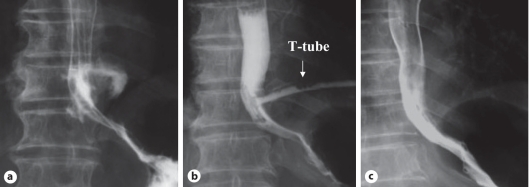
The late management of spontaneous esophageal perforation is the most challenging problem for the surgeon. In this paper, we present a case in whom a spontaneous esophageal perforation was successfully treated by T-tube drainage after unsuccessful conservative treatment. The patient, a 68-year-old male, was admitted to the hospital with sudden upper abdominal pain. After 2 days, esophageal perforation was diagnosed, and conservative management was begun. Thereafter, the subcutaneous emphysema disappeared, and the patient's temperature decreased. However, on day 13, the patient's temperature spiked above 38°C, and computed tomography showed a mediastinal abscess. An emergency left thoracotomy with laparotomy was performed. Since a 2-cm longitudinal perforation with severe inflammatory reactions was observed, the T-tube drainage method was performed. The patient was discharged without postoperative complications and has not experienced any gastrointestinal symptoms, such as gastroesophageal reflux or dysphagia. In conclusion, the T-tube drainage method appears to be a simple and effective method for the late management of esophageal perforation with severe inflammatory reaction.
自发性食管穿孔的后期处理对外科医生来说是最具挑战性的问题。在本文中,我们报告了一例经保守治疗失败后通过T管引流成功治疗自发性食管穿孔的病例。该患者为68岁男性,因突发上腹部疼痛入院。2天后诊断为食管穿孔,并开始进行保守治疗。此后,皮下气肿消失,患者体温下降。然而,在第13天,患者体温升至38°C以上,计算机断层扫描显示纵隔脓肿。遂急诊行左胸开胸及剖腹手术。由于观察到一处2厘米长的纵向穿孔并伴有严重炎症反应,故采用T管引流法。患者术后无并发症出院,且未出现任何胃肠道症状,如胃食管反流或吞咽困难。总之,T管引流法似乎是一种简单有效的治疗伴有严重炎症反应的食管穿孔后期处理方法。