
临床上无功能的生长激素腺瘤很常见。
Clinically silent somatotroph adenomas are common.
机构信息
Division of Endocrinology, Diabetes and Metabolism, Department of Medicine, University of Pennsylvania School of Medicine, 3400 Civic Center Boulevard, 12-135 Translational Research Center, Philadelphia, Pennsylvania 19104, USA.
出版信息
Eur J Endocrinol. 2011 Jul;165(1):39-44. doi: 10.1530/EJE-11-0216. Epub 2011 Apr 14.
OBJECTIVE
Somatotroph adenomas are typically recognized when they secrete GH excessively and cause acromegaly. Both 'silent' somatotroph adenomas (immunohistochemical evidence of GH excess without biochemical or clinical evidence) and 'clinically silent' somatotroph adenomas (immunohistochemical and biochemical evidence but no clinical evidence) have occasionally been reported. The relative frequency of each presentation is unknown. The goal of this study was, therefore, to determine the frequency of clinically silent somatotroph adenomas, a group that is potentially recognizable in vivo.
DESIGN
We retrospectively identified 100 consecutive patients who had surgically excised and histologically confirmed pituitary adenomas.
METHODS
Each pituitary adenoma was classified immunohistochemically by pituitary cell type. Somatotroph adenomas were further classified as 'classic' (obvious clinical features of acromegaly and elevated serum IGF1), 'subtle' (subtle clinical features of acromegaly and elevated IGF1), 'clinically silent' (no clinical features of acromegaly but elevated IGF1), and 'silent' (no clinical features of acromegaly and normal IGF1).
RESULTS
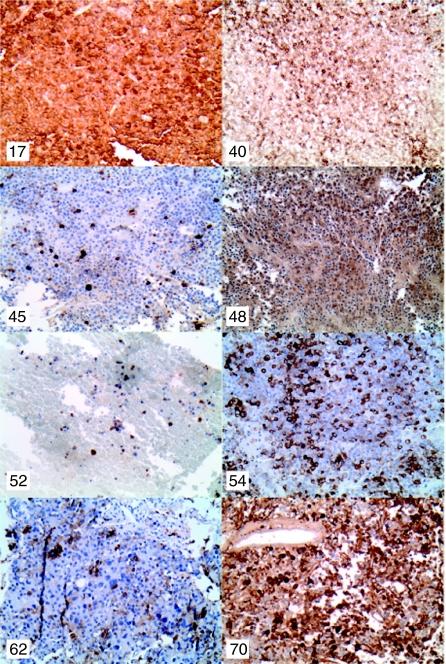
Of the 100 consecutive pituitary adenomas, 29% were gonadotroph/glycoprotein, 24% somatotroph, 18% null cell, 15% corticotroph, 6% lactotroph, 2% thyrotroph, and 6% not classifiable. Of the 24 patients with somatotroph adenomas, classic accounted for 45.8%, subtle 16.7%, clinically silent 33.3%, and silent 4.2%.
CONCLUSIONS
Clinically silent somatotroph adenomas are more common than previously appreciated, representing one-third of all somatotroph adenomas. IGF1 should be measured in all patients with a sellar mass, because identification of a mass as a somatotroph adenoma expands the therapeutic options and provides a tumor marker to monitor treatment.
目的
当生长激素(GH)过度分泌并导致肢端肥大症时,通常会发现生长激素细胞瘤。已经偶尔报道过“无功能”的生长激素细胞瘤(GH 过度的免疫组化证据,但无生化或临床证据)和“临床无功能”的生长激素细胞瘤(免疫组化和生化证据,但无临床证据)。每种表现的相对频率尚不清楚。因此,本研究的目的是确定临床无功能的生长激素细胞瘤的频率,这是一组在体内可能被识别的肿瘤。
设计
我们回顾性地确定了 100 例连续接受手术切除并经组织学证实的垂体腺瘤患者。
方法
通过垂体细胞类型对每个垂体腺瘤进行免疫组织化学分类。生长激素细胞瘤进一步分为“经典型”(肢端肥大症的明显临床特征和 IGF1 升高)、“微妙型”(肢端肥大症的微妙临床特征和 IGF1 升高)、“临床无功能型”(无肢端肥大症的临床特征但 IGF1 升高)和“无功能型”(无肢端肥大症且 IGF1 正常)。
结果
在 100 例连续的垂体腺瘤中,29%为促性腺激素/糖蛋白,24%为生长激素瘤,18%为无功能细胞,15%为促皮质素瘤,6%为催乳素瘤,2%为促甲状腺素瘤,6%无法分类。在 24 例生长激素细胞瘤患者中,经典型占 45.8%,微妙型占 16.7%,临床无功能型占 33.3%,无功能型占 4.2%。
结论
临床无功能的生长激素细胞瘤比以前认为的更为常见,占所有生长激素细胞瘤的三分之一。所有鞍区肿块患者均应测量 IGF1,因为将肿块识别为生长激素细胞瘤会扩大治疗选择,并提供肿瘤标志物来监测治疗。
 Zotero 插件