Prince of Wales Clinical School, University of New South Wales, Sydney, New South Wales, Australia.
PLoS One. 2011 Apr 8;6(4):e18469. doi: 10.1371/journal.pone.0018469.
Oxaliplatin, a platinum-based chemotherapy utilised in the treatment of colorectal cancer, produces two forms of neurotoxicity--acute sensorimotor neuropathic symptoms and a dose-limiting chronic sensory neuropathy. Given that a Na(+) channelopathy has been proposed as the mechanism underlying acute oxaliplatin-induced neuropathy, the present study aimed to determine specific mechanisms of Na(+) channel dysfunction.
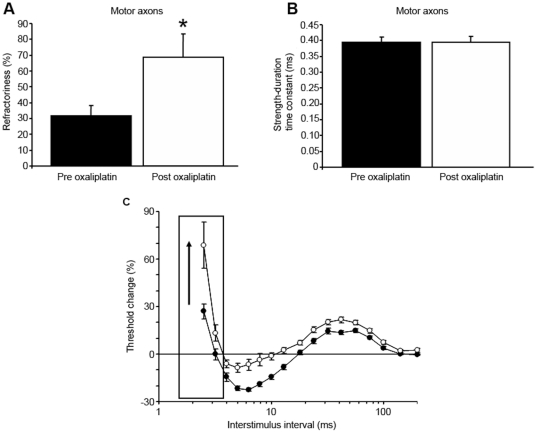
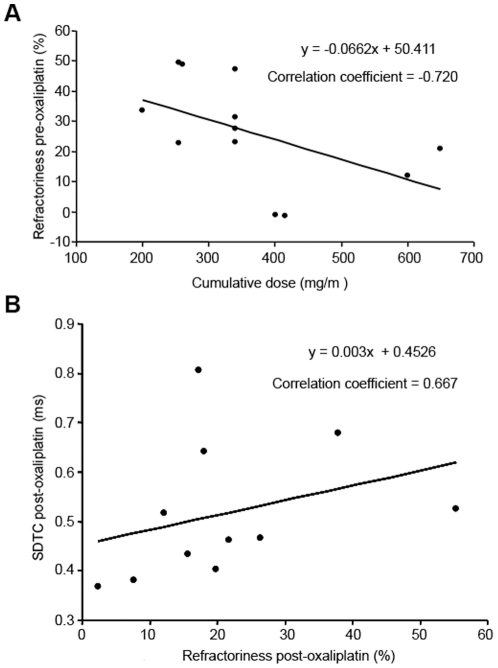
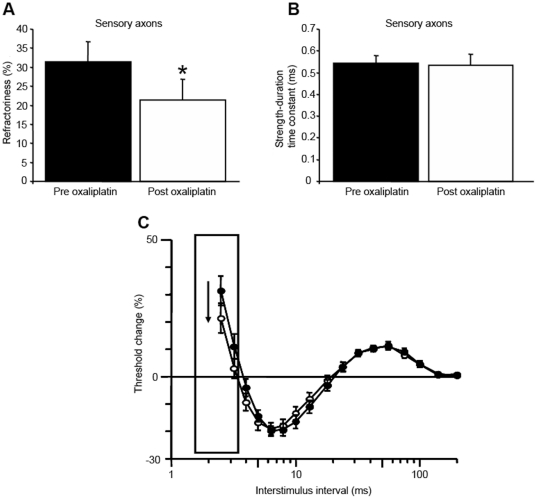
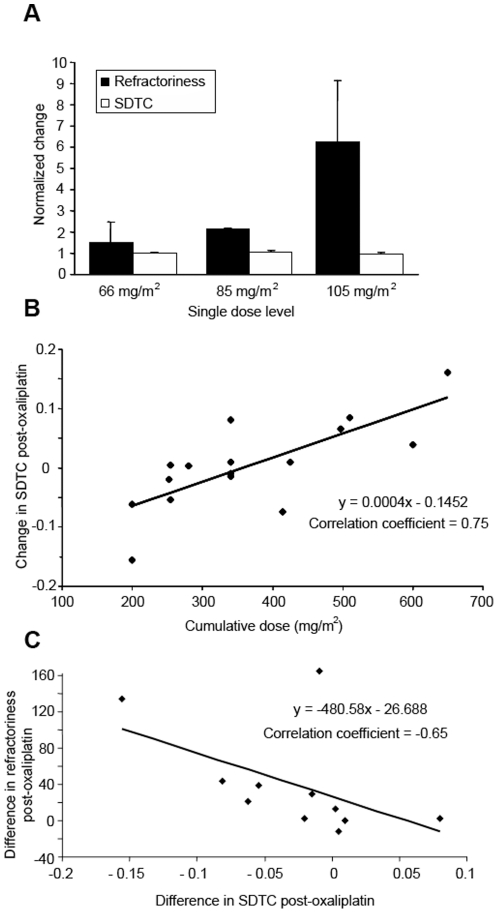
METHODOLOGY/PRINCIPAL FINDINGS: Specifically the function of transient and persistent Na(+) currents were followed during treatment and were investigated in relation to oxaliplatin dose level. Eighteen patients were assessed before and after a single oxaliplatin infusion with motor and sensory axonal excitability studies performed on the median nerve at the wrist. While refractoriness (associated with Na(+) channel inactivation) was significantly altered post-oxaliplatin infusion in both motor (Pre: 31.7±6.4%; Post: 68.8±14.5%; P≤.001) and sensory axons (Pre: 31.4±5.4%; Post: 21.4±5.5%; P<.05), strength-duration time constant (marker of persistent Na(+) conductances) was not significantly altered post-infusion (Motor Pre: 0.395±0.01 ms; Post: 0.394±0.02 ms; NS; Sensory Pre:0.544±0.03 ms; Post: 0.535±0.05 ms; NS). However, changes in strength-duration time constant were significantly correlated with changes in refractoriness in motor and sensory axons (Motor correlation coefficient = -.65; P<.05; Sensory correlation coefficient = .67; P<.05).
CONCLUSIONS/SIGNIFICANCE: It is concluded that the predominant effect of acute oxaliplatin exposure in human motor and sensory axons is mediated through changes in transient rather than persistent Na(+) conductances. These findings are likely to have implications for the design and trial of neuroprotective strategies.
奥沙利铂是一种用于治疗结直肠癌的铂类化疗药物,可引起两种形式的神经毒性——急性感觉运动神经性症状和剂量限制的慢性感觉神经病。鉴于已经提出钠离子通道病作为急性奥沙利铂诱导神经病的机制,本研究旨在确定钠离子通道功能障碍的特定机制。
方法/主要发现:具体来说,在治疗过程中跟踪了瞬时和持续钠离子电流的功能,并研究了其与奥沙利铂剂量水平的关系。18 名患者在单次奥沙利铂输注前后接受正中神经腕部运动和感觉轴突兴奋性研究。奥沙利铂输注后,运动(预处理:31.7±6.4%;后处理:68.8±14.5%;P≤.001)和感觉轴突(预处理:31.4±5.4%;后处理:21.4±5.5%;P<.05)的不应期明显改变,而强度-持续时间常数(持续性钠离子电导的标志物)后输注无明显改变(运动前:0.395±0.01 ms;后:0.394±0.02 ms;NS;感觉前:0.544±0.03 ms;后:0.535±0.05 ms;NS)。然而,运动和感觉轴突的强度-持续时间常数的变化与不应期的变化呈显著相关(运动相关系数=-.65;P<.05;感觉相关系数=-.67;P<.05)。
结论/意义:结论是急性奥沙利铂暴露在人类运动和感觉轴突中的主要作用是通过改变瞬时而不是持续性钠离子电导来介导的。这些发现可能对神经保护策略的设计和试验具有重要意义。