Fraser Health, Environmental Health Services, New Westminster, Canada.
PLoS One. 2011 Apr 8;6(4):e18492. doi: 10.1371/journal.pone.0018492.
It has been proposed that vitamin D deficiency may be responsible for an increase in the prevalence of allergic diseases and asthma worldwide. Human ability to generate physiologically required quantities of vitamin D through sun exposure is decreasing with increasing geographical latitude.
Considering that vitamin D deficiency is usually due to lack of outdoor sun exposure, this study is designed to test the hypothesis that a higher prevalence of asthma should be expected at high relative to low geographical latitudes.
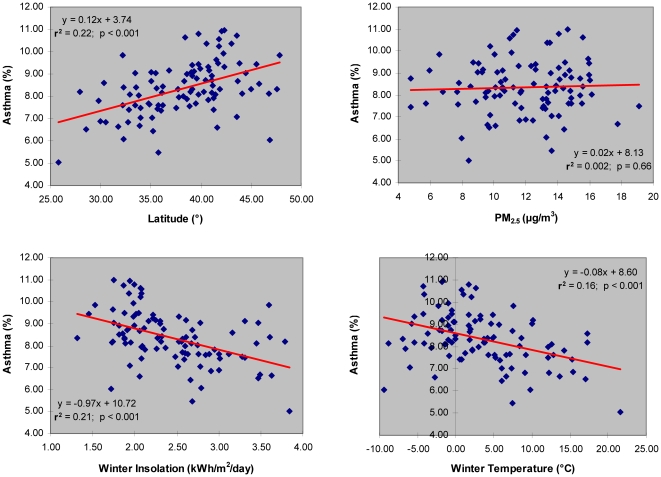
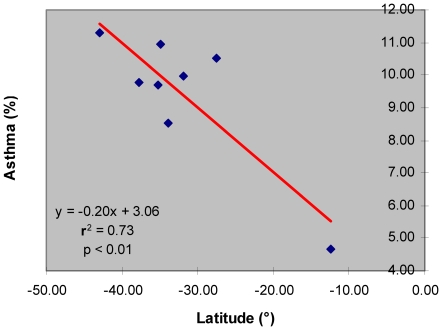
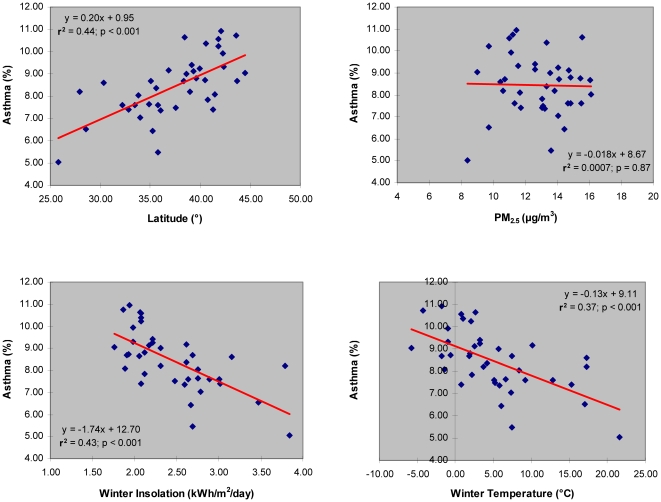
Linear regression analyses are performed on asthma prevalence in the U.S. adult population vs. geographical latitude, insolation, air temperature, and air pollution (PM(2.5)) for 97 major metropolitan/micropolitan statistical areas of the continental United States of America and on general population asthma prevalence vs. geographical latitude in eight metropolitan areas of Australia.
A 10° change in geographical latitude from southern to northern regions of the Eastern Seaboard is associated with a 2% increase in adult asthma prevalence (p<0.001). Total insolation in winter months is almost as strong as latitude in its ability to explain the observed spatial variation in the prevalence of asthma (r(2) = 0.43; p<0.001). Similar results are obtained using the Australian data (r(2) = 0.73; p<0.01), suggesting a consistent association between the latitude/insolation and asthma prevalence worldwide.
The results of this study suggest that, as a known modulator of the immune response closely linked with the geographical latitude and erythemal UV irradiation, vitamin D may play an important role in the development/exacerbation of asthma.
有人提出,维生素 D 缺乏可能是导致全球过敏疾病和哮喘发病率上升的原因之一。随着地理位置的增加,人类通过阳光照射产生生理所需维生素 D 的能力正在下降。
鉴于维生素 D 缺乏通常是由于缺乏户外阳光照射,本研究旨在检验以下假设:在相对较高的地理位置,哮喘的发病率应该更高。
对美国成年人哮喘发病率与地理位置、日照、空气温度和空气污染(PM(2.5))进行线性回归分析,对美国大陆 97 个主要大都市区/大城市统计区的一般人群哮喘发病率与地理位置进行线性回归分析,对澳大利亚 8 个大都市区的一般人群哮喘发病率与地理位置进行线性回归分析。
从东海岸的南部到北部地区,地理位置每变化 10°,成年人哮喘发病率增加 2%(p<0.001)。冬季总日照量与纬度一样,几乎可以解释哮喘发病率的空间变化(r²=0.43;p<0.001)。使用澳大利亚的数据也得到了类似的结果(r²=0.73;p<0.01),这表明纬度/日照量与全球哮喘发病率之间存在一致的关联。
本研究结果表明,作为与地理位置和红斑紫外线辐射密切相关的免疫反应的已知调节剂,维生素 D 可能在哮喘的发展/恶化中发挥重要作用。