Gao Zhiqiang, Han Baohui, Shen Jie, Gu Aiqin, Zhong Hua
Department of Pulmonary Medcine, Chest Hospital Affiliated to Shanghai Jiao Tong University, Shanghai, China.
Zhongguo Fei Ai Za Zhi. 2011 Apr;14(4):340-4. doi: 10.3779/j.issn.1009-3419.2011.04.07.
It has been proven that ribonucleotide reductase M1 (RRM1) expression level was closely related to gemcitabine drug-resistance to tumor cells. The aim of this study is to explore the relations between RRM1 protein expression levels and effects of gemcitabine and cisplatin chemotherapy in advanced non-small cell lung cancer (NSCLC) patients.
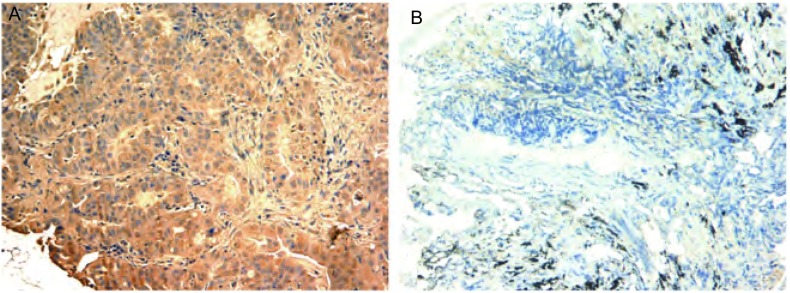
The expressions of RRM1 in 75 advanced NSCLC tissues were qualitatively detected by immunohistochemical methods. Seventy-five patients had received gemcitabine and cisplatin (GP) chemotherapy regimen. General characteristics of patients, response to treatment, efficacy evaluation and survival time were retrospectively investigated. Differences between the groups were statistically analysed by chi-square test. Survival differences were analysed by temporal inspection and Kaplan-Meier survival curves.
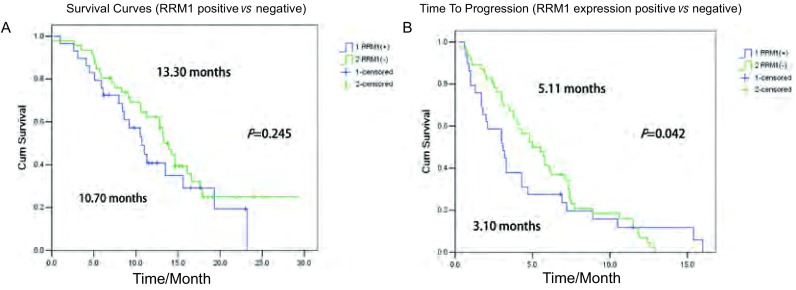
RRM1 protein expression rate was 38.7%. RRM1 protein expression had no obvious relationship with gender, age, smoking status, and the clinical stages and histopathological types (P > 0.05). Response rate in RRM1 protein high expression groups (31.3%) was remarkably lower than that in low expression groups (41.3%), the difference was statistically significant (P=0.005). 1-year survival rate in RRM1 protein high expression groups (27.6%) was remarkably lower than that in low expression group (58.7%), the difference was statistically significant (P=0.009). No significant different of median survival was observed between RMM1 protein high expression group and low expression group (P >0.245). Time to progression in RRM1 protein high expression groups (3.10 months) was remarkably lower than that in low expression group (5.11 months), the difference was statistically significant (P=0.042).
RRM1 protein expression levels are closely related to effects of gemcitabine and cisplatin chemotherapy and prognosis of advanced NSCLC patients.
已证实核糖核苷酸还原酶M1(RRM1)表达水平与吉西他滨对肿瘤细胞的耐药性密切相关。本研究旨在探讨RRM1蛋白表达水平与晚期非小细胞肺癌(NSCLC)患者吉西他滨和顺铂化疗疗效之间的关系。
采用免疫组化方法对75例晚期NSCLC组织中RRM1的表达进行定性检测。75例患者接受了吉西他滨和顺铂(GP)化疗方案。回顾性调查患者的一般特征、治疗反应、疗效评估和生存时间。采用卡方检验对组间差异进行统计学分析。采用时序检验和Kaplan-Meier生存曲线分析生存差异。
RRM1蛋白表达率为38.7%。RRM1蛋白表达与性别、年龄、吸烟状况、临床分期及组织病理学类型无明显关系(P>0.05)。RRM1蛋白高表达组的缓解率(31.3%)明显低于低表达组(41.3%),差异有统计学意义(P=0.005)。RRM1蛋白高表达组的1年生存率(27.6%)明显低于低表达组(58.7%),差异有统计学意义(P=0.009)。RMM1蛋白高表达组与低表达组的中位生存期无显著差异(P>0.245)。RRM1蛋白高表达组的疾病进展时间(3.10个月)明显低于低表达组(5.11个月),差异有统计学意义(P=0.042)。
RRM1蛋白表达水平与吉西他滨和顺铂化疗疗效及晚期NSCLC患者的预后密切相关。