University of Minnesota Gamma Knife, Minneapolis Radiation Oncology, Minneapolis, MN, USA.
Int J Radiat Oncol Biol Phys. 2012 Apr 1;82(5):2111-7. doi: 10.1016/j.ijrobp.2011.02.027. Epub 2011 Apr 15.
The diagnosis-specific Graded Prognostic Assessment (GPA) was published to clarify prognosis for patients with brain metastases. This study refines the existing Breast-GPA by analyzing a larger cohort and tumor subtype.
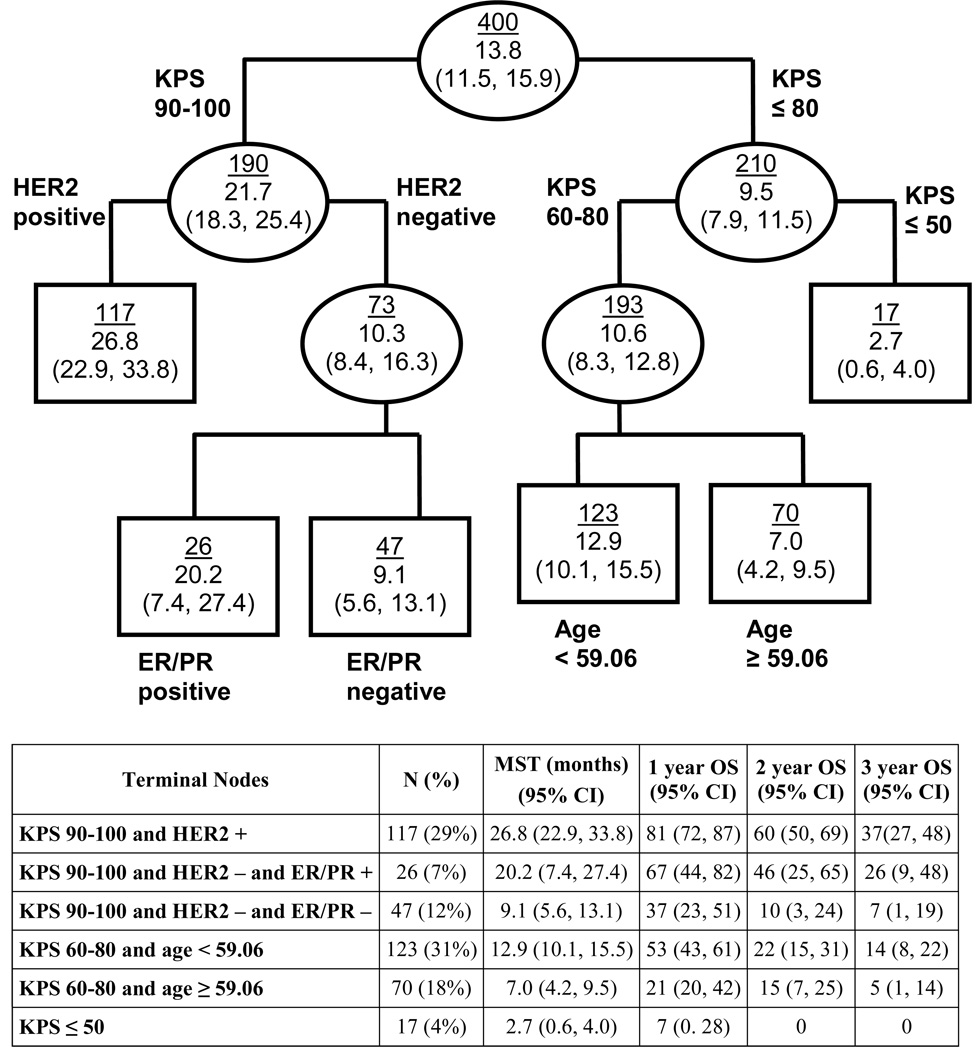
A multi-institutional retrospective database of 400 breast cancer patients treated for newly diagnosed brain metastases was generated. Prognostic factors significant for survival were analyzed by multivariate Cox regression and recursive partitioning analysis (RPA). Factors were weighted by the magnitude of their regression coefficients to define the GPA index.
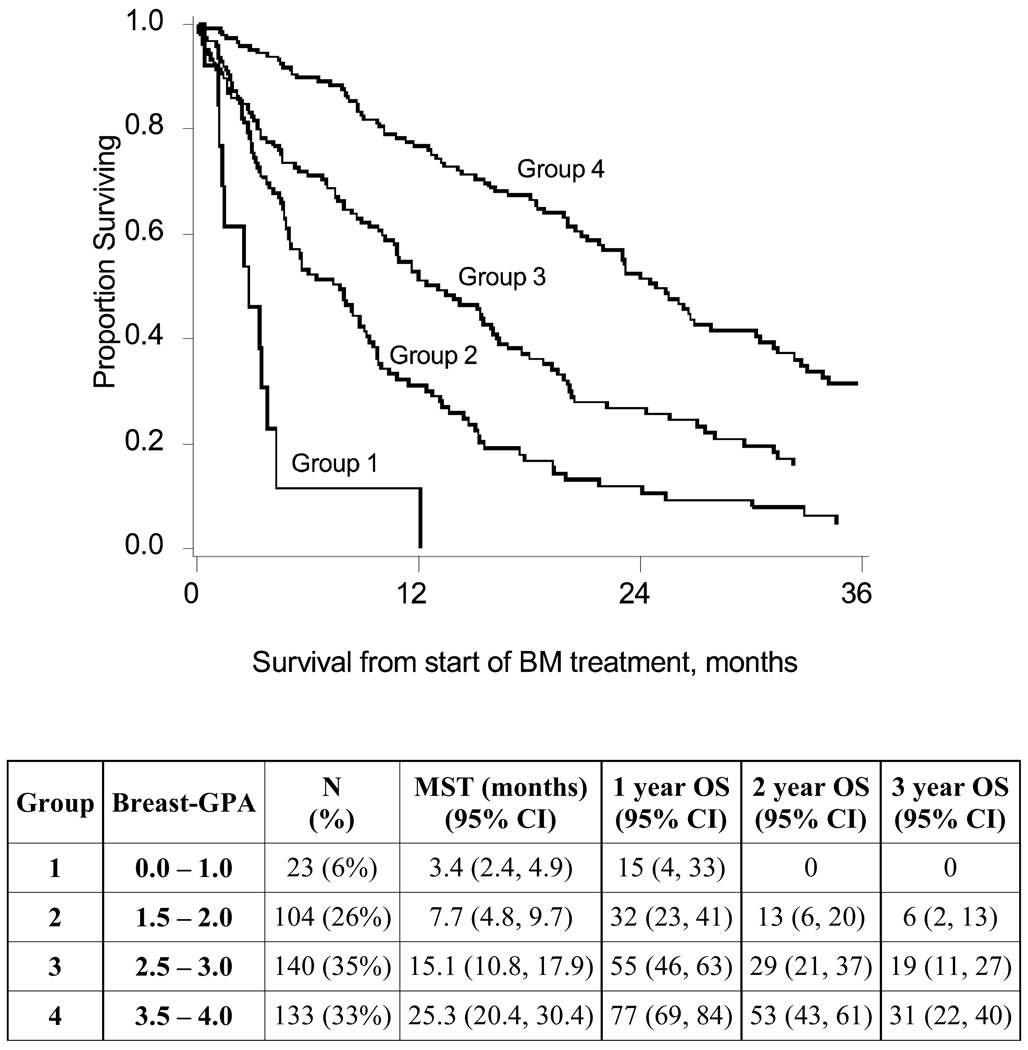
Significant prognostic factors by multivariate Cox regression and RPA were Karnofsky performance status (KPS), HER2, ER/PR status, and the interaction between ER/PR and HER2. RPA showed age was significant for patients with KPS 60 to 80. The median survival time (MST) overall was 13.8 months, and for GPA scores of 0 to 1.0, 1.5 to 2.0, 2.5 to 3.0, and 3.5 to 4.0 were 3.4 (n = 23), 7.7 (n = 104), 15.1 (n = 140), and 25.3 (n = 133) months, respectively (p < 0.0001). Among HER2-negative patients, being ER/PR positive improved MST from 6.4 to 9.7 months, whereas in HER2-positive patients, being ER/PR positive improved MST from 17.9 to 20.7 months. The log-rank statistic (predictive power) was 110 for the Breast-GPA vs. 55 for tumor subtype.
The Breast-GPA documents wide variation in prognosis and shows clear separation between subgroups of patients with breast cancer and brain metastases. This tool will aid clinical decision making and stratification in clinical trials. These data confirm the effect of tumor subtype on survival and show the Breast-GPA offers significantly more predictive power than the tumor subtype alone.
特定于诊断的分级预后评估(GPA)的发布旨在阐明脑转移患者的预后。本研究通过分析更大的队列和肿瘤亚型来完善现有的乳腺 GPA。
为了进行这项研究,我们生成了一个由 400 名接受新诊断脑转移治疗的乳腺癌患者组成的多机构回顾性数据库。通过多变量 Cox 回归和递归分区分析(RPA)分析对生存有显著影响的预后因素。通过回归系数的大小对这些因素进行加权,以定义 GPA 指数。
多变量 Cox 回归和 RPA 的显著预后因素是 Karnofsky 表现状态(KPS)、HER2、ER/PR 状态以及 ER/PR 和 HER2 之间的相互作用。RPA 显示年龄对 KPS 为 60 至 80 的患者有意义。总体中位生存时间(MST)为 13.8 个月,对于 GPA 评分为 0 至 1.0、1.5 至 2.0、2.5 至 3.0 和 3.5 至 4.0 的患者,MST 分别为 3.4(n = 23)、7.7(n = 104)、15.1(n = 140)和 25.3(n = 133)个月(p < 0.0001)。在 HER2 阴性患者中,ER/PR 阳性将 MST 从 6.4 个月改善至 9.7 个月,而在 HER2 阳性患者中,ER/PR 阳性将 MST 从 17.9 个月改善至 20.7 个月。对数秩检验(预测能力)为 110,用于乳腺 GPA,而肿瘤亚型为 55。
乳腺 GPA 记录了预后的广泛变化,并清楚地区分了乳腺癌和脑转移患者的亚组。该工具将有助于临床决策制定和临床试验分层。这些数据证实了肿瘤亚型对生存的影响,并表明乳腺 GPA 提供的预测能力明显优于肿瘤亚型单独提供的预测能力。