Behavioural Science Institute, Radboud University Nijmegen, Montessorilaan 3, Nijmegen, The Netherlands.
J Youth Adolesc. 2012 Apr;41(4):449-59. doi: 10.1007/s10964-011-9661-7. Epub 2011 Apr 17.
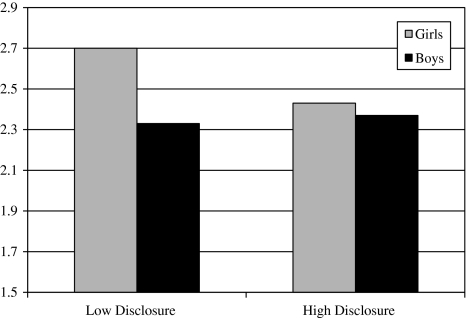
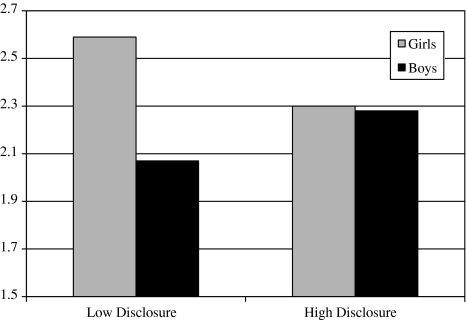
This article reports on a longitudinal study investigating gender differences in the association between maternal disclosure and adolescents' depressive symptoms. Little research has examined the relationship of parental disclosure to adolescents' depressive symptoms and research on sex differences is particularly lacking. In a sample of 428 families with a mean age of 13.36 (52% female) of the target adolescents, maternal and children's disclosure and depressive symptoms were assessed twice with an interval of 4 years. Controlling for the quality of the parent-child relationship and levels of maternal depressive symptoms, the analyses revealed an interaction effect for child's gender, moderating the effect of maternal disclosure on adolescents' depressive symptoms. Higher levels of maternal disclosure were accompanied by lower levels of depressive symptoms in girls and higher levels of depressive symptoms in boys. Gender differences in socialization, communication, individuation and social networks might explain why daughters and sons are differently affected by maternal disclosure.
这篇文章报告了一项纵向研究,调查了母亲表露与青少年抑郁症状之间的关联存在性别差异。很少有研究调查父母表露与青少年抑郁症状的关系,而且关于性别差异的研究尤其缺乏。在一个平均年龄为 13.36 岁(女性占 52%)的 428 个家庭样本中,对母亲和孩子的表露情况以及抑郁症状进行了两次评估,两次评估的间隔为 4 年。在控制了亲子关系的质量和母亲抑郁症状的水平后,分析显示,孩子的性别存在交互作用,调节了母亲表露对青少年抑郁症状的影响。母亲表露水平越高,女孩的抑郁症状水平越低,男孩的抑郁症状水平越高。在社会化、沟通、个体化和社交网络方面的性别差异可能解释了为什么女儿和儿子受到母亲表露的影响不同。