Division of Women & Child Health, The Aga Khan University, Karachi, Pakistan.
BMC Public Health. 2011 Apr 13;11 Suppl 3(Suppl 3):S23. doi: 10.1186/1471-2458-11-S3-S23.
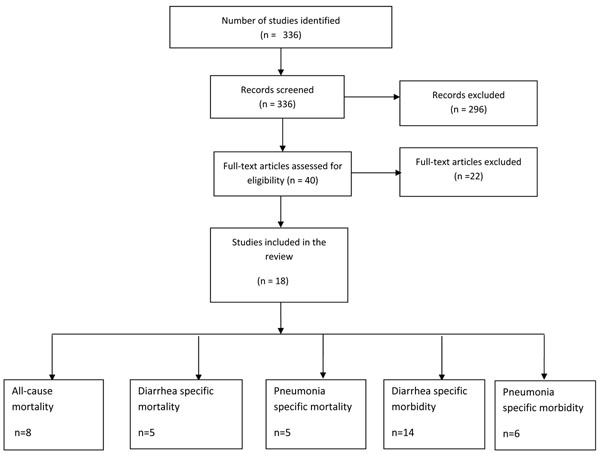
Zinc deficiency is commonly prevalent in children in developing countries and plays a role in decreased immunity and increased risk of infection. Preventive zinc supplementation in healthy children can reduce mortality due to common causes like diarrhea, pneumonia and malaria. The main objective was to determine all-cause mortality and cause-specific mortality and morbidity in children under five in developing countries for preventive zinc supplementation. DATA SOURCES/ REVIEW METHODS: A literature search was carried out on PubMed, the Cochrane Library and the WHO regional databases to identify RCTs on zinc supplementation for greater than 3 months in children less than 5 years of age in developing countries and its effect on mortality was analyzed.
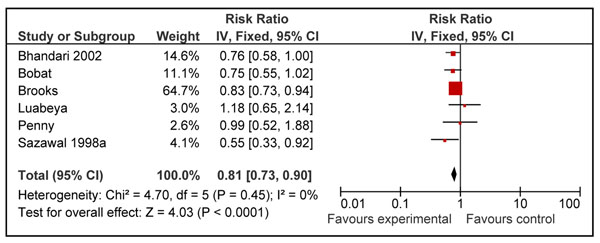
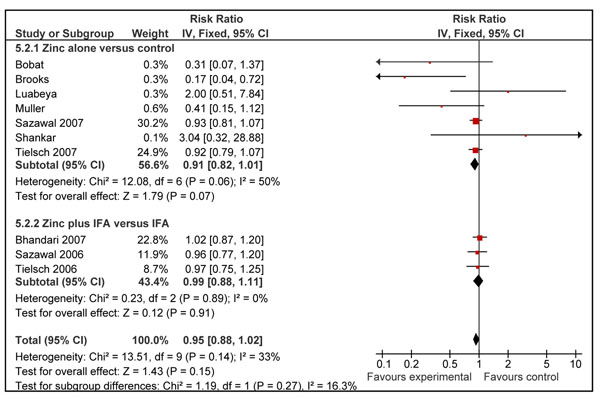
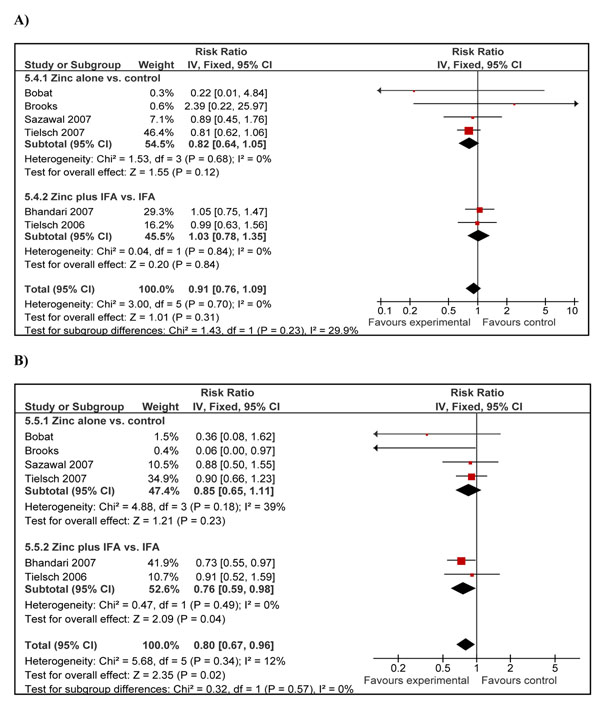
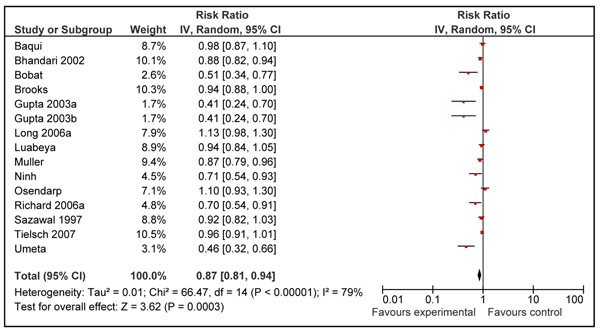
The effect of preventive zinc supplementation on mortality was given in eight trials, while cause specific mortality data was given in five of these eight trials. Zinc supplementation alone was associated with a statistically insignificant 9% (RR = 0.91; 95% CI: 0.82, 1.01) reduction in all cause mortality in the intervention group as compared to controls using a random effect model. The impact on diarrhea-specific mortality of zinc alone was a non-significant 18% reduction (RR = 0.82; 95% CI: 0.64, 1.05) and 15% for pneumonia-specific mortality (RR = 0.85; 95% CI: 0.65, 1.11). The incidence of diarrhea showed a 13% reduction with preventive zinc supplementation (RR = 0.87; 95% CI: 0.81, 0.94) and a 19% reduction in pneumonia morbidity (RR = 0.81; 95% CI: 0.73, 0.90). Keeping in mind the direction of effect of zinc supplementation in reducing diarrhea and pneumonia related morbidity and mortality; we considered all the outcomes for selection of effectiveness estimate for inclusion in the LiST model. After application of the CHERG rules with consideration to quality of evidence and rule # 6, we used the most conservative estimates as a surrogate for mortality. We, therefore, conclude that zinc supplementation in children is associated with a reduction in diarrhea mortality of 13% and pneumonia mortality of 15% for inclusion in the LiST tool. Preventive zinc supplementation had no effect on malaria specific mortality (RR = 0.90; 95% CI: 0.77, 1.06) or incidence of malaria (RR = 0.92; 95 % CI 0.82-1.04).
Zinc supplementation results in reductions in diarrhea and pneumonia mortality.
发展中国家的儿童普遍缺锌,缺锌会降低免疫力,增加感染风险。健康儿童预防性补锌可降低腹泻、肺炎和疟疾等常见病因导致的死亡率。本主要目的是确定发展中国家 5 岁以下儿童补锌的全因死亡率和病因死亡率及发病率。
数据来源/审查方法:在 PubMed、Cochrane 图书馆和世卫组织区域数据库中进行了文献检索,以确定发展中国家 5 岁以下儿童补锌时间超过 3 个月的 RCT,并分析其对死亡率的影响。
8 项试验报告了补锌对死亡率的影响,其中 5 项试验报告了病因特异性死亡率数据。采用随机效应模型,与对照组相比,补锌单独干预组的全因死亡率降低了 9%(RR=0.91;95%CI:0.82,1.01),差异无统计学意义。单独补锌对腹泻特异性死亡率的影响为非显著降低 18%(RR=0.82;95%CI:0.64,1.05),对肺炎特异性死亡率的影响降低 15%(RR=0.85;95%CI:0.65,1.11)。预防性补锌可使腹泻发生率降低 13%(RR=0.87;95%CI:0.81,0.94),肺炎发病率降低 19%(RR=0.81;95%CI:0.73,0.90)。考虑到补锌在降低腹泻和肺炎相关发病率和死亡率方面的作用方向;我们选择了对入选 LiST 模型的有效性估计有影响的所有结果。在考虑到证据质量和规则 #6 的情况下应用 CHERG 规则后,我们使用最保守的估计值作为死亡率的替代值。因此,我们的结论是,儿童补锌可降低 13%的腹泻死亡率和 15%的肺炎死亡率,这将被纳入 LiST 工具。预防性补锌对疟疾死亡率(RR=0.90;95%CI:0.77,1.06)或疟疾发病率(RR=0.92;95%CI 0.82-1.04)没有影响。
补锌可降低腹泻和肺炎死亡率。