The Beatson Institute for Cancer Research, Glasgow, G61 1BD, UK.
Dis Model Mech. 2011 Jul;4(4):548-55. doi: 10.1242/dmm.006874. Epub 2011 Apr 18.
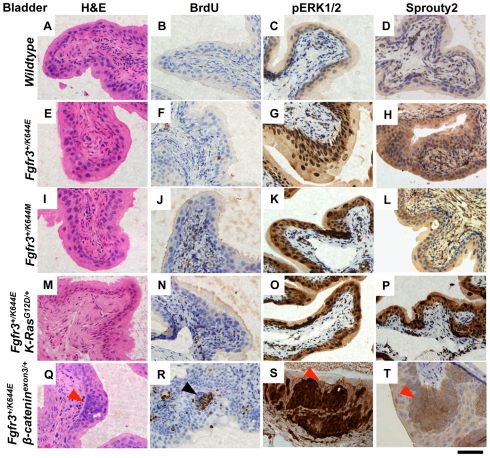
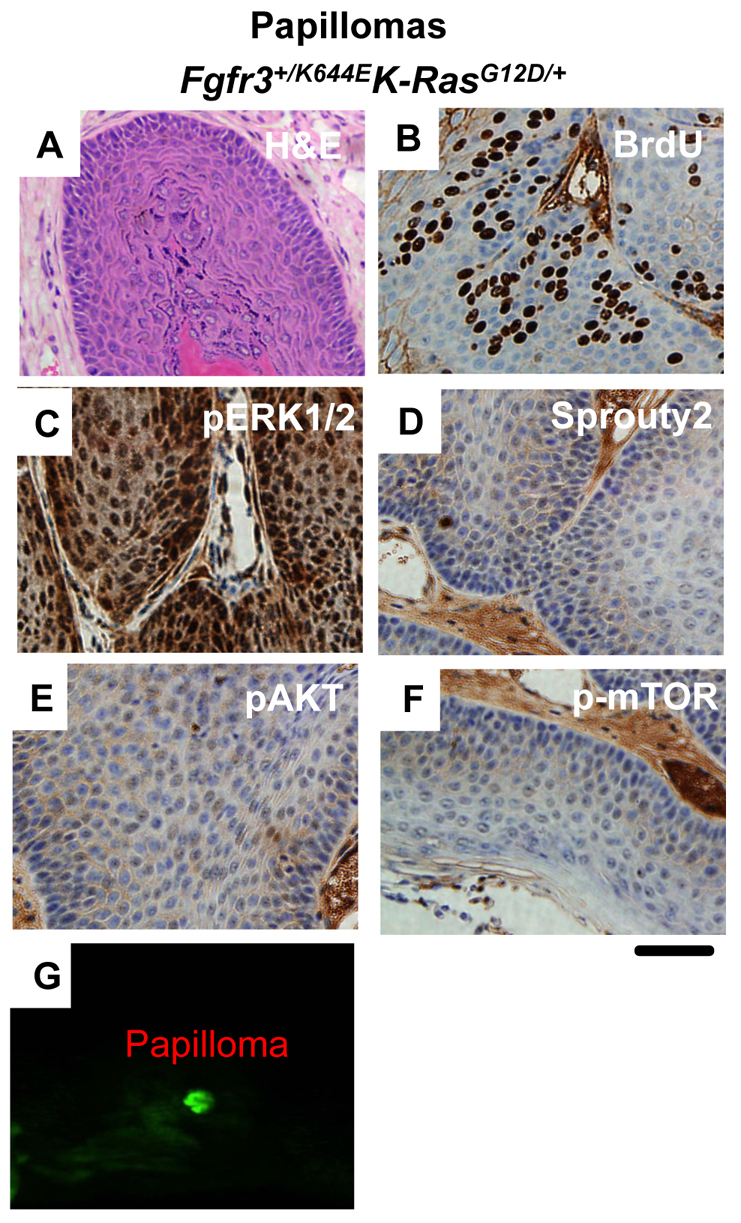
The human fibroblast growth factor receptor 3 (FGFR3) gene is frequently mutated in superficial urothelial cell carcinoma (UCC). To test the functional significance of FGFR3 activating mutations as a 'driver' of UCC, we targeted the expression of mutated Fgfr3 to the murine urothelium using Cre-loxP recombination driven by the uroplakin II promoter. The introduction of the Fgfr3 mutations resulted in no obvious effect on tumorigenesis up to 18 months of age. Furthermore, even when the Fgfr3 mutations were introduced together with K-Ras or β-catenin (Ctnnb1) activating mutations, no urothelial dysplasia or UCC was observed. Interestingly, however, owing to a sporadic ectopic Cre recombinase expression in the skin and lung of these mice, Fgfr3 mutation caused papilloma and promoted lung tumorigenesis in cooperation with K-Ras and β-catenin activation, respectively. These results indicate that activation of FGFR3 can cooperate with other mutations to drive tumorigenesis in a context-dependent manner, and support the hypothesis that activation of FGFR3 signaling contributes to human cancer.
人类成纤维细胞生长因子受体 3(FGFR3)基因在表浅性尿路上皮细胞癌(UCC)中经常发生突变。为了测试 FGFR3 激活突变作为 UCC“驱动因素”的功能意义,我们使用由尿路上皮蛋白 II 启动子驱动的 Cre-loxP 重组将突变型 Fgfr3 靶向表达于小鼠尿路上皮。直到 18 个月大,引入 Fgfr3 突变对肿瘤发生没有明显影响。此外,即使同时引入 Fgfr3 突变与 K-Ras 或 β-连环蛋白(Ctnnb1)激活突变,也未观察到尿路上皮发育不良或 UCC。然而,有趣的是,由于这些小鼠的皮肤和肺部中存在散发性异位 Cre 重组酶表达,Fgfr3 突变导致了乳头状瘤,并分别与 K-Ras 和 β-连环蛋白的激活协同促进了肺肿瘤的发生。这些结果表明,FGFR3 的激活可以与其他突变以依赖于上下文的方式协同驱动肿瘤发生,并支持 FGFR3 信号激活有助于人类癌症的假说。