Department of Infectious Diseases, Institute for Microbiology, University of Veterinary Medicine Hannover, Bischofsholer Damm 15, 30173 Hannover, Germany.
Proteome Sci. 2011 Apr 20;9(1):23. doi: 10.1186/1477-5956-9-23.
Protection of pigs by vaccination against Actinobacillus pleuropneumoniae, the causative agent of porcine pleuropneumonia, is hampered by the presence of 15 different serotypes. A DIVA subunit vaccine comprised of detergent-released proteins from A. pleuropneumoniae serotypes 1, 2 and 5 has been developed and shown to protect pigs from clinical symptoms upon homologous and heterologous challenge. This vaccine has not been characterized in-depth so far. Thus we performed i) mass spectrometry in order to identify the exact protein content of the vaccine and ii) cross-serotype 2-D immunoblotting in order to discover cross-reactive antigens. By these approaches we expected to gain results enabling us to argue about the reasons for the efficacy of the analyzed vaccine.
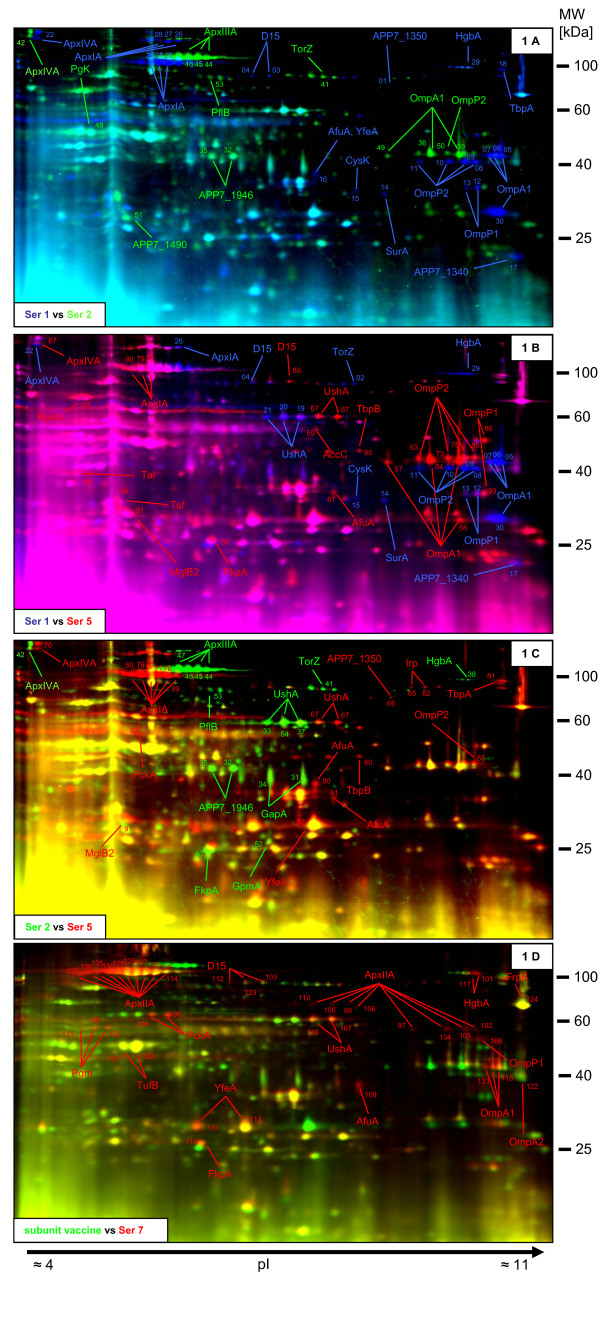
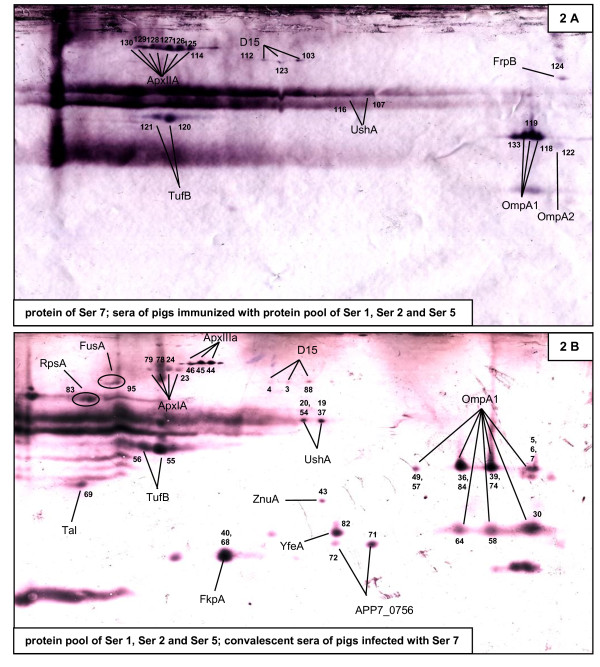
We identified 75 different proteins in the vaccine. Using the PSORTb algorithm these proteins were classified according to their cellular localization. Highly enriched proteins are outer membrane-associated lipoproteins like OmlA and TbpB, integral outer membrane proteins like FrpB, TbpA, OmpA1, OmpA2, HgbA and OmpP2, and secreted Apx toxins. The subunit vaccine also contained large amounts of the ApxIVA toxin so far thought to be expressed only during infection. Applying two-dimensional difference gel electrophoresis (2-D DIGE) we showed different isoforms and variations in expression levels of several proteins among the strains used for vaccine production. For detection of cross-reactive antigens we used detergent released proteins of serotype 7. Sera of pigs vaccinated with the detergent-released proteins of serotypes 1, 2, and 5 detected seven different proteins of serotype 7, and convalescent sera of pigs surviving experimental infection with serotype 7 reacted with 13 different proteins of the detergent-released proteins of A. pleuropneumoniae serotypes 1, 2, and 5.
A detergent extraction-based subunit vaccine of A. pleuropneumoniae was characterized by mass spectrometry. It contained a large variety of immunogenic and virulence associated proteins, among them the ApxIVA toxin. The identification of differences in expression as well as isoform variation between the serotypes implied the importance of combining proteins of different serotypes for vaccine generation. This finding was supported by immunoblotting showing the induction of cross-reactive antibodies against several surface associated proteins in immunized animals.
由于胸膜肺炎放线杆菌(Actinobacillus pleuropneumoniae)有 15 种不同的血清型,通过疫苗接种来保护猪免受感染的效果受到了阻碍,这种细菌是猪传染性胸膜肺炎的病原体。一种由胸膜肺炎放线杆菌血清型 1、2 和 5 的去污剂释放蛋白组成的 DIVA 亚单位疫苗已经被开发出来,并已被证明可在同源和异源攻毒时保护猪免受临床症状的影响。到目前为止,这种疫苗还没有被深入研究。因此,我们进行了 i)质谱分析以确定疫苗的确切蛋白质含量,和 ii)跨血清型 2-D 免疫印迹以发现交叉反应性抗原。通过这些方法,我们希望获得能够证明分析疫苗有效性的结果。
我们在疫苗中鉴定出 75 种不同的蛋白质。使用 PSORTb 算法,根据它们的细胞定位对这些蛋白质进行分类。高度富集的蛋白质是外膜相关脂蛋白,如 OmlA 和 TbpB,完整的外膜蛋白,如 FrpB、TbpA、OmpA1、OmpA2、HgbA 和 OmpP2,以及分泌的 Apx 毒素。亚单位疫苗还含有大量的 ApxIVA 毒素,到目前为止,人们认为这种毒素只在感染期间表达。通过二维差异凝胶电泳(2-D DIGE),我们显示了用于疫苗生产的菌株之间几种蛋白质的不同同工型和表达水平的变化。为了检测交叉反应性抗原,我们使用了血清型 7 的去污剂释放蛋白。用血清型 1、2 和 5 的去污剂释放蛋白免疫接种的猪的血清检测到血清型 7 的七种不同蛋白,而从实验感染血清型 7 中存活下来的猪的恢复期血清与胸膜肺炎放线杆菌血清型 1、2 和 5 的去污剂释放蛋白反应,与 13 种不同的蛋白反应。
采用基于去污剂提取的胸膜肺炎放线杆菌亚单位疫苗,通过质谱法进行了表征。它含有大量的免疫原性和毒力相关蛋白,其中包括 ApxIVA 毒素。血清型之间表达差异和同工型变异的鉴定表明,结合不同血清型的蛋白对疫苗的产生很重要。免疫印迹显示,在免疫动物中诱导了针对几种表面相关蛋白的交叉反应性抗体,这一发现支持了这一发现。