Department of Biochemical Sciences A, Rossi Fanelli, Sapienza University, 00185 Rome, Italy.
BMC Bioinformatics. 2010 Jan 20;11:39. doi: 10.1186/1471-2105-11-39.
Bacterial infections represent a global health challenge. The identification of novel antibacterial targets for both therapy and vaccination is needed on a constant basis because resistance continues to spread worldwide at an alarming rate. Even infections that were once easy to treat are becoming difficult or, in some cases, impossible to cure. Ideal targets for both therapy and vaccination are bacterial proteins exposed on the surface of the organism, which are often involved in host-pathogen interaction. Their identification can greatly benefit from technologies such as bioinformatics, proteomics and DNA microarrays.
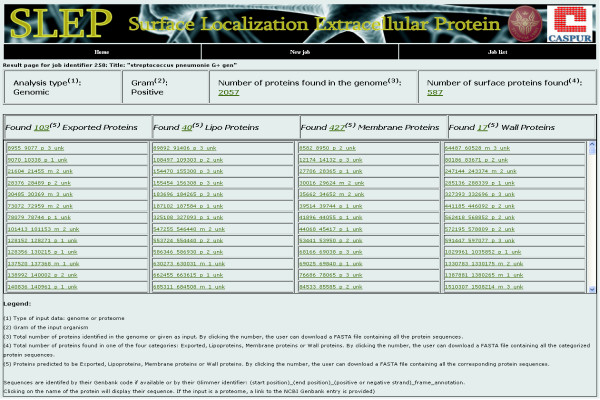
Here we describe a pipeline named SLEP (Surface Localization Extracellular Proteins), based on an automated optimal combination and sequence of usage of reliable available tools for the computational identification of the surfome, i.e. of the subset of proteins exposed on the surface of a bacterial cell.
The tool not only simplifies the usage of these methods, but it also improves the results by selecting the specifying order and combination of the instruments. The tool is freely available at http://www.caspur.it/slep.
细菌感染是全球性的健康挑战。我们需要不断寻找新的抗菌靶点,用于治疗和疫苗接种,因为耐药性正在以惊人的速度在全球范围内传播。即使曾经容易治疗的感染现在也变得难以治疗,在某些情况下甚至无法治愈。理想的治疗和疫苗接种靶点是暴露在生物体表面的细菌蛋白,这些蛋白通常与宿主-病原体相互作用有关。这些靶点的鉴定可以极大地受益于生物信息学、蛋白质组学和 DNA 微阵列等技术。
在这里,我们描述了一个名为 SLEP(表面定位细胞外蛋白)的管道,它基于自动化的最优组合和可靠的可用工具的序列使用,用于计算鉴定表面组,即暴露在细菌细胞表面的蛋白质子集。
该工具不仅简化了这些方法的使用,而且通过选择指定的仪器顺序和组合来提高结果。该工具可免费在 http://www.caspur.it/slep 获得。